There are two ways to put AI agents into an AML team. One gives them decisions and asks people to check a sample. The other gives them the preparation, every piece of it, and keeps every decision with a person. InsightAML is built the second way. Seven agents work on cases and on the rules; each stops at a prepared decision that a person accepts, rejects or asks about. None of them can close a case, escalate one, send a request, submit or file a SAR, or tune a rule.
In short
- Seven agents, one job each. Triage, profile comparison, network, supervisor, narrative writer and quality reviewer on each case; a tuning analyst over the rules.
- They prepare; people decide. Each agent ends at a prepared decision (take the case, ask the RM, escalate, use this narrative, submit, apply this tuning) with its facts attached.
- Capped at L2, in code. Every action an agent can prepare has a hard ceiling of “ask first”. Raising the tenant ceiling doesn’t lift it, and the API refuses an agent that tries to determine, send, submit, file or tune.
- Grounded, with or without a model. Figures come from the engines. With a model on, an answer carrying a name or number not in the facts is thrown away; with it off, as in the demo, the agents reason by rules and say so.
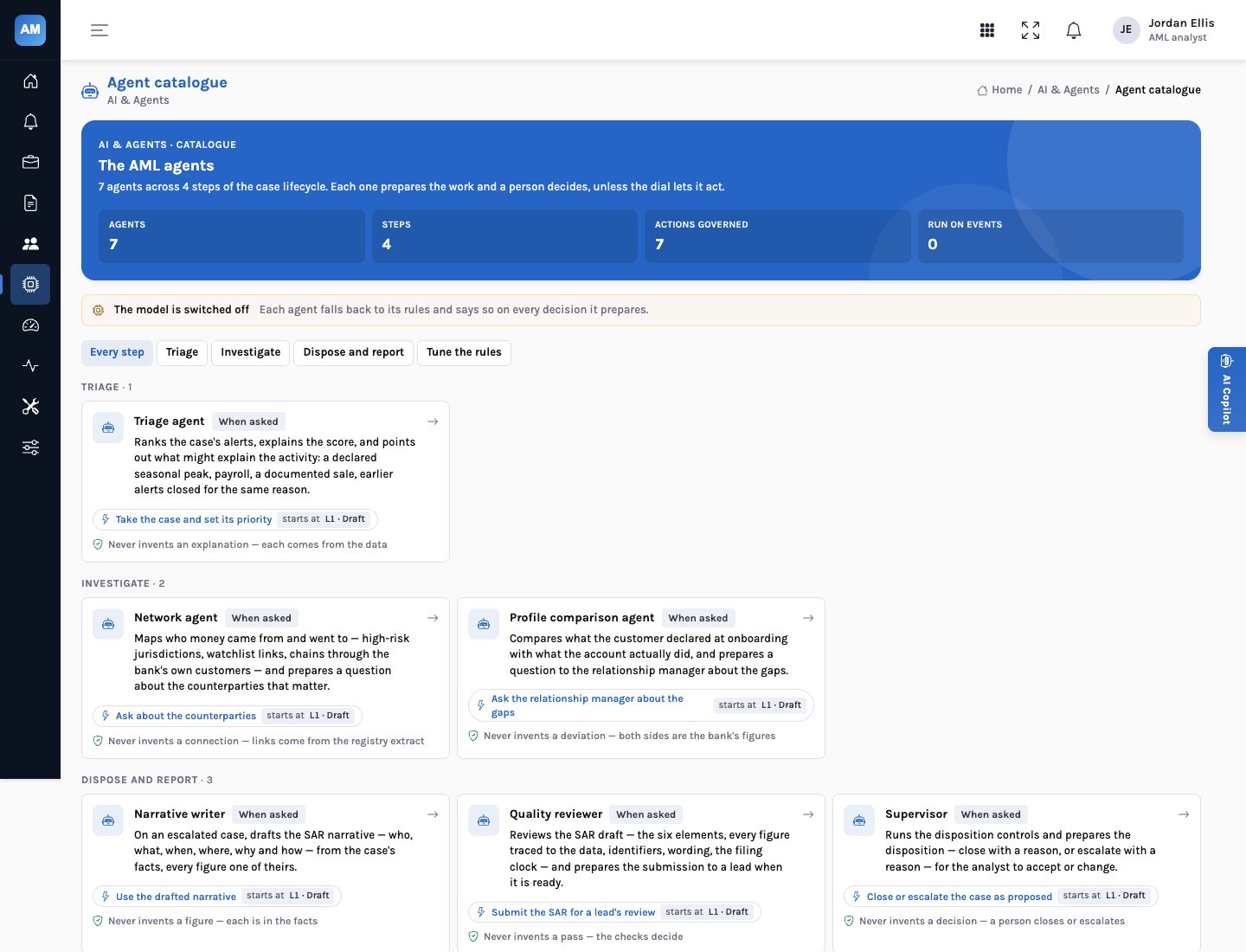
The seven agents
| Agent | What it prepares | It never invents |
|---|---|---|
| Triage agent | Takes the case and sets its priority; lists what in the data might explain the alerts | an explanation: each comes from the data |
| Profile comparison agent | A question to the relationship manager about the gaps between declared and actual | a deviation: both sides are the bank’s figures |
| Network agent | A question about the counterparties that matter | a connection: links come from the registry extract |
| Supervisor | The disposition: close with a reason, or escalate with a reason, after the controls | a decision: a person closes or escalates |
| Narrative writer | The six-part SAR narrative from the case’s facts | a figure: each is in the facts |
| Quality reviewer | The quality review, and the submission to a lead when it is ready | a pass: the checks decide |
| Tuning analyst | A parameter change for a lead, with its effect on this period’s alerts | a rate: each is counted |
A run on one case
“Run the agents” runs the six case agents in order. Each one either prepares something, finds nothing to do, or skips because the case isn’t at its stage yet. On Ridgeback Ski & Snowboard Rentals (AML-2026-000006) at Northmere Bank (fictional), a velocity alert scored 15. The triage agent found two possible explanations in the data: the customer declared a seasonal peak at onboarding and the review period falls in it, and the legacy system raised the same rule on this customer before and closed it as a seasonal business peak. The supervisor prepared a closure with the reason “seasonal pattern the customer declared”. The profile agent prepared a question to the relationship manager about two gaps. The narrative writer and quality reviewer skipped: there is no SAR to draft.
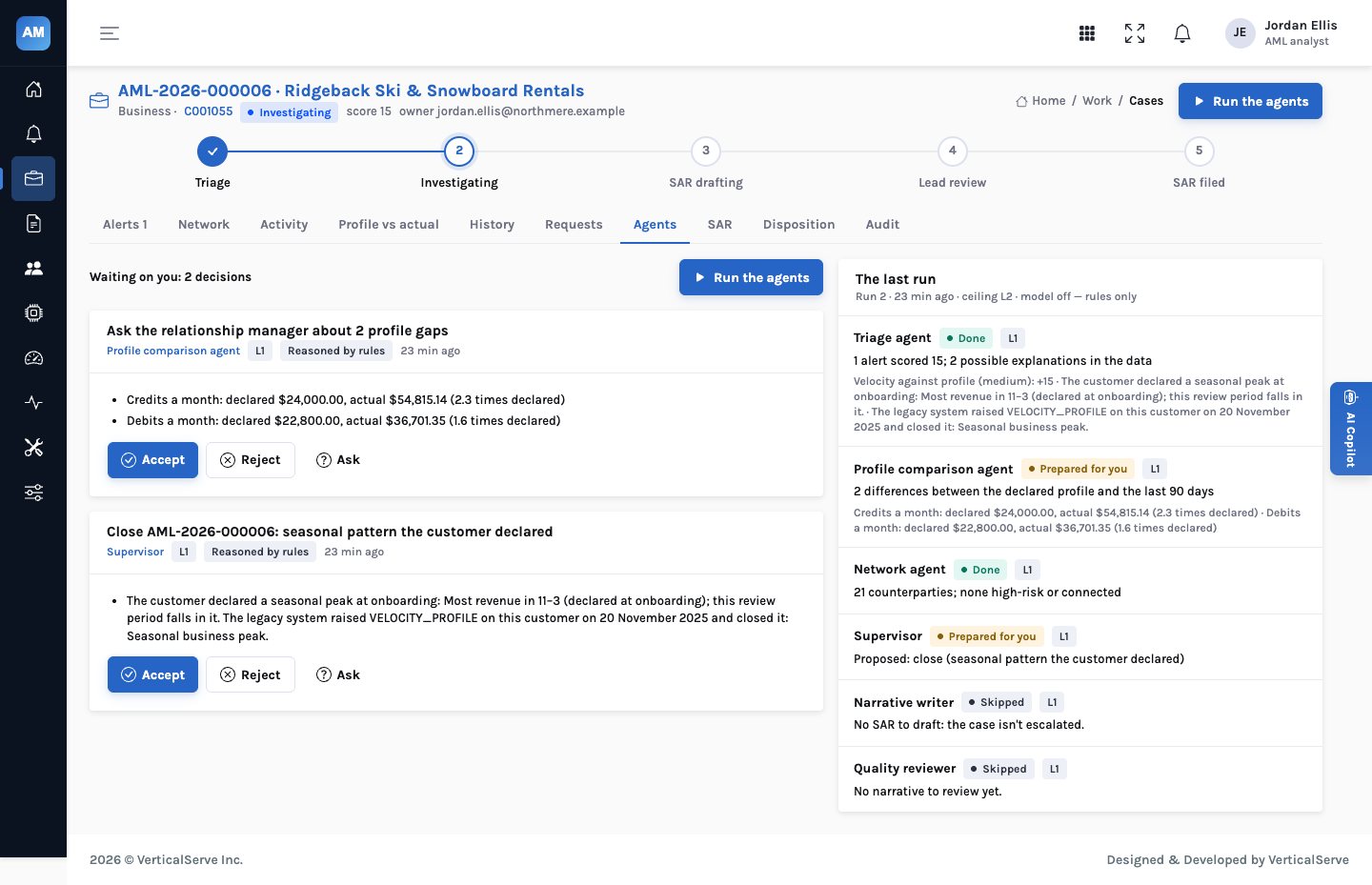
The run is in order; anything prepared waits for a person.
Accept, reject, ask
A prepared decision carries a title, the lines behind it and the facts it rests on. The investigator accepts it, rejects it, or asks a question. Accepting doesn’t bypass anything: if the supervisor prepared a closure and the investigator accepts it, the disposition controls still run, and a high-value or watchlist closure is still referred to a lead. Every answer is recorded on the case’s decision record as a prepared decision, with who answered.
AML-2026-000032 in the demo: an accepted proposal still went to a lead.
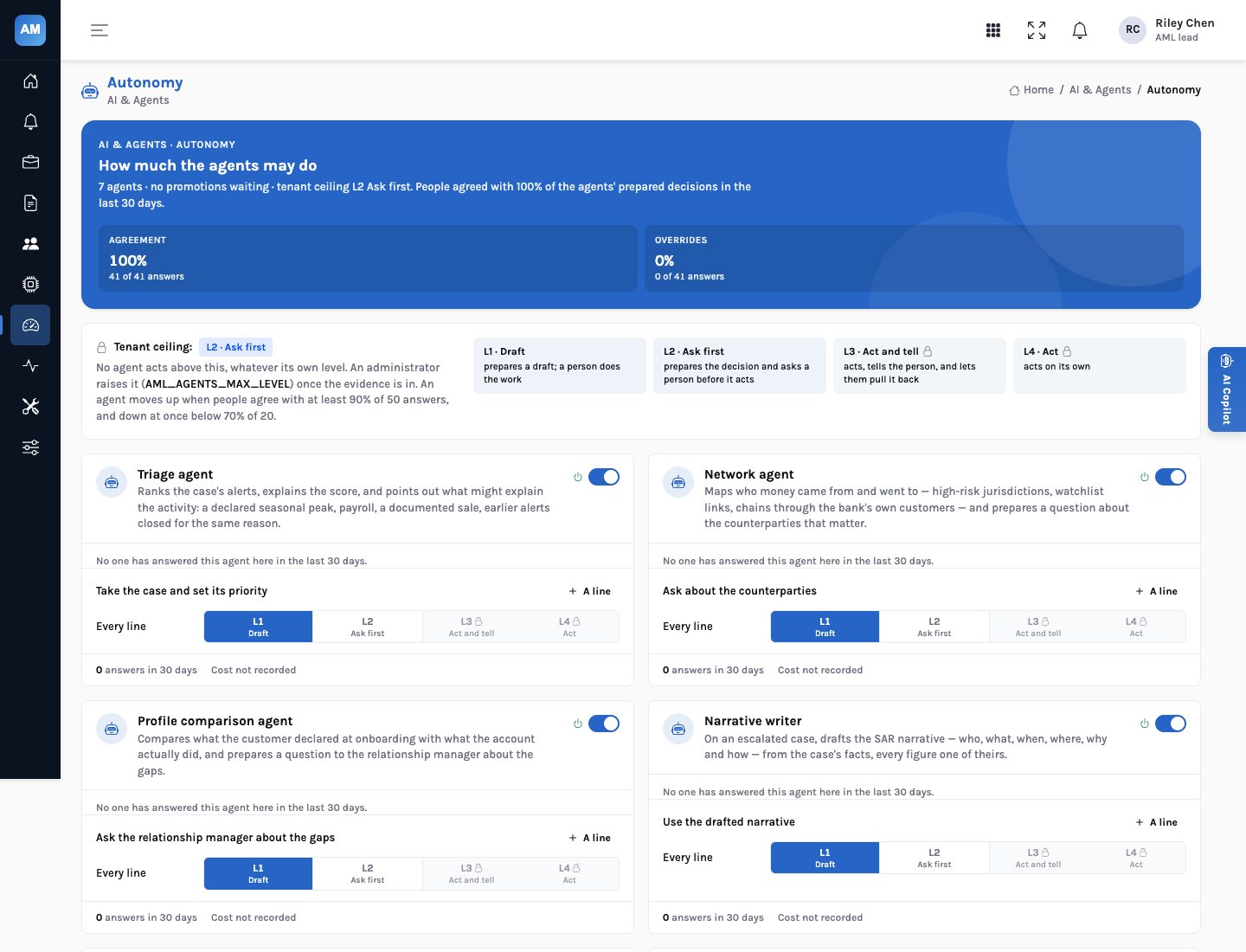
Autonomy, and why it stops at L2
The shared agent runtime has four levels: L1 Draft (prepares a draft; a person does the work), L2 Ask
first (prepares the decision and asks a person before it acts), L3 Act and tell, and L4 Act. A tenant
ceiling (AML_AGENTS_MAX_LEVEL) caps every agent, and the platform can promote an agent
when people agree with enough of its answers. InsightAML adds a hard cap on top: every action an AML
agent can prepare is capped at L2, whatever the ceiling or the agreement rate says.
That is a deliberate choice, not a temporary one. Closing a case, escalating it, contacting a customer, filing a report and changing a monitoring rule are each decisions a regulator expects a named person to own. An agent can make them faster to take; it can’t take them.
An auto-closed alert is reviewed later, if it is in the sample. The record says the model closed it.
Every closure, escalation, request, submission, filing and tuning change has a named person on the record, and the agent’s preparation beside it.
What the record shows
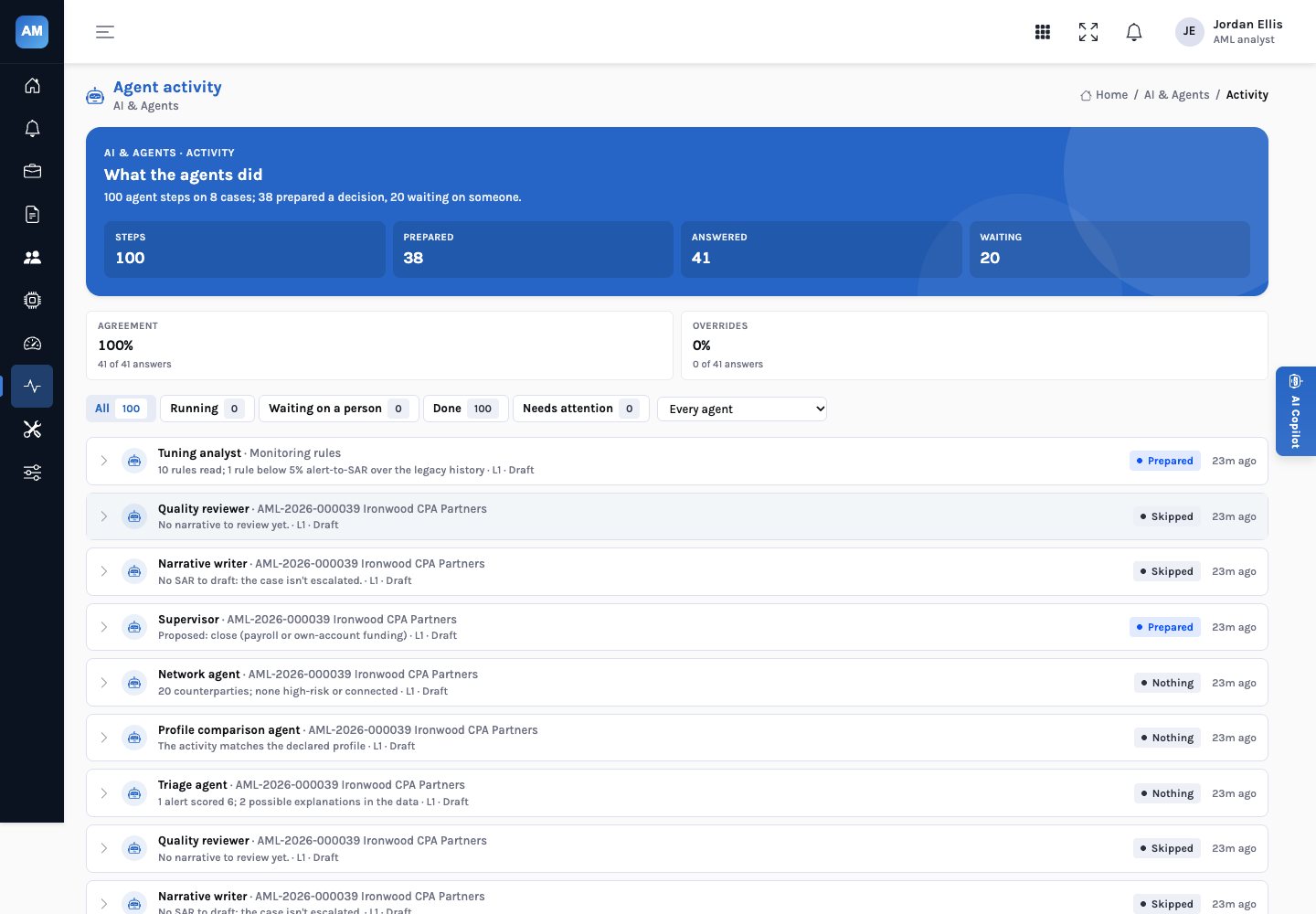
The activity page lists every agent step on every case and on the rules: what it found, what it prepared, at which level, and whether a person has answered. In the demo, after the seeded investigations, it showed 100 steps, 38 prepared decisions and 41 answers, with people agreeing with all 41. That agreement rate is the evidence a promotion would rest on, and in InsightAML it can’t lift an agent past L2 anyway.
The copilot reads, it doesn’t act
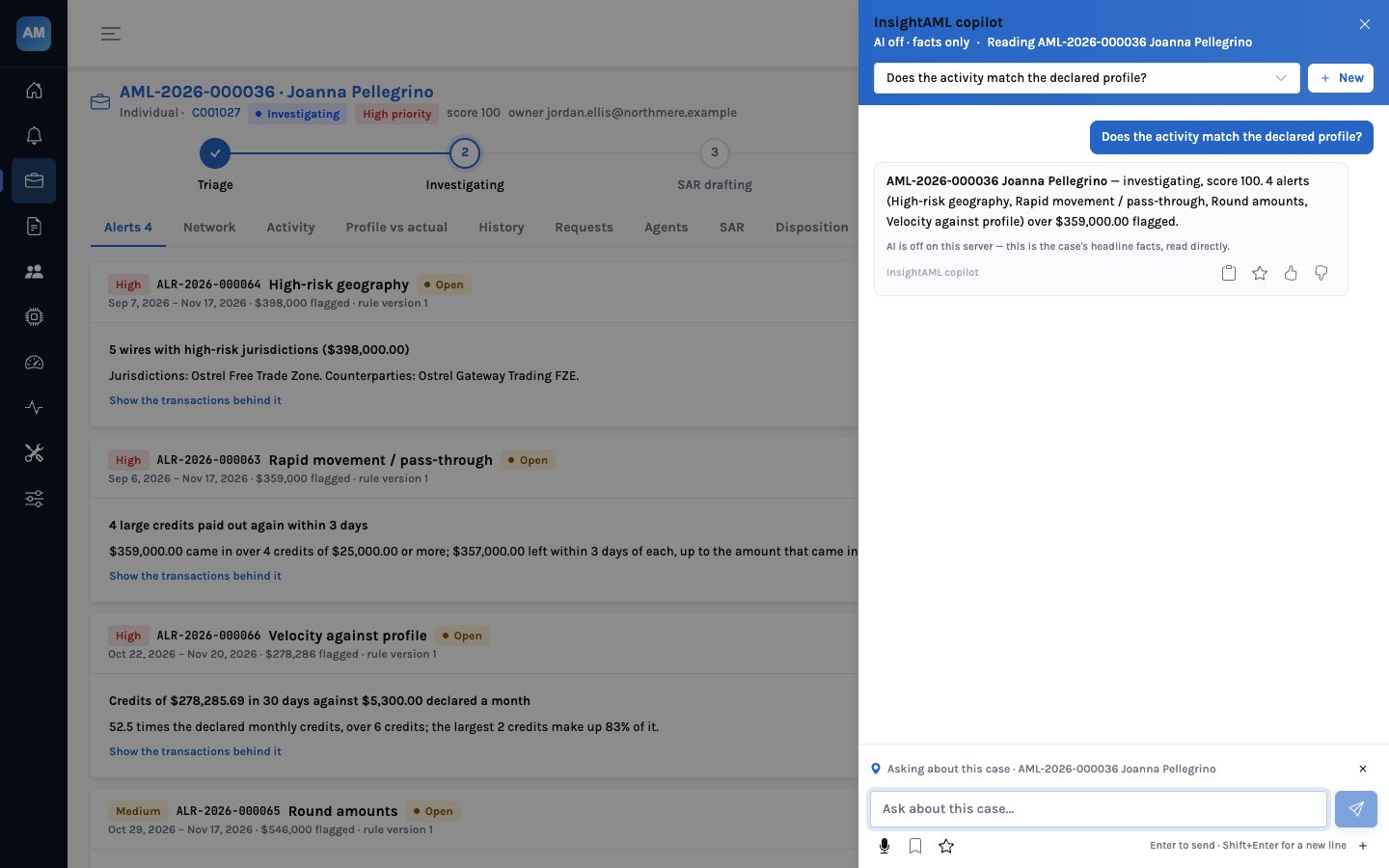
Alongside the agents, the case copilot answers questions about one case with eight read-only tools: the case summary, the alerts, the counterparty network, the profile comparison, the customer’s history, the SAR draft, the agents’ work and the requests for information. It links to the tab where the answer came from. It has no tool that changes anything. With no model configured, it answers with the case’s headline facts and says the AI is off.
For the BSA officer & MLRO
Every decision a supervisor cares about has a named person on it. Agents can’t be the decision-maker by configuration.
When asked how AI is used, you can show the prepared decision, the facts it rested on, and who accepted it.
For the investigations lead
The preparation (score, explanations, profile gaps, network questions, narrative draft, quality review) is done before the investigator opens the case.
Accept, reject and ask keep the investigator in control without retyping anything.
For the board
AI is speeding up the work, not taking the decisions. The cap is in the code, not in a policy someone might change.
Agents prepare. Investigators decide. The record says which was which.
Seven agents do the preparation on every case. Every action they can prepare is capped at ask-first, and every decision that matters is taken by a named person.