- contact@insightaml.com
InsightAML · anti-money-laundering investigations, prepared by agents
Every alert investigated. Every decision yours.
InsightAML reads the bank’s transactions with ten monitoring rules that show their evidence, and puts each customer’s alerts in one case. It maps who the money came from and went to, compares what the customer declared with what the account actually did, and drafts the suspicious activity report narrative from the facts, every figure traceable. Then it stops. An investigator closes or escalates, and a lead who didn’t prepare the report files it.
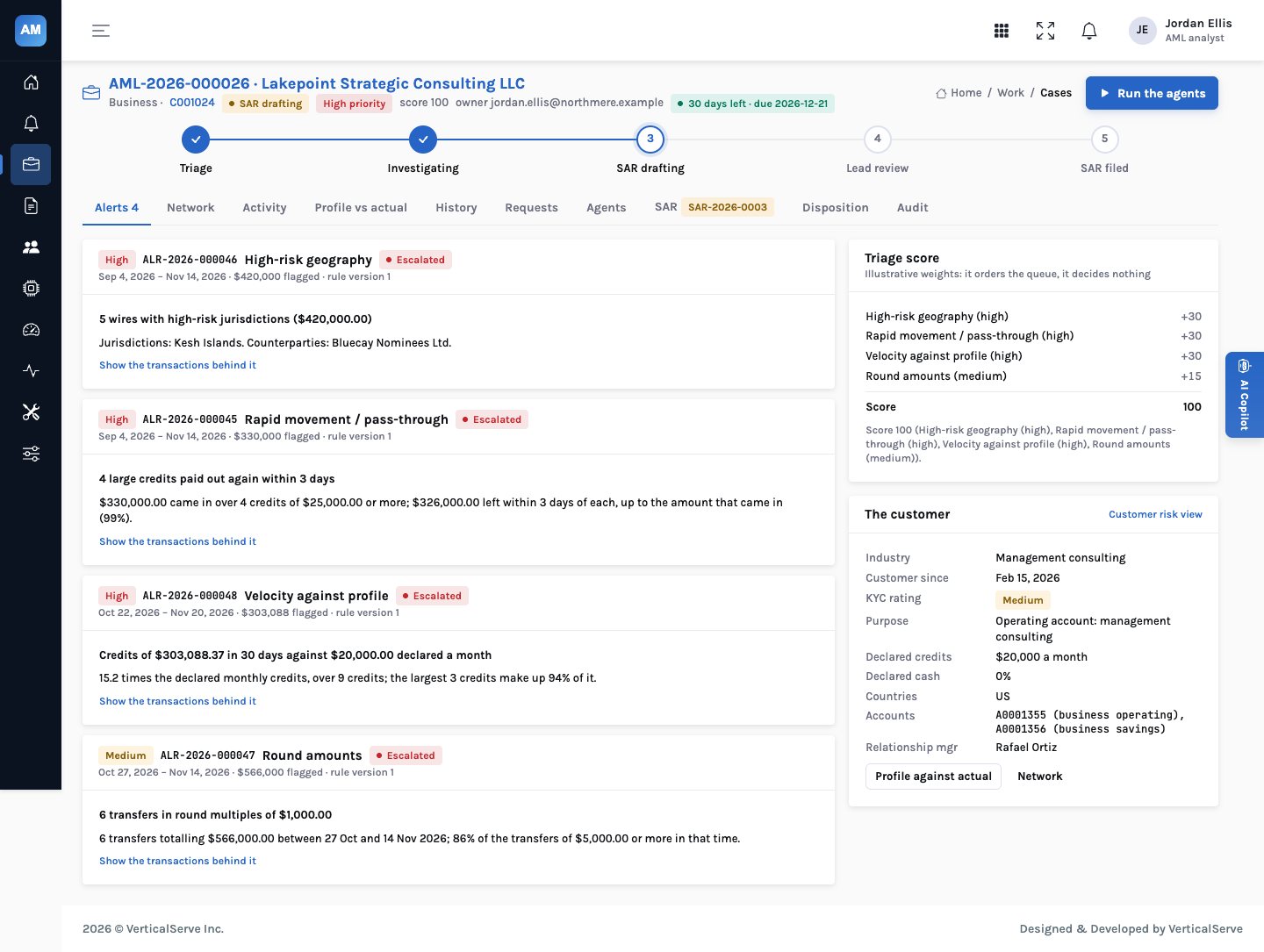
- Every alert carries its transactions
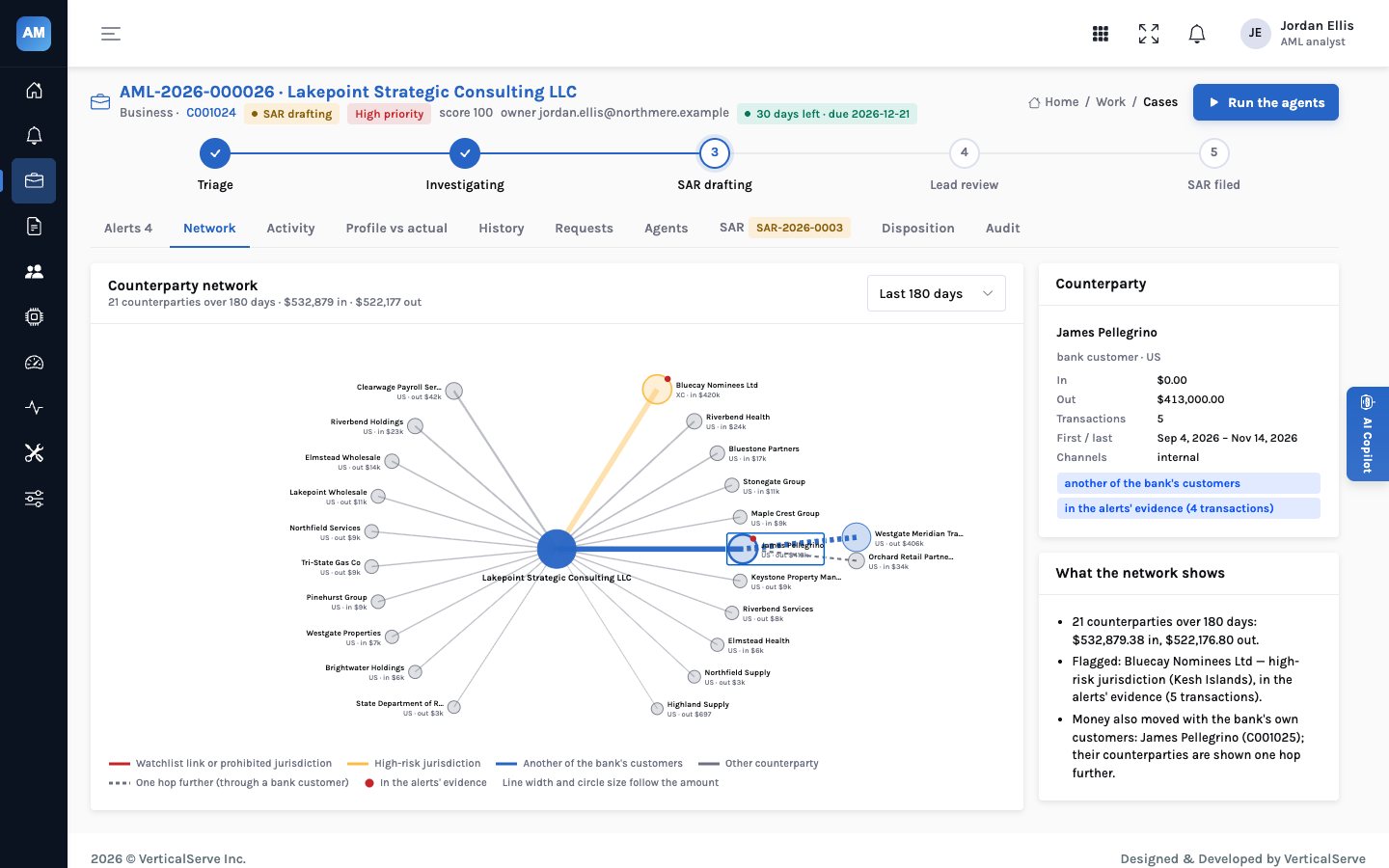
- The network one hop further
- Four eyes on every filing
What a case is built from
Core banking transactionsAccountsDeclared customer profilesCounterparties
BranchesTrade invoicesCommodity price bandsJurisdiction risk list
Watchlist & registry linksPrior SARsLegacy alert historyYour policy, in Rules Studio
The problem
Investigators don’t lack alerts. They lack time to read each one properly.
Most of an investigation is preparation: pulling the transactions behind an alert, finding the customer’s declared profile, tracing where the money went, checking whether the same pattern was explained last year, and then retyping all of it into a narrative. The judgement, which only a person can make, gets whatever time is left, and the filing deadline keeps running.
Volume
Alerts that arrive without their evidence
A rule name and a score tell an investigator where to start, not what happened. Every alert sends them into three other systems before they can decide anything.
Context
The same customer, four separate alerts
Structuring, a high-risk wire, credits ten times the profile and an unusual cash share are one story about one customer. Worked as four alerts, they are four half-investigations.
The report
A narrative written from memory
The suspicious activity report is what law enforcement reads. A figure copied wrong, a missing “where”, or a conclusion instead of a fact weakens it, and nobody checks until a lead reads it, close to the deadline.
How it works
Monitor → Triage → Investigate → Dispose → Report
One case per customer, from the first alert to a filed report or a closure with a reason. Seven agents prepare each step. A person accepts, rejects or asks about what they prepared, and makes every decision that matters.
1
Monitor
Ten rules read the last 90 days of transactions. Each alert keeps the transactions behind it and the figures it computed. A rerun doesn’t duplicate an alert.
2
Triage
Alerts land in their customer’s case, ordered by a triage score that lists its points. The triage agent looks for what in the data might explain the activity.
3
Investigate
The counterparty network, the transaction timeline, the declared profile against the last 90 days, prior SARs and the legacy system’s alerts, on one page.
4
Dispose
Close with a reason or escalate with a reason. Disposition controls refer risky closures to a lead. Escalating opens the SAR and starts the filing clock.
5
Report
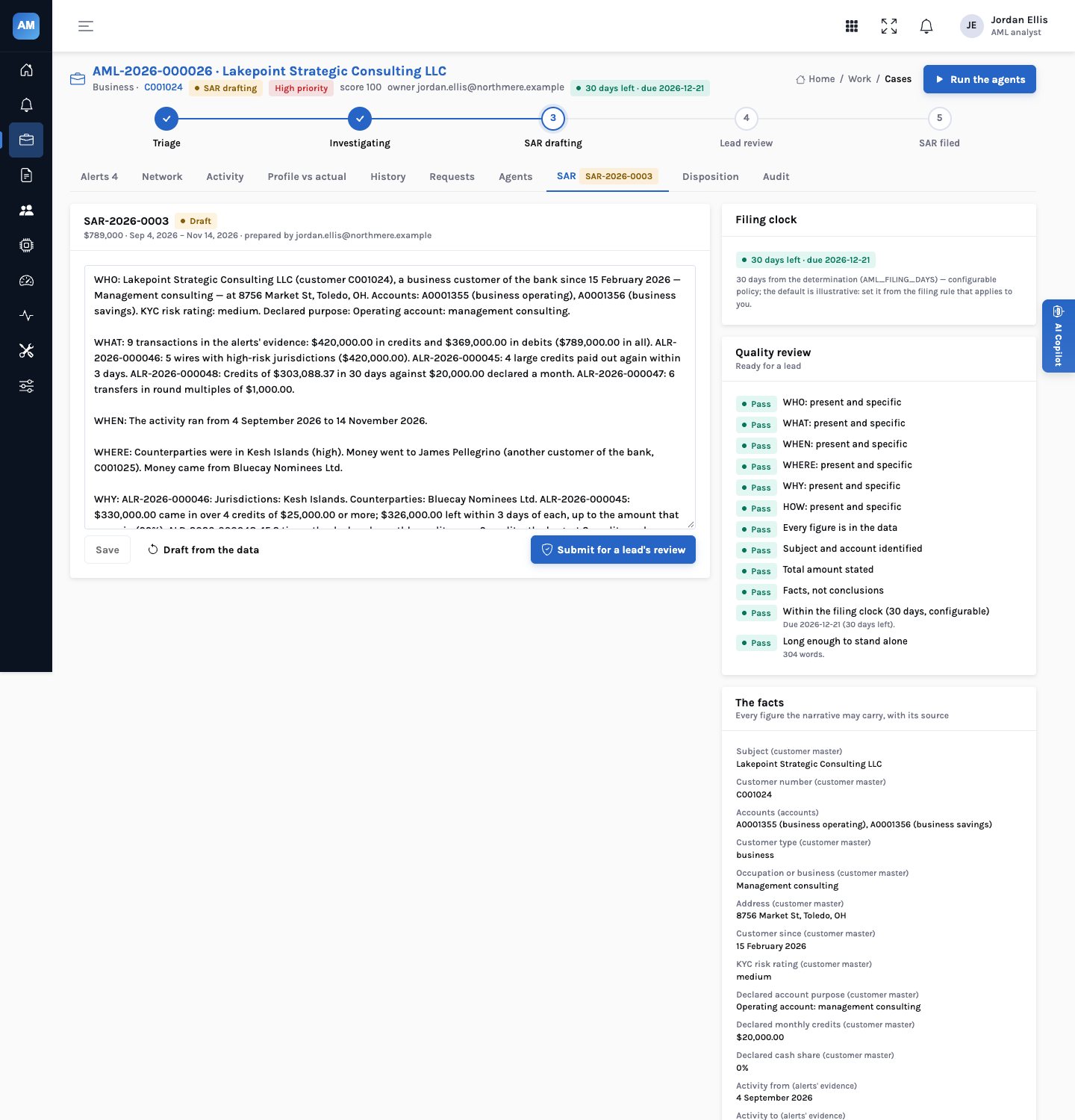
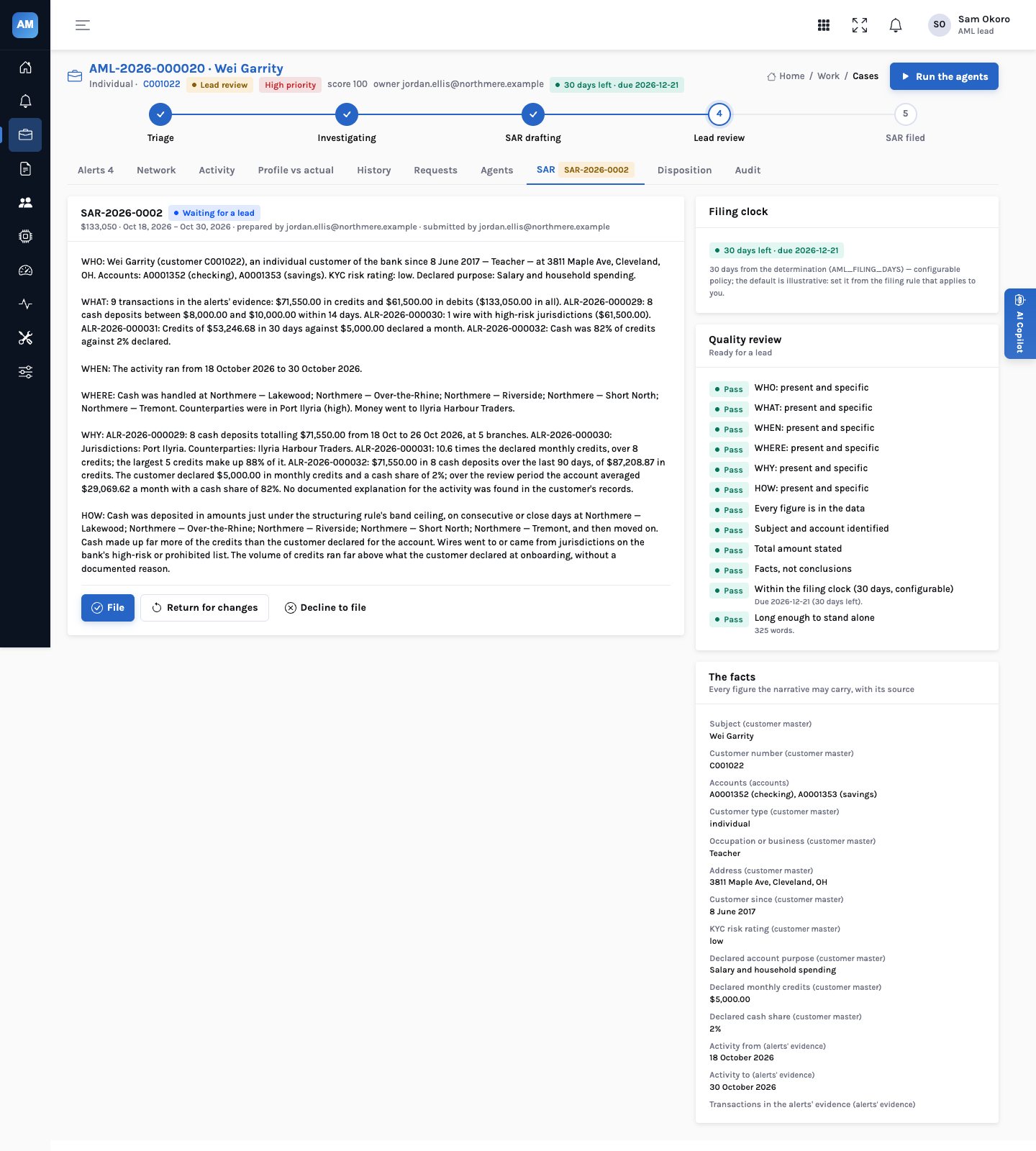
A six-part narrative drafted from the facts, a quality review, and a lead who didn’t prepare it files, returns or declines it, on the decision record.
A worked case from the demo bank
$330,000 in, 99% of it out again within three days
From Northmere Bank, a fictional bank whose every transaction is generated: Lakepoint Strategic Consulting LLC declared $20,000 a month in credits. Four rules fired on it. InsightAML put them in one case, AML-2026-000026, scored it 100, and traced part of the money to another of the bank’s own customers.
Paid in byBluecay Nominees LtdKesh Islands (an invented high-risk jurisdiction): five wires, $420,000
The customerLakepoint Strategic Consulting LLCdeclared $20,000 a month; $303,088.37 arrived in 30 days
Paid on toJames Pellegrino (C001025)another customer of the bank, $413,000 out
One hop furtherWestgate Meridian Trading LLCa bank customer in James Pellegrino’s own network
The triage score
Why this case is at the top of the queue
The score orders the queue; it decides nothing. Its weights are illustrative and yours to set.
- High-risk geography (high)5 wires with Kesh Islands, $420,000.00+30
- Rapid movement / pass-through (high)4 credits of $25,000 or more; $326,000 left within 3 days of each+30
- Velocity against profile (high)15.2 times the declared monthly credits+30
- Round amounts (medium)6 transfers in round thousands, $566,000+15
- Score, capped at 100 → high priority100
What happened next
Prepared by agents, decided by the investigator
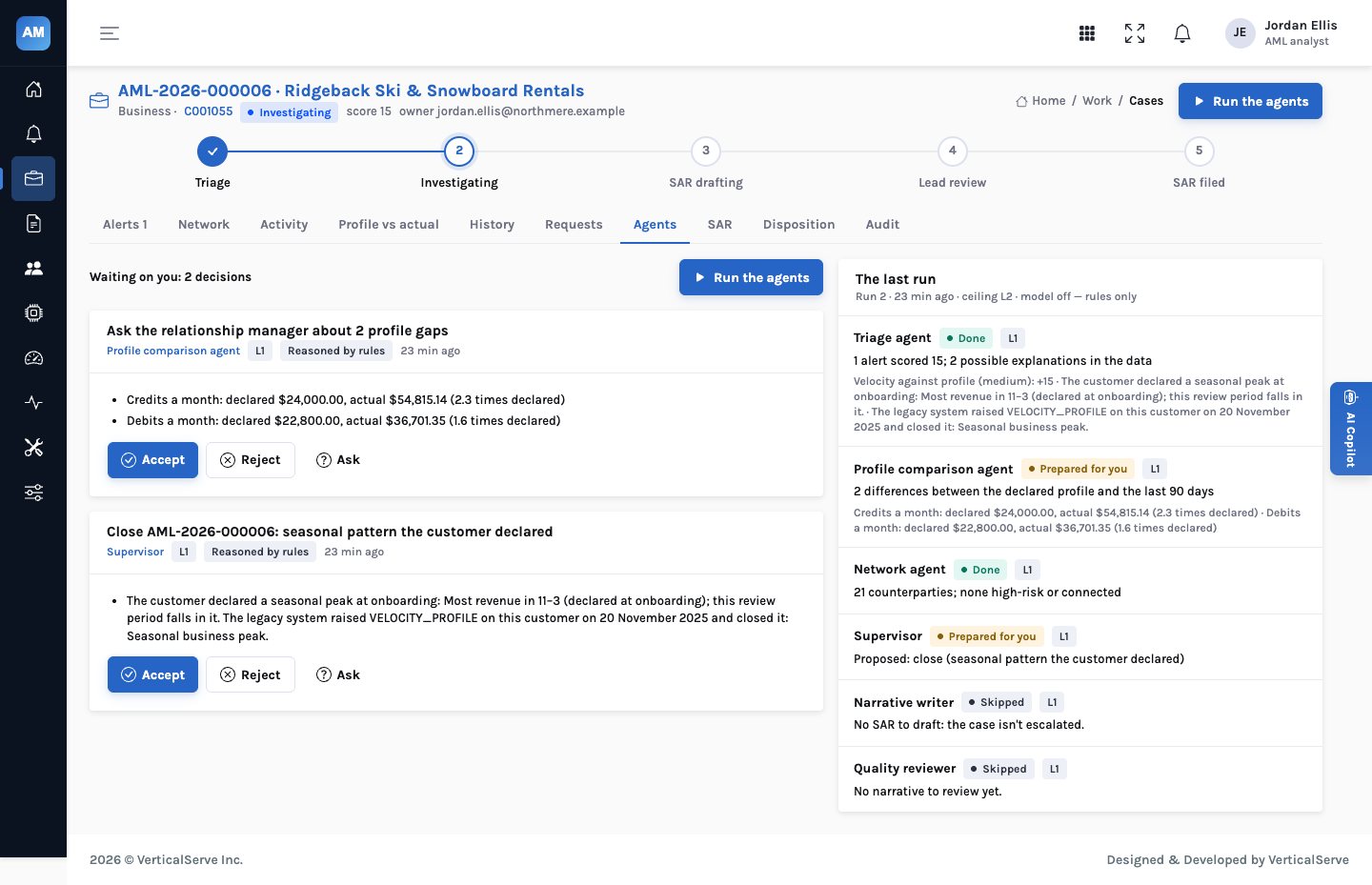
- Triage agent4 alerts scored 100; nothing in the data explains themL1
- Profile comparison agent3 differences between the declared profile and the last 90 daysL1
- Network agent21 counterparties; 2 need a closer lookL1
- Jordan Ellis, analystescalated: layering or pass-through activity; the filing clock startedperson
- Narrative writer & quality reviewerSAR-2026-0003 drafted, 304 words, 12 of 12 checks passL1
The submission to a lead waits for the analyst. A lead other than the analyst files it.
What it does
The whole investigation, in one place
Every number on a case is computed by the engines from the bank’s own data. The language model, when one is configured, explains and drafts over those numbers; it never supplies them.
Monitoring
Ten rules over a 90-day review window, parameters in plain sight.
- Structuring, pass-through, funnel accounts
- High-risk geography, round amounts
- Velocity and cash against the declared profile
- Dormant reactivation, trade pricing, watchlist-adjacent
Cases and triage
Alerts grouped one case per customer, ordered by an explainable score.
- Points per alert severity, prior SAR, KYC rating
- Owner, stage and priority on every case
- Six stages, triage to filed or closed
Investigation
What an investigator would otherwise assemble by hand.
- Counterparty network, 180 days, one hop further
- Transaction timeline with flagged days
- Declared profile against the last 90 days
- Prior SARs, legacy alerts, earlier cases
Dispositions
Close or escalate, each with a reason code and a note.
- Eight close reasons, eight escalate reasons
- Risky closures referred to a lead
- Every control’s outcome on the decision record
SAR and filing
A narrative that can be traced, filed by someone else.
- Who, what, when, where, why, how
- Twelve quality checks; unsupported figures block filing
- 30-day clock from the determination (configurable)
- Four eyes: file, return or decline
Requests and tuning
Ask without tipping off; tune on outcomes.
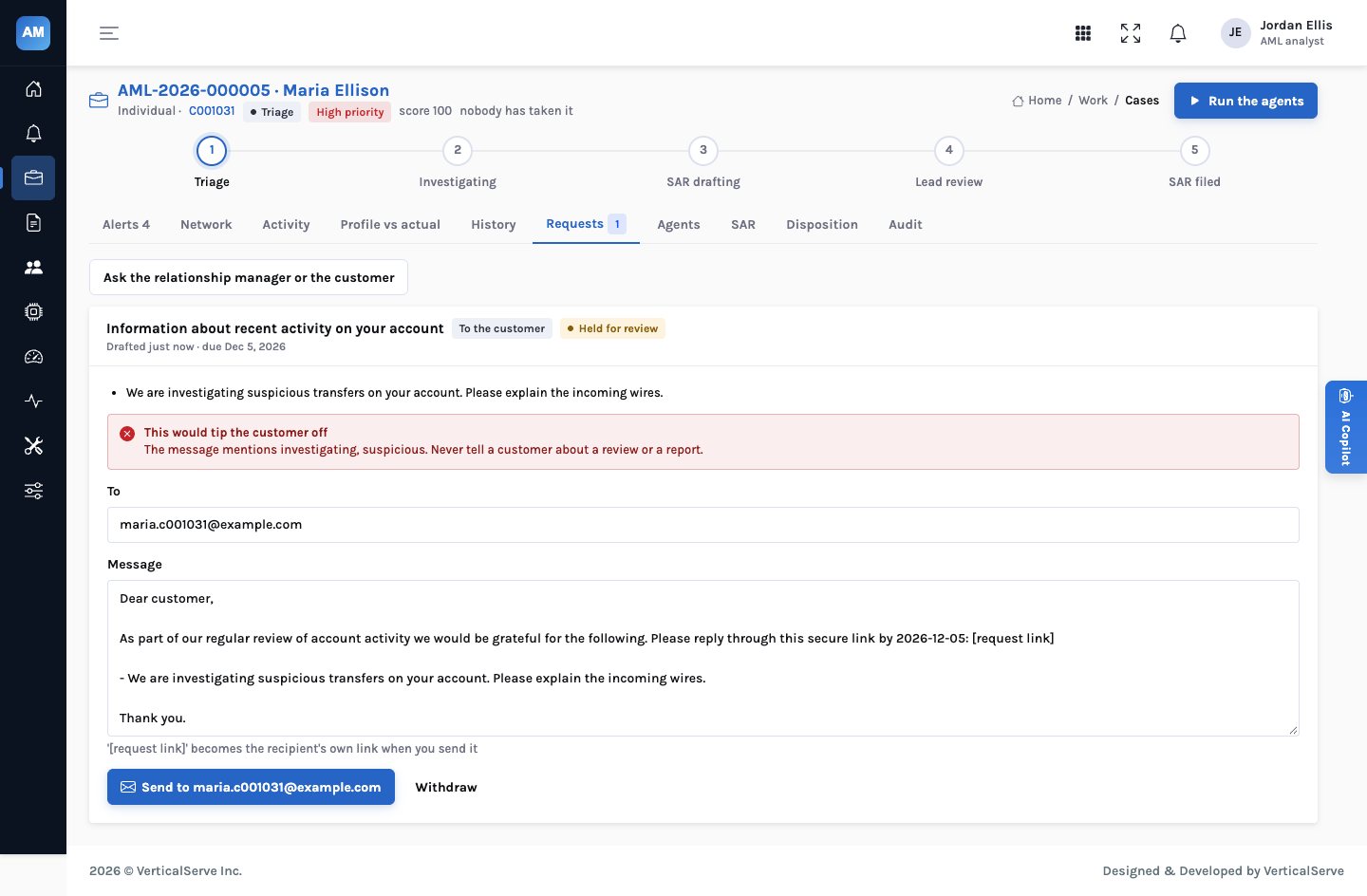
- Requests to the RM or customer, held until sent
- No-login link; a tipping-off message can’t be sent
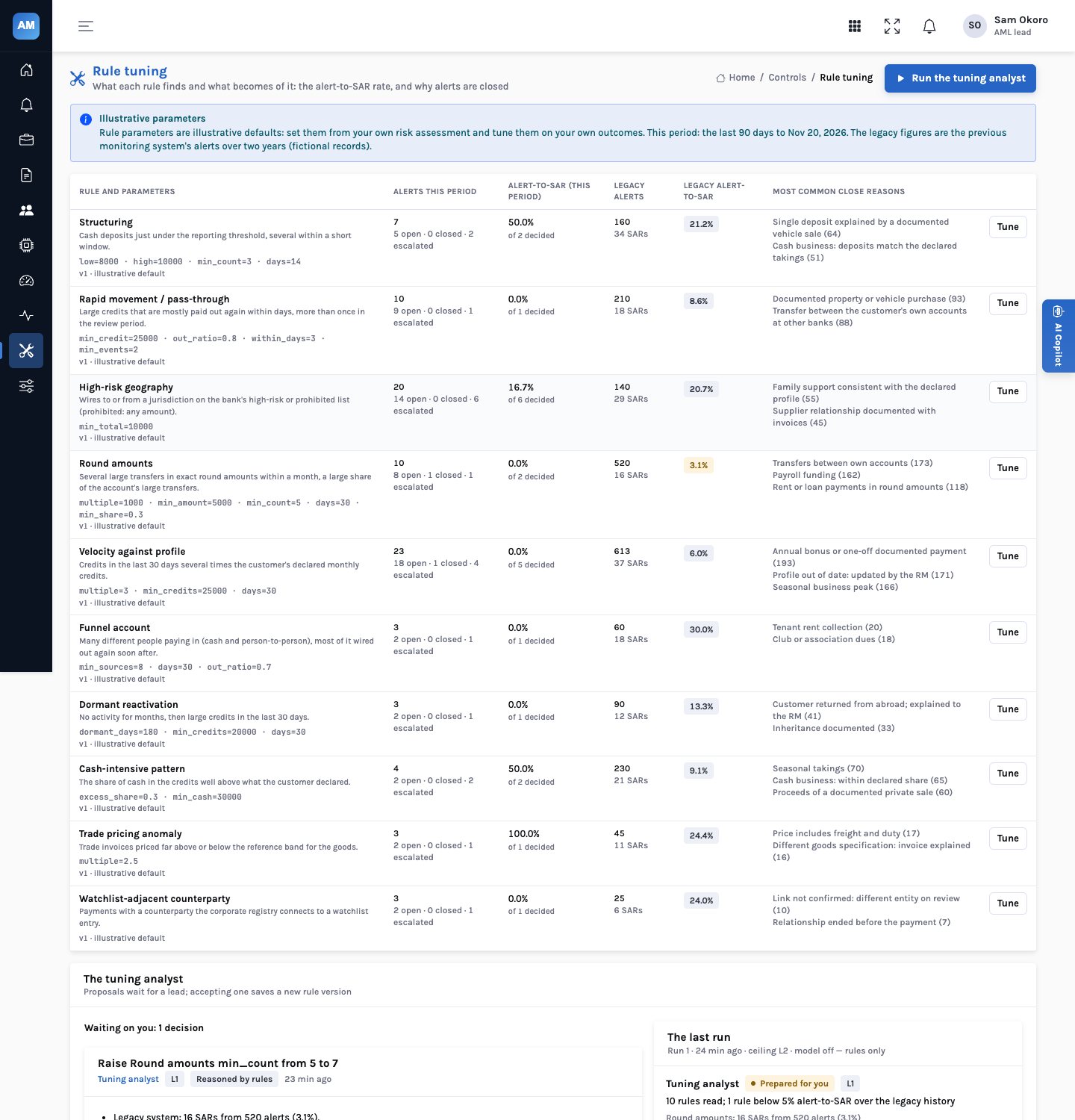
- Alert-to-SAR rate per rule, this system and legacy
- Leads tune parameters with a reason, versioned
AI agents
Seven agents prepare. None of them closes, escalates, sends or files.
Each agent does one step of the case and stops at a prepared decision: take the case, ask the relationship manager, close or escalate as proposed, use the drafted narrative, submit for a lead’s review. You accept, reject or ask a question. Every answer goes on the record.
- Triage, profile comparison, network — rank the alerts, find what might explain them, measure the gaps, map the counterparties
- Supervisor, narrative writer, quality reviewer — run the controls and propose a disposition, draft the SAR, review it against twelve checks
- Tuning analyst — reads each rule’s outcomes and proposes a change to a lead, with the alerts it would drop
- Capped at L2 — at most “ask first”, whatever the autonomy setting; the cap is in the code
- Model optional — with no model configured, every agent runs on its rules and says so
Requests for information
Ask the customer about the account. Never about the review.
Agents draft questions to the relationship manager or the customer, and the request is held until a person sends it. The recipient answers through their own link with no login. A message to a customer that mentions suspicion, an investigation, a SAR or a report to the authorities can’t be sent.
- Held for review — nothing leaves until a person releases it
- One link per request — InsightAML keeps only a hash of it
- The customer sees no case — their page shows a request reference, not the case reference
- Answers become facts — an answer is available to the narrative, quoted, with its source
For BSA officers and MLROs
Answers for the examiner, and for the board
The questions an AML leader is asked are simple. InsightAML keeps the evidence for each answer on the case, as it stood when the decision was made.
Why was it closed?
A reason code, a note in the analyst’s words, and every disposition control’s outcome at that moment, on the decision record.
Did two people look?
The lead who files or declines a SAR can’t be the person who prepared or submitted it. The API refuses otherwise.
Are we on time?
Every escalated case carries its filing clock: days left, due soon at seven days, overdue in red, and an overdue filing needs a reason.
Do our rules work?
Alert-to-SAR rates per rule, for this system and the legacy one, with the close reasons behind the false positives.
Design & trust
Built to be examined
A Python API, a React app and PostgreSQL, designed to run in your own cloud account against your own systems. Nothing in a case is a value the model made up.
Grounded
No invented figures
Rules, scores, the network, the profile comparison and the narrative’s facts are deterministic code. A model answer carrying a name or number not in the facts is thrown away.
Read-only sources
Your systems stay yours
InsightAML reads transactions, profiles, invoices and lists from the bank’s systems and keeps its own work in its own schema.
Policy
Your rules, in Rules Studio
Which closures need a lead and what blocks a filing are controls you can read, test against a real case and publish, not code.
Your filing
Recorded here, submitted by you
A lead records the filing in InsightAML. The submission to your financial intelligence unit happens through your own channel, outside it.