A management consultancy in Toledo, Ohio told the bank it expected about $20,000 a month. Between September and November, $330,000 arrived in four large wires from a nominee company in a high-risk jurisdiction, and 99% of it left again within three days of each arrival, to another of the bank’s own customers. That customer then paid it on to a third. This post follows the case from four alerts to a SAR draft that is ready for a lead.
In short
- Four rules, one customer, one case. High-risk geography, rapid movement, velocity against profile and round amounts all fired on Lakepoint Strategic Consulting LLC. InsightAML grouped them into AML-2026-000026 with a triage score of 100.
- The pass-through is counted, not guessed. $330,000 came in over four credits of $25,000 or more; $326,000 left within three days of each, up to the amount that came in: 99%.
- The network follows the money one hop further. The outgoing transfers went to James Pellegrino, another customer of the bank, who sent $406,000 on to Westgate Meridian Trading LLC.
- A person escalated; the draft is grounded. The analyst escalated for layering. The narrative writer drafted the SAR from the case’s facts and the quality reviewer passed all 12 checks. A lead still has to file it.
The situation
The case comes from InsightAML’s demo data for Northmere Bank, a fictional bank. Every customer, counterparty and transaction is generated, and the jurisdictions on its high-risk list, such as the Kesh Islands, are invented and carry ISO user-assigned codes (XA to XG) so that no real country is given a rating. The monitoring run read the last 90 days of transactions.
Lakepoint Strategic Consulting LLC (customer C001024) opened its accounts on 15 February 2026: a business operating account (A0001355) and a business savings account (A0001356). At onboarding it declared management consulting, an operating account, about $20,000 in monthly credits, no cash and the US as its only country. Its KYC rating is medium; its relationship manager is Rafael Ortiz.
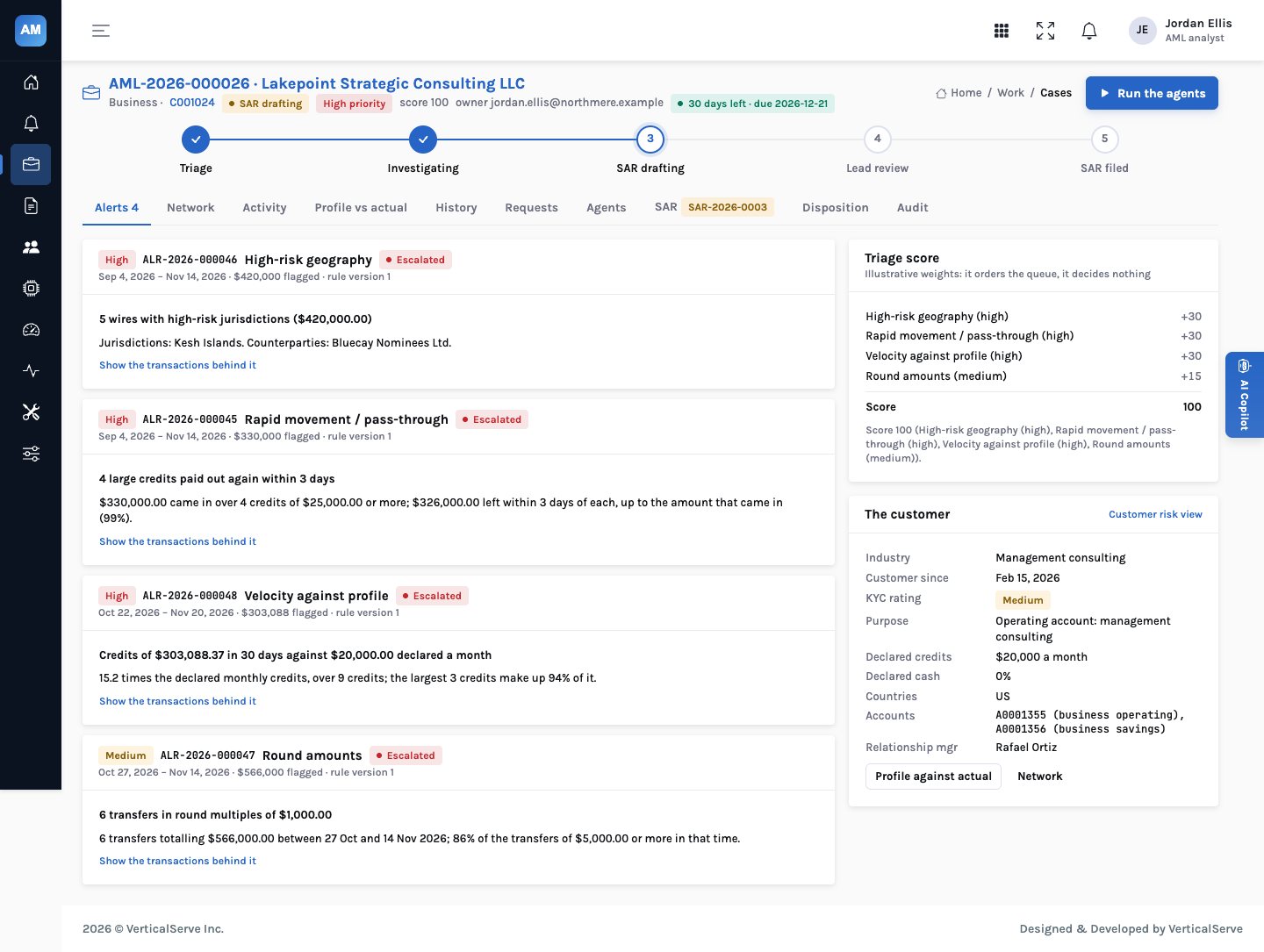
| Alert | Rule | What the rule computed |
|---|---|---|
| ALR-2026-000046 | High-risk geography (high) | 5 wires with a high-risk jurisdiction, $420,000.00, all from Bluecay Nominees Ltd in the Kesh Islands |
| ALR-2026-000045 | Rapid movement / pass-through (high) | $330,000.00 came in over 4 credits of $25,000.00 or more; $326,000.00 left within 3 days of each (99%) |
| ALR-2026-000048 | Velocity against profile (high) | Credits of $303,088.37 in 30 days against $20,000.00 declared a month: 15.2 times |
| ALR-2026-000047 | Round amounts (medium) | 6 transfers in round multiples of $1,000.00 totalling $566,000.00 between 27 Oct and 14 Nov 2026; 86% of the transfers of $5,000.00 or more |
Each alert carries the transactions behind it. Laid side by side, the in-and-out pairs are plain:
| Date | In, from Bluecay Nominees Ltd (wire) | Out, to James Pellegrino (internal transfer) |
|---|---|---|
| 4 September 2026 | $45,000.00 and $90,000.00 | $88,000.00 |
| 27 October 2026 | $45,000.00 | $45,000.00 |
| 31 October 2026 | $120,000.00 | $118,000.00 |
| 14 November 2026 | $120,000.00 | $118,000.00 |
The rapid-movement rule pairs each large credit with the debits that followed it within three days, and uses each debit only once. Four credits qualified; the second wire on 4 September was not paired because the outflow that day had already answered the first. That is why the alert says $330,000 in and not $420,000.
Following the money
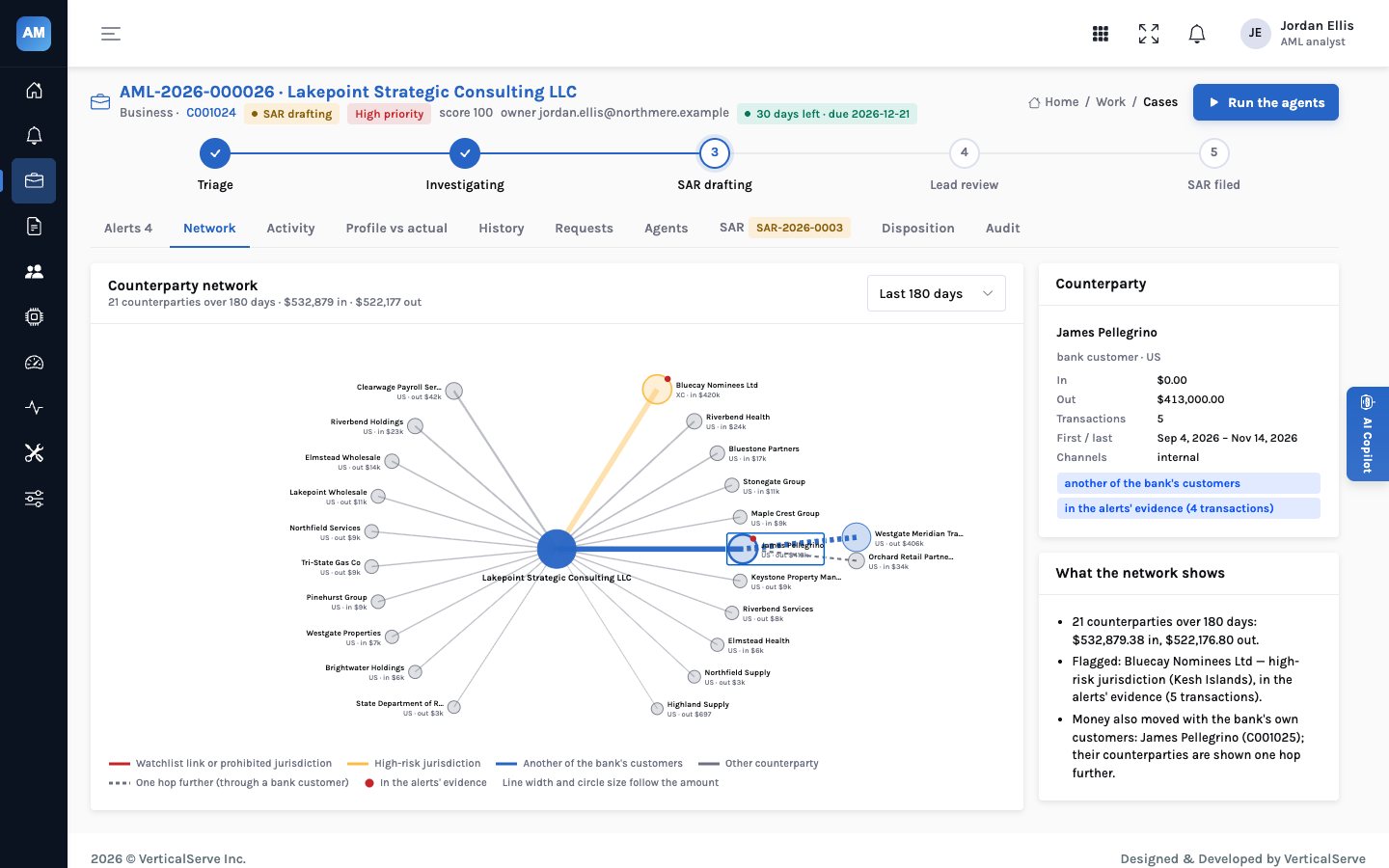
A pass-through account is only half a story: the question is where the money went next. The network tab draws every counterparty over the last 180 days, flags those in a high-risk jurisdiction, on or connected to the watchlist, or in the alerts’ evidence, and goes one hop further through the bank’s own customers, because the bank can see their accounts too.
From the network tab over 180 days. The second hop is visible because James Pellegrino banks at Northmere too.
The network agent read the same picture: 21 counterparties, two that need a closer look. Bluecay Nominees Ltd, in the Kesh Islands and in five of the alerts’ transactions; and James Pellegrino, another of the bank’s customers, in four. Clicking his circle shows $413,000.00 out of Lakepoint to him over five transactions between 4 September and 14 November, all internal.
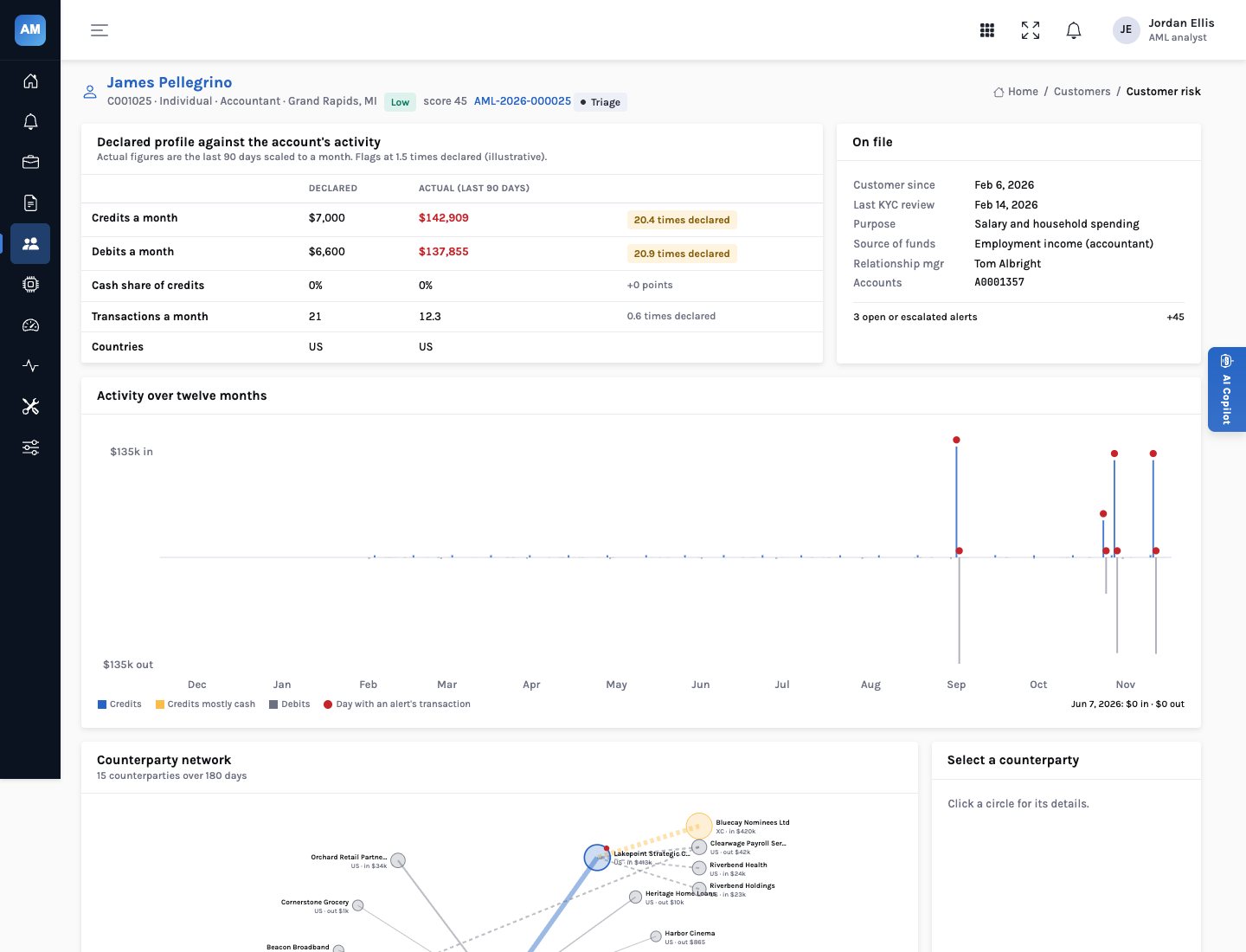
Opening James Pellegrino’s own customer page shows why the chain matters. He declared $7,000 a month as an accountant. Over the last 90 days his credits averaged $142,909 a month, 20.4 times what he declared. He has his own case, AML-2026-000025, still in triage, and Westgate Meridian Trading LLC has another, AML-2026-000018. InsightAML does not merge them: each customer is one case, and the network is how an investigator sees that they are connected.
What the agents prepared, and who decided
Every agent on the case prepares; none of them closes, escalates, sends or files. The triage agent found nothing in the data that explains the alerts. The profile agent found three differences: credits of $159,485.91 a month against $20,000 declared (8.0 times), debits of $154,948.92 against $19,000 (8.2 times), and an undeclared country, the Kesh Islands. The supervisor prepared an escalation for layering; Jordan Ellis, the analyst, accepted it, which made the determination his.
Agents prepare each step; the analyst determines; a different person, a lead, files.
Escalating opened SAR-2026-0003 and started the filing clock: 30 days from the determination, due
21 December 2026. The 30 days is a configurable policy setting (AML_FILING_DAYS), not a
legal statement. In the US, 31 CFR 1020.320 gives a bank 30 calendar days from the initial detection
of facts that may constitute a basis for filing, extendable to 60 if no suspect has been identified;
a bank sets its own clock from its own procedure.
The draft
The narrative writer builds the draft from a list of facts, each with its source: the customer master, the accounts, the alerts’ evidence, the transactions. Its WHAT section reads, in part: “9 transactions in the alerts’ evidence: $420,000.00 in credits and $369,000.00 in debits ($789,000.00 in all).” Its WHERE section names the counterparty: “Money went to James Pellegrino (another customer of the bank, C001025). Money came from Bluecay Nominees Ltd.”
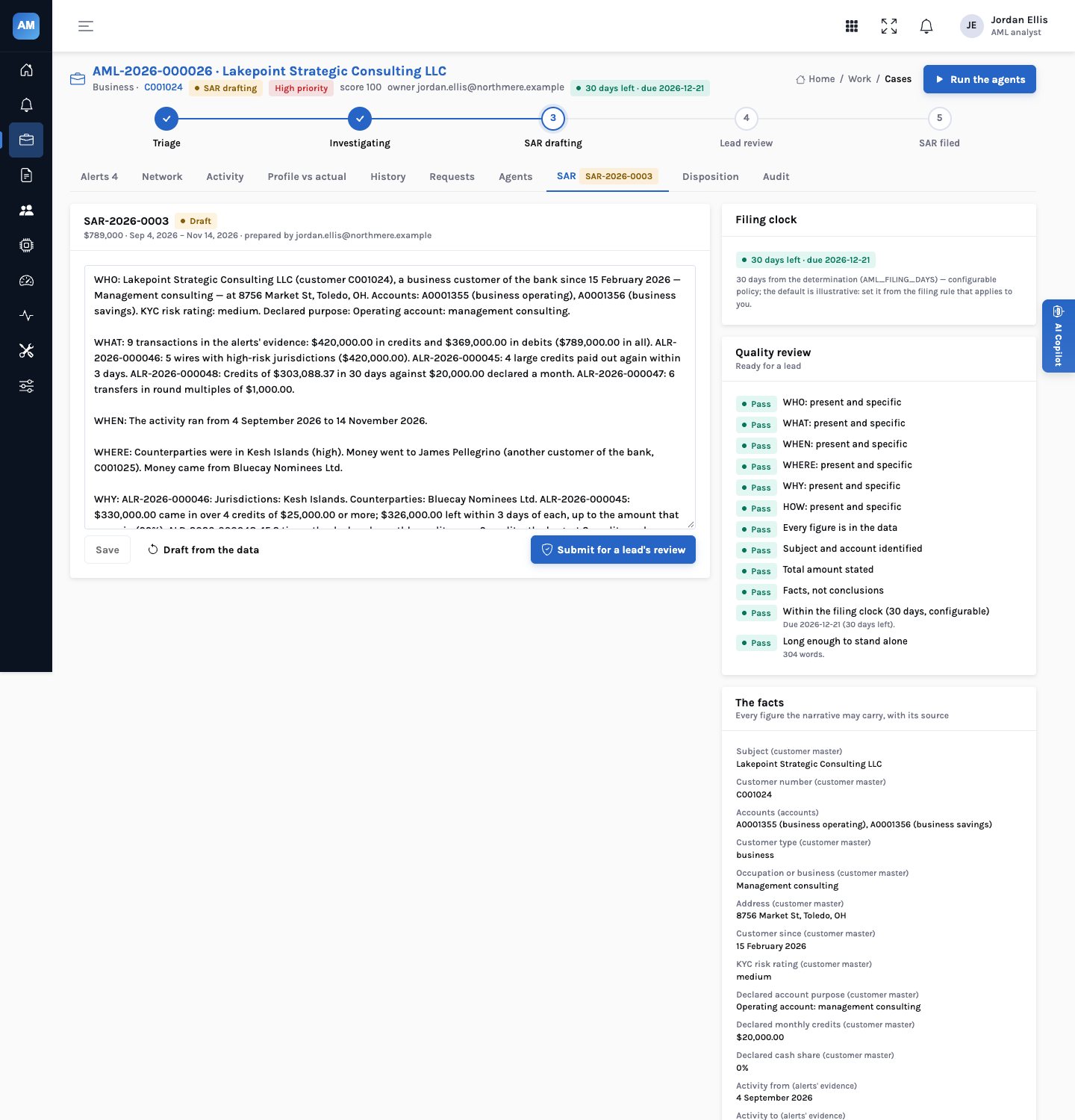
The quality review is deterministic. It checks that each of the six sections is present and specific, that every figure in the text is one of the facts, that the customer number and an account are named, that the total is stated, that there is no conclusory wording such as “laundered” or “criminal”, that the clock has not run out and that the text is long enough to stand alone. The draft is 304 words and passes all 12.
What the narrative does not say
It does not say Lakepoint laundered money, and it does not say what Bluecay Nominees Ltd is. It says what moved, when, where, and why that is unusual against what the customer declared. The conclusion belongs to the people who read the report. The quality reviewer flags conclusory words, and a filing control warns a lead if any are left.
Who does what
Four alerts on one customer are one question. Pair the credits with the outflows.
The network tab, one hop further through the bank’s customers. Open the next customer’s page.
Declared credits, debits, cash share and countries against the last 90 days.
Escalated: layering or pass-through activity. The note stays on the decision record.
Six parts from the facts; 12 checks.
A lead who neither prepared nor submitted the SAR. Filing is recorded in InsightAML; the submission to the regulator happens outside it.
For the BSA officer & MLRO
The escalation, the controls that were checked and the analyst’s note are on the decision record as they stood, before the narrative existed.
For the investigations lead
The second hop turned one case into three connected ones. Assign the linked cases to the same investigator, or at least make sure they read each other.
For the board
Nothing here needed a model. Pairing transactions, multiplying ratios and checking figures are code; the agents explain and draft over those facts.
The rule parameters behind this case (credits of $25,000 or more, 80% out within three days, at least two events) and the triage weights are illustrative defaults. A bank sets them from its own risk assessment and tunes them on its own outcomes.