Banks are putting AI into alert triage, investigation summaries and suspicious activity report drafting. Supervisors have encouraged innovation in anti-money-laundering compliance, and they have also been clear that a new tool does not change who is accountable. The questions an examiner will ask are predictable. This post lists them, points to the guidance behind them, and shows how InsightAML is designed so the answers are short.
In short
- US regulators invited innovation, and kept the bar. The December 2018 joint statement encouraged innovative approaches to BSA/AML compliance; the April 2021 interagency statement explained how model risk management applies to BSA/AML systems.
- The examiner’s first question is who decided. In InsightAML no agent closes, escalates, sends, files or tunes. Every action is capped at the level where a person must answer it.
- The second is where each figure came from. Figures are computed by deterministic engines; the model only explains and drafts over numbered facts, and an answer naming a figure that isn’t in them is thrown away.
- The third is what the AI did, and how often people agreed. Every agent step and every answer to it is recorded, with agreement rates per agent.
The guidance behind the questions
In the US, two statements set the frame. In December 2018 the Federal Reserve, FDIC, FinCEN, NCUA and OCC issued a joint statement encouraging banks to consider innovative approaches, including artificial intelligence, to meet their Bank Secrecy Act obligations, and said that pilots would not by themselves draw supervisory criticism. In April 2021 the federal banking agencies, in consultation with FinCEN, issued an interagency statement on model risk management for bank systems supporting BSA/AML compliance. It explains how the principles of the existing model risk guidance (SR 11-7 and OCC Bulletin 2011-12) can apply to such systems, and says the statement does not create new requirements: a bank’s practices should be risk-based and proportionate.
Elsewhere the language differs but the expectations converge: the firm stays responsible for its reporting decisions; it should understand and be able to explain its systems; and it should be able to show what happened on a given case. In the EU, the AI Act, Regulation (EU) 2024/1689, adds its own obligations depending on how a system is classified; how it applies to a given AML use is a question for your counsel.
| What an examiner will ask | What InsightAML can show |
|---|---|
| Who decided to close, escalate or file this case? | The decision record: the person, the reason code, the note, and each disposition or filing control’s outcome at that moment. |
| What did the system do, and what did a person do? | The audit trail separates people from agents acting as themselves; every prepared decision shows who accepted, rejected or asked. |
| Where did this figure in the narrative come from? | The facts panel: every figure with its source. The quality review fails a narrative carrying a figure that isn’t in the facts. |
| How was this alert scored? | The triage score lists each point and why. Its weights are illustrative and it orders the queue; it decides nothing. |
| How are the rules tuned, and by whom? | A lead changes a rule’s parameters with a reason; each change is a new version. Agents can only propose. |
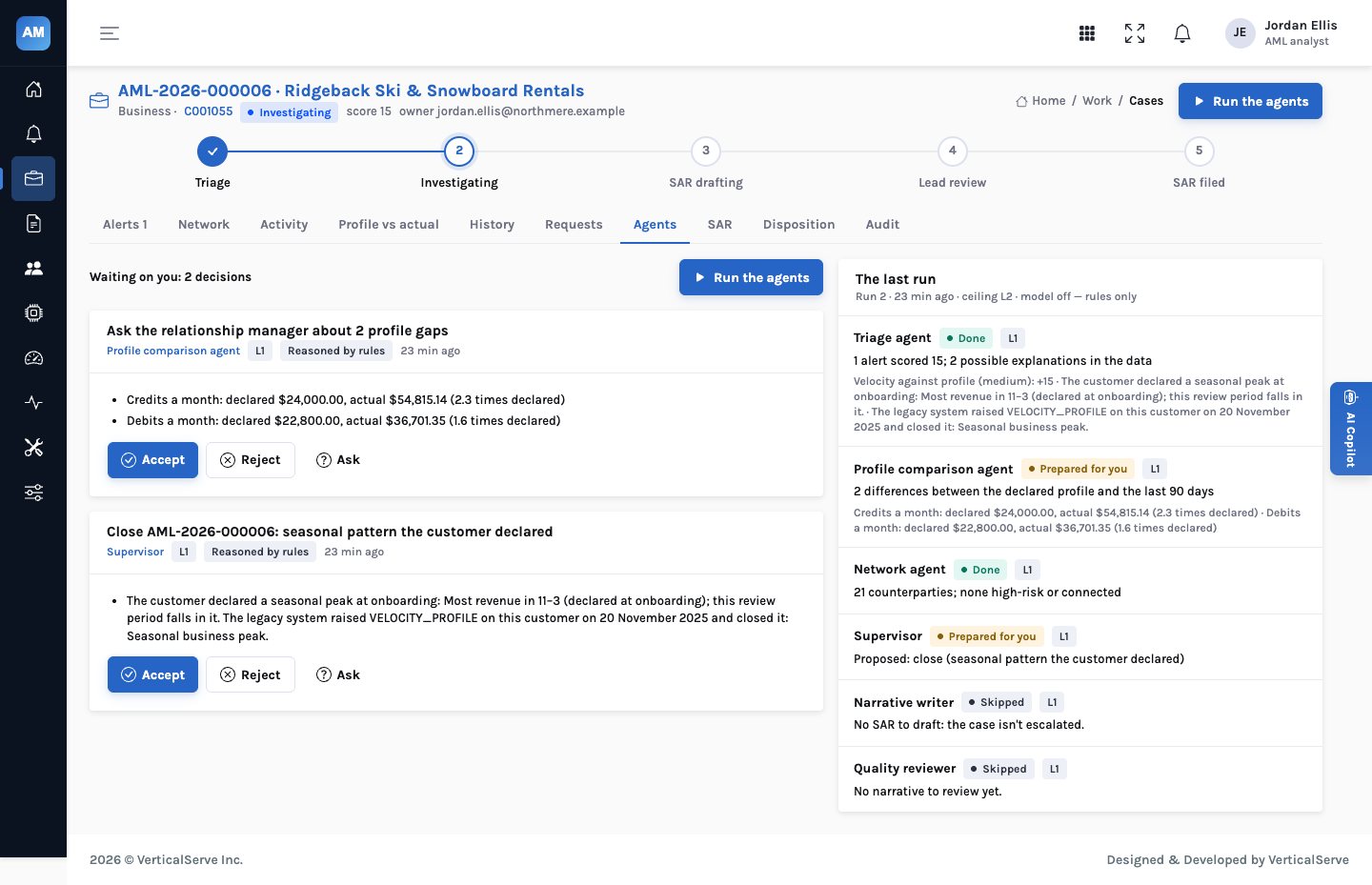
| What happens when the model is off? | Each agent falls back to its rules and says so. The demo runs that way. |
Question one: who decided?
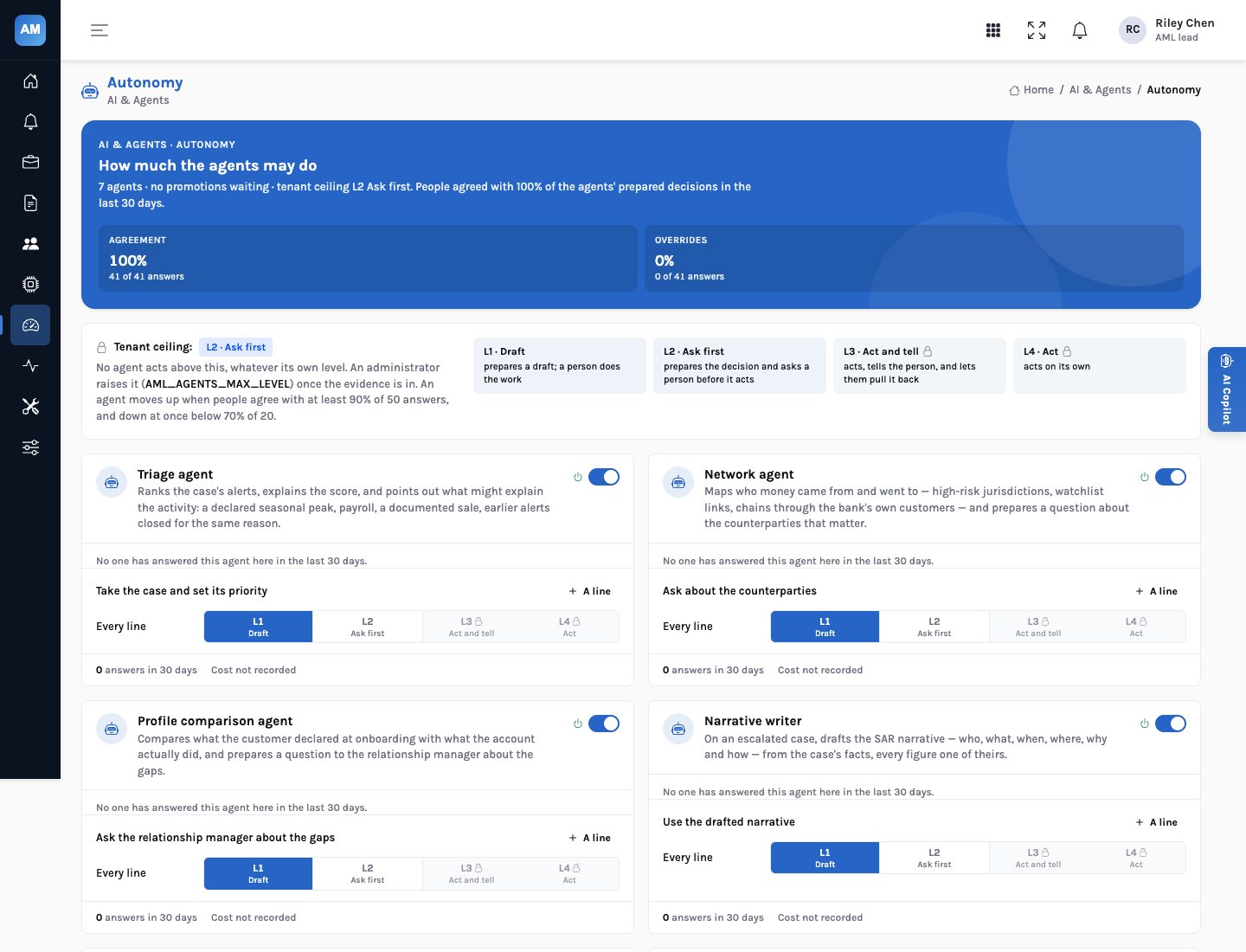
InsightAML’s seven agents each prepare one step: triage, profile comparison, network, the supervisor’s proposed disposition, the narrative, the quality review, and a tuning proposal. What they prepare waits for a person to accept, reject or ask about it. Each action has an autonomy level, from L1 (draft) through L2 (ask first) to L3 and L4, where an agent would act on its own. In InsightAML every action is capped at L2 in code, below any setting an administrator chooses, and the server refuses an agent that tries to close or escalate a case, send a request, submit or file a SAR, or tune a rule.
Figures come from the engines; the model, when on, only explains them; a person answers every prepared decision.
Question two: where did this come from?
Every figure on a case is computed by code an examiner can read: the ten monitoring rules, the triage score, the counterparty network, the profile comparison, the SAR facts. When a language model is configured, the agents and the copilot use it to explain and draft over those facts, numbered [F1], [F2] and so on, and each agent’s instructions forbid stating any name, date, amount, count, jurisdiction or conclusion that isn’t in them. An answer that carries one anyway is discarded and the agent falls back to its rules. The SAR narrative goes further: its quality review fails any figure not found in the facts, and a filing control blocks the filing until it is corrected.
Model off is a real mode, not a failure
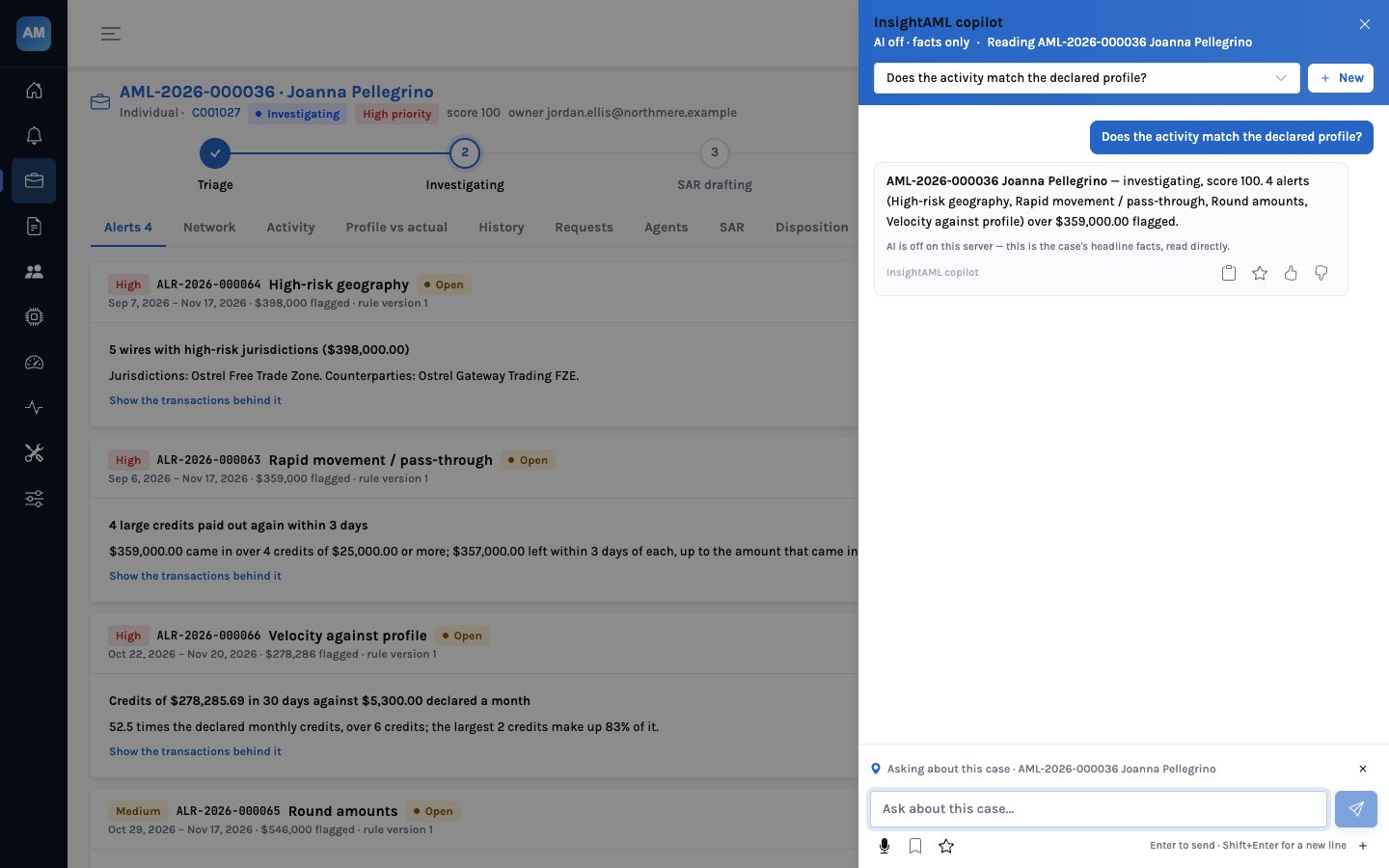
The demo bank runs with the language model switched off. Every agent still prepares its step from the engines’ figures, and the copilot answers with the case’s headline facts and says that AI is off. That is how you can run the system, and show it to an examiner, before deciding whether to switch a model on.
Question three: what did the AI do?
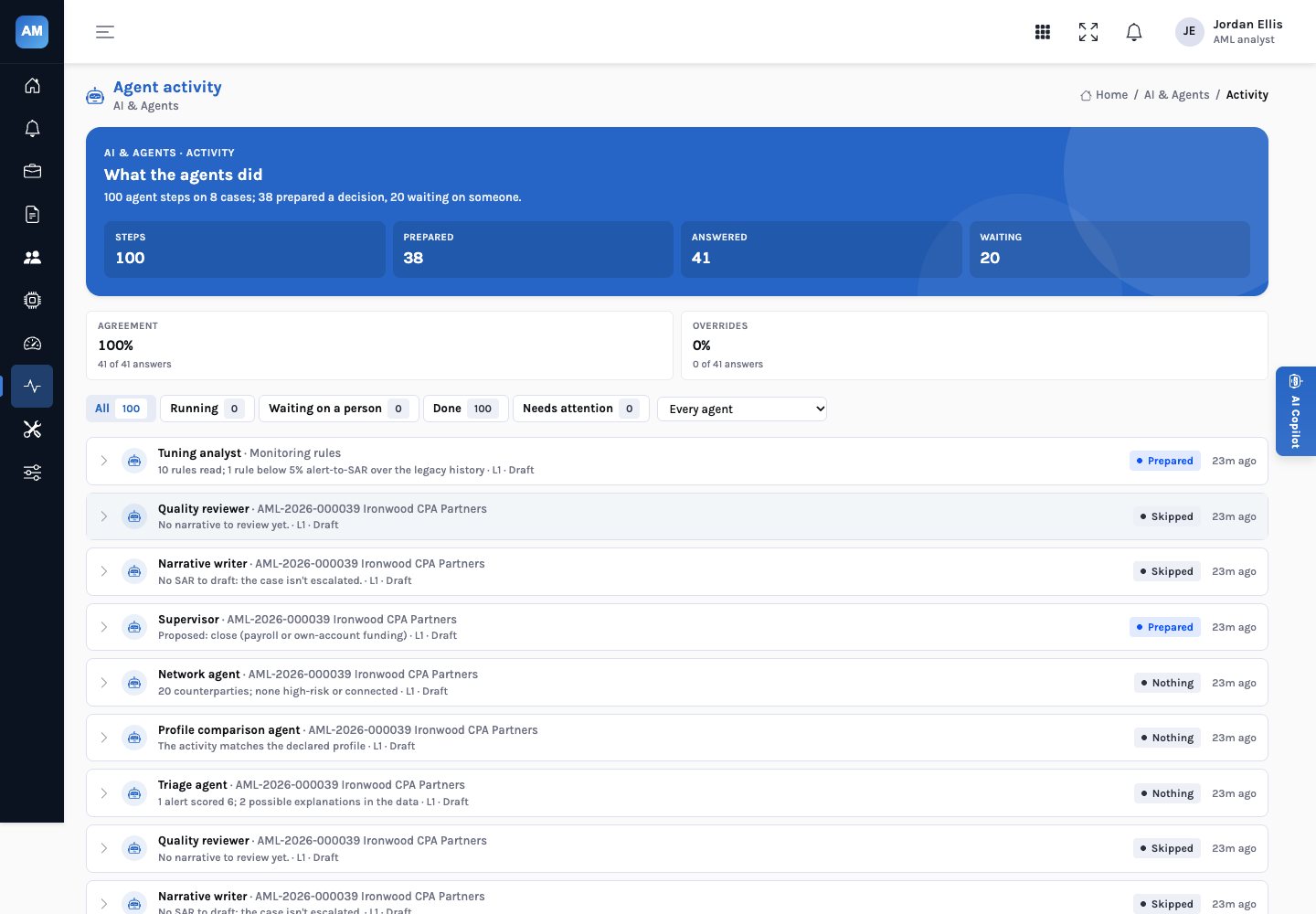
Agent activity is a page, not a log file. It lists every agent step on every case, what it prepared, whether it is waiting on someone, and who answered. Agreement and override rates are counted per agent from those answers. On the autonomy page, the stated rule for moving an agent up a level is sustained agreement (at least 90% of 50 answers), and for moving it down, falling below 70% of 20; in InsightAML the L2 cap applies whatever the agreement rate.
Even when the investigator accepts the agent’s proposal, the determination is theirs, and the controls are checked again.
The copilot is read-only
InsightAML’s copilot answers questions about the case open in front of the investigator, through eight read-only tools: the case summary, the alerts, the counterparty network, the profile comparison, the customer’s history, the SAR draft, the agents’ work and the requests for information. It can link to the place in the case where a person acts. It cannot act.
For the BSA officer & MLRO
Accountability doesn’t move to a vendor or a model. The design keeps every determination and filing with a named person, and a decision record that shows what they saw.
Fold the agents into your model inventory and validation in proportion to what they do; here, they prepare and never decide.
For the investigations lead
Your team keeps its judgement and loses its copying. Every prepared decision can be rejected with one click, and the reason is kept.
Agreement rates tell you which agents are earning trust and which steps need better rules.
For the board
Ask two questions: can we show who decided every case, and can we show where every figure in a report came from? With this design the answer to both is a page in the product.
Explainability isn’t a feature you add to a model. It is a design where the model never owns a fact or a decision.
Compute the figures in code you can read. Let the model, if you use one, explain them and draft from them, and throw away anything it adds. Cap what an agent may do below the point of decision. Record every answer. Then an examination of the AI is an examination of the record.