An investigator opens an alert that says “velocity, high”. Before any judgement can start, someone has to find out what the rule actually measured, over which window, against which threshold, and which transactions it counted. When the rule is a black box, that work is repeated on every alert, and the investigator can’t argue with a number they can’t see. This post is about the opposite: monitoring rules whose parameters sit in plain sight, alerts that carry their own evidence, and a queue ordered by a score that lists its points.
In short
- A rule is a sentence with numbers in it. “Three or more cash deposits between $8,000 and $10,000 within 14 days” can be read, challenged and tuned. The numbers are your policy; InsightAML ships them as illustrative defaults.
- Every alert carries its evidence. The transactions behind it and the figures the rule computed travel with the alert, so the first hour isn’t spent rebuilding them.
- The triage score orders the queue and decides nothing. Each point has a label: a high-severity alert, a prior SAR, a high KYC rating, a wire with a prohibited jurisdiction.
- Rules are versioned. A lead changes a parameter with a written reason, and every alert remembers the rule version that raised it.
Why readable rules matter
Supervisors expect a bank’s monitoring to fit its risk assessment and to be understood by the people who run it. In the US, the interagency statement on model risk management for BSA/AML systems (April 2021) describes how model risk principles can apply to monitoring; in practice, examiners ask why a threshold sits where it does and what evidence supports it. A rule written as a readable sentence, with its parameters on the screen, makes that conversation short.
It also changes the investigator’s job. When the rule says what it counted, the investigator can spend the time on the question that matters: is there an innocent explanation?
The ten rules
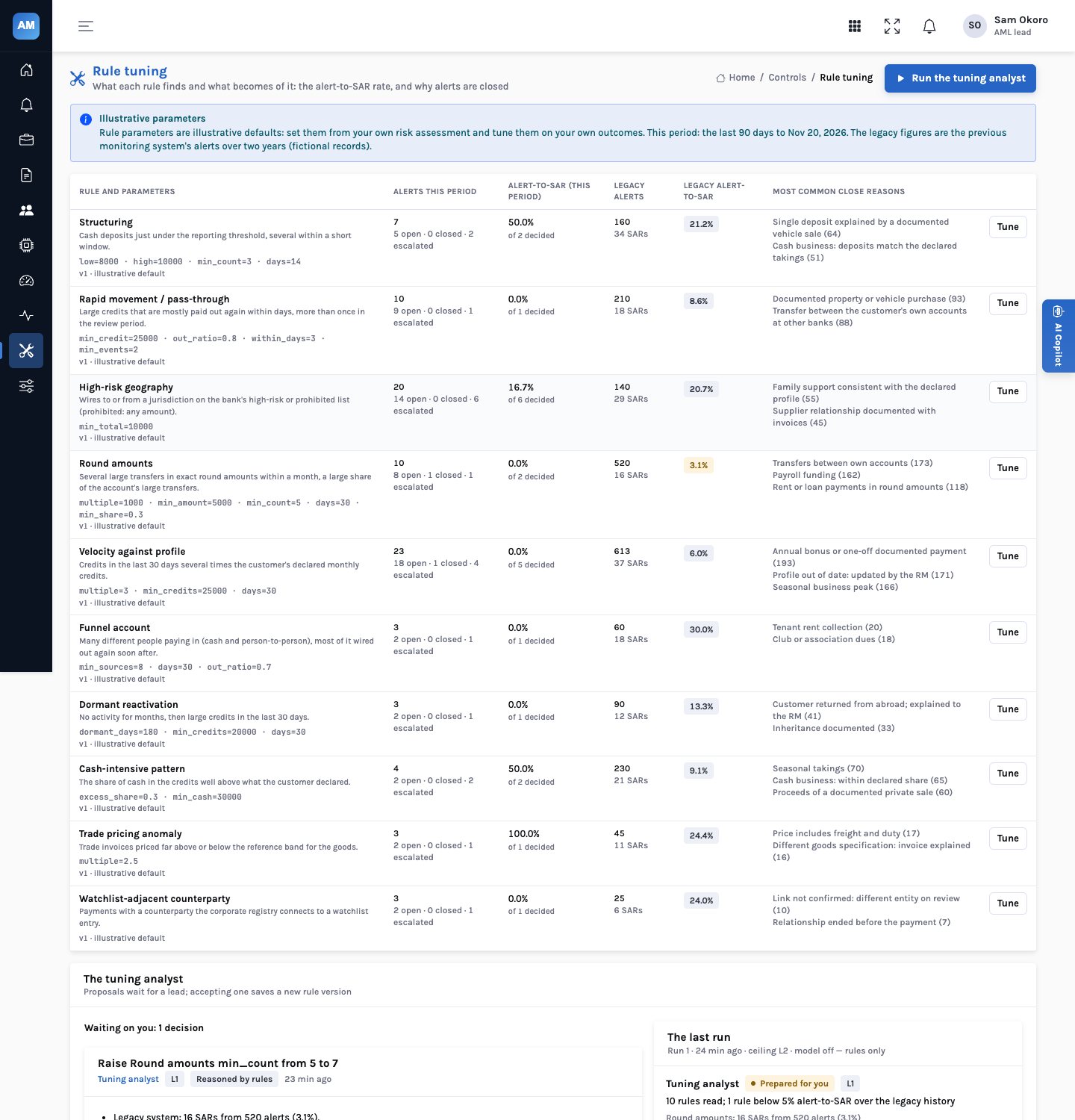
InsightAML runs ten rules over the bank’s transactions in a 90-day review window
(AML_REVIEW_DAYS). The parameters below are the shipped defaults. They are illustrative:
a bank sets them from its own risk assessment and tunes them on its own outcomes.
| Rule | What it looks for | Default parameters (illustrative) |
|---|---|---|
| Structuring | Cash deposits just under the reporting threshold, several within days | $8,000 to $10,000, at least 3, within 14 days |
| Rapid movement / pass-through | Large credits mostly paid out again within days, more than once | credits of $25,000+, 80% out within 3 days, at least 2 times |
| High-risk geography | Wires with a jurisdiction on the bank’s high-risk or prohibited list | $10,000 in total; prohibited: any amount |
| Round amounts | Many large transfers in exact round amounts | multiples of $1,000, $5,000+, at least 5 in 30 days, 30%+ of large transfers |
| Velocity against profile | Credits in 30 days far above the declared monthly credits | 3 times declared, at least $25,000 |
| Funnel account | Many different people paying in, most of it wired out | 8+ sources in 30 days, 70% wired out |
| Dormant reactivation | No activity for months, then large credits | 180 days quiet, then $20,000+ in 30 days |
| Cash-intensive pattern | Cash share of credits well above what was declared | 30 points above declared, $30,000+ in cash |
| Trade pricing anomaly | Invoices priced far outside the reference band for the goods | 2.5 times above the band’s top or below its bottom |
| Watchlist-adjacent counterparty | Payments with a counterparty a registry links to a watchlist entry | any payment |
Each rule also sets a severity. Some are fixed (structuring is high when there are five or more deposits or two or more branches, medium otherwise); others follow the figures (a velocity alert is high at six times the declared credits). A rerun of monitoring doesn’t duplicate alerts: each one has a fingerprint of the customer, the rule and the month.
An alert that carries its own evidence
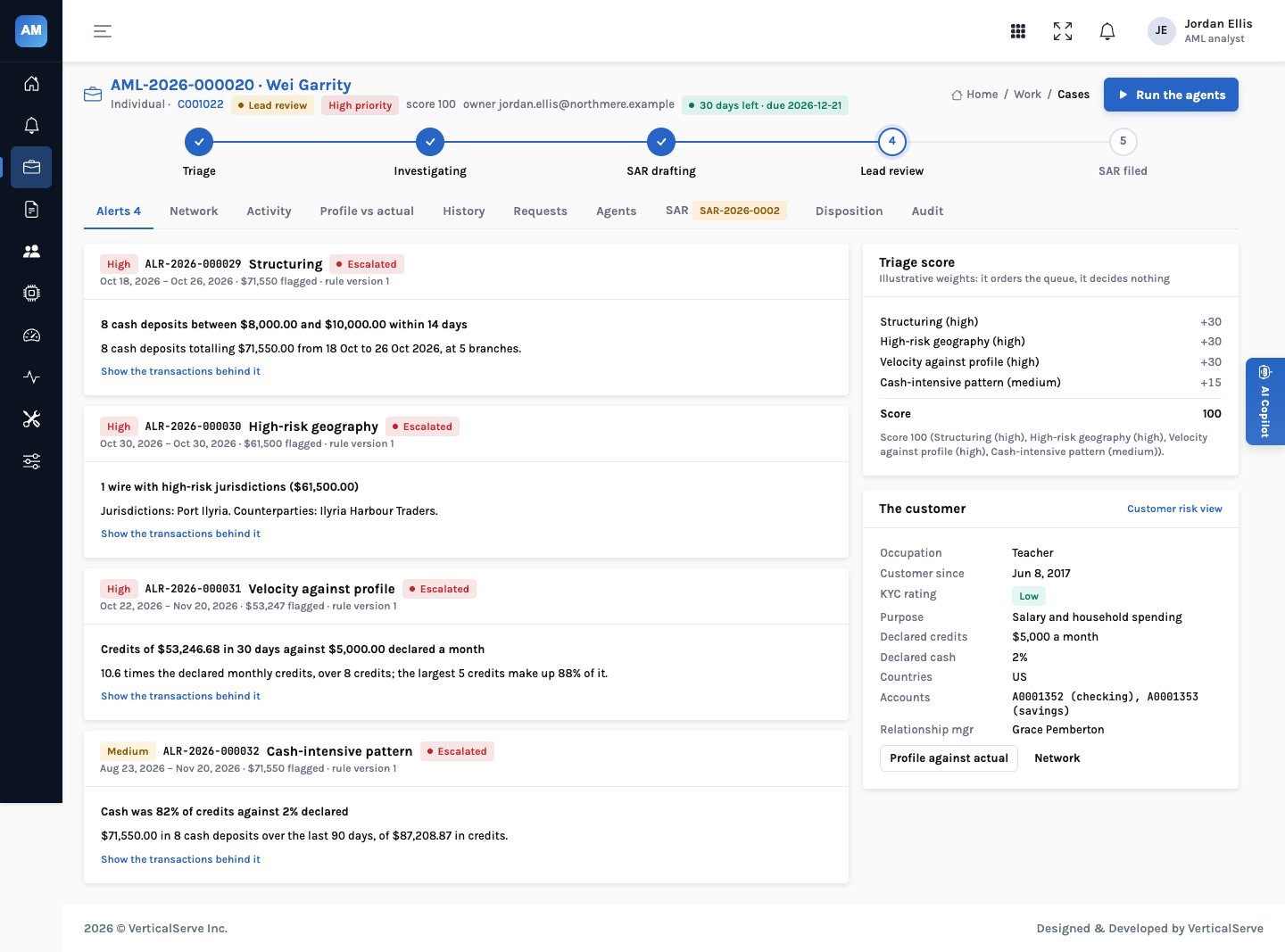
Here is what one rule left on a case at the demo bank, Northmere Bank (fictional). The structuring alert on Wei Garrity (AML-2026-000020) reads: “8 cash deposits between $8,000.00 and $10,000.00 within 14 days”, and underneath, “8 cash deposits totalling $71,550.00 from 18 Oct to 26 Oct 2026, at 5 branches.” The eight deposits are attached, with dates, amounts, channel and branch.
The investigator opens the core banking system, filters the account, finds the deposits, counts the branches and works out the total before deciding anything.
The count, the total, the window, the branches and every transaction the rule counted are on the alert, with the rule version that raised it.
A triage score that shows its points
Queues need an order. The order should be explainable, and it should never be mistaken for a decision. InsightAML’s triage score adds illustrative weights and caps the total at 100:
| Factor | Points (illustrative) |
|---|---|
| Each high-severity alert | +30 |
| Each medium-severity alert | +15 |
| Each low-severity alert | +6 |
| A prior SAR on the customer | +15 |
| KYC risk rating high | +10 |
| Wires with a prohibited jurisdiction | +25 |
A case is high priority at 60 points or more, or whenever it holds a watchlist-adjacent alert or a wire with a prohibited jurisdiction, whatever the score. Wei Garrity’s case scored 100: structuring (high) +30, high-risk geography (high) +30, velocity against profile (high) +30 and cash-intensive pattern (medium) +15, capped at 100. Copperline Components Import (AML-2026-000003) scored 65 from a single alert: high-risk geography (high) +30, wires with a prohibited jurisdiction +25 and a high KYC rating +10.
The score orders the work. The investigator decides it.
Changing a rule, on the record
A rule nobody can change becomes a rule everybody works around. A rule anybody can change becomes a rule nobody can defend. InsightAML puts the change with a lead: tuning a rule requires a written reason, raises the rule’s version and keeps the history of every version with who changed it and why. An agent can propose a change; it can’t make one.
Tuning is a lead’s decision, written down and versioned.
What it counted, the window, the threshold and the version that raised it.
Dates, amounts, channels, counterparties and countries, on the alert.
Which alerts and which customer facts put the case where it is in the queue.
A declared seasonal peak, payroll, a documented sale, an earlier alert closed for the same reason.
The score orders the work; it doesn’t decide it.
For the BSA officer & MLRO
You can tell an examiner what each rule measures, at which threshold, since when, and who changed it and why.
The thresholds are yours. The defaults are illustrative and the screen says so.
For the investigations lead
Investigators start from the evidence instead of rebuilding it, and the queue explains its own order.
Close reasons and alert-to-SAR rates show which rules are earning their alerts.
For the board
Monitoring is a set of written, versioned policy choices with an owner, not a vendor setting nobody can explain.
A rule an investigator can read is a rule they can challenge.
InsightAML keeps the parameters on the screen, the evidence on the alert and the points on the score. People make the decisions, and change the rules, on the record.