A business case for investigation tooling usually arrives with a vendor’s percentage in it: so many hours saved, so many fewer false positives. A CFO is right to discount it. The numbers that matter are your own, and you already have most of them: how many alerts you raise, how many cases you open, how long each takes, how many become reports, and how often a filing is late or comes back. This post gives you the model to put them in, and says plainly what InsightAML changes and what it doesn’t.
In short
- No numbers from us. This post contains no savings estimate. Every figure in the model is one you measure in your own operation, before and during a pilot.
- Time goes to preparation. Gathering transactions, building the counterparty picture, comparing the profile and writing the narrative. That is the part agents can prepare.
- Some costs are not hours. A late filing, a narrative a lead or an examiner sends back, a closure nobody can explain later. Put them in the case as events you count.
- The decision stays with people. Every close, escalation, filing and tuning change is still made by an investigator or a lead. Don’t model headcount you are not prepared to remove from judgement.
Where an investigator’s time goes
Walk one alert through your current process and time each step. In most operations the steps look like this, whatever the system:
Shaded: preparation that can be done before a person sees the case. The decision is not shaded.
| Step | What InsightAML does before a person looks | What stays with the person |
|---|---|---|
| Gather | Groups every alert on a customer into one case, with the transactions behind each alert and the figures the rule computed | Reading it |
| Profile | Declared profile against the last 90 days: credits, debits, cash share, transactions, countries | Judging whether a gap matters |
| Network | Counterparties over 180 days, flagged by jurisdiction and watchlist links, one hop further through the bank’s own customers | Deciding what the connections mean |
| History | Prior SARs, the legacy system’s alerts and how they closed, earlier cases | Weighing them |
| Disposition | The triage agent’s explanations from the data; the supervisor’s proposed close or escalate with a reason; the controls that apply | Closing or escalating, with a note |
| Narrative | A six-part draft written only from the case’s facts, and a twelve-check quality review | Editing, submitting |
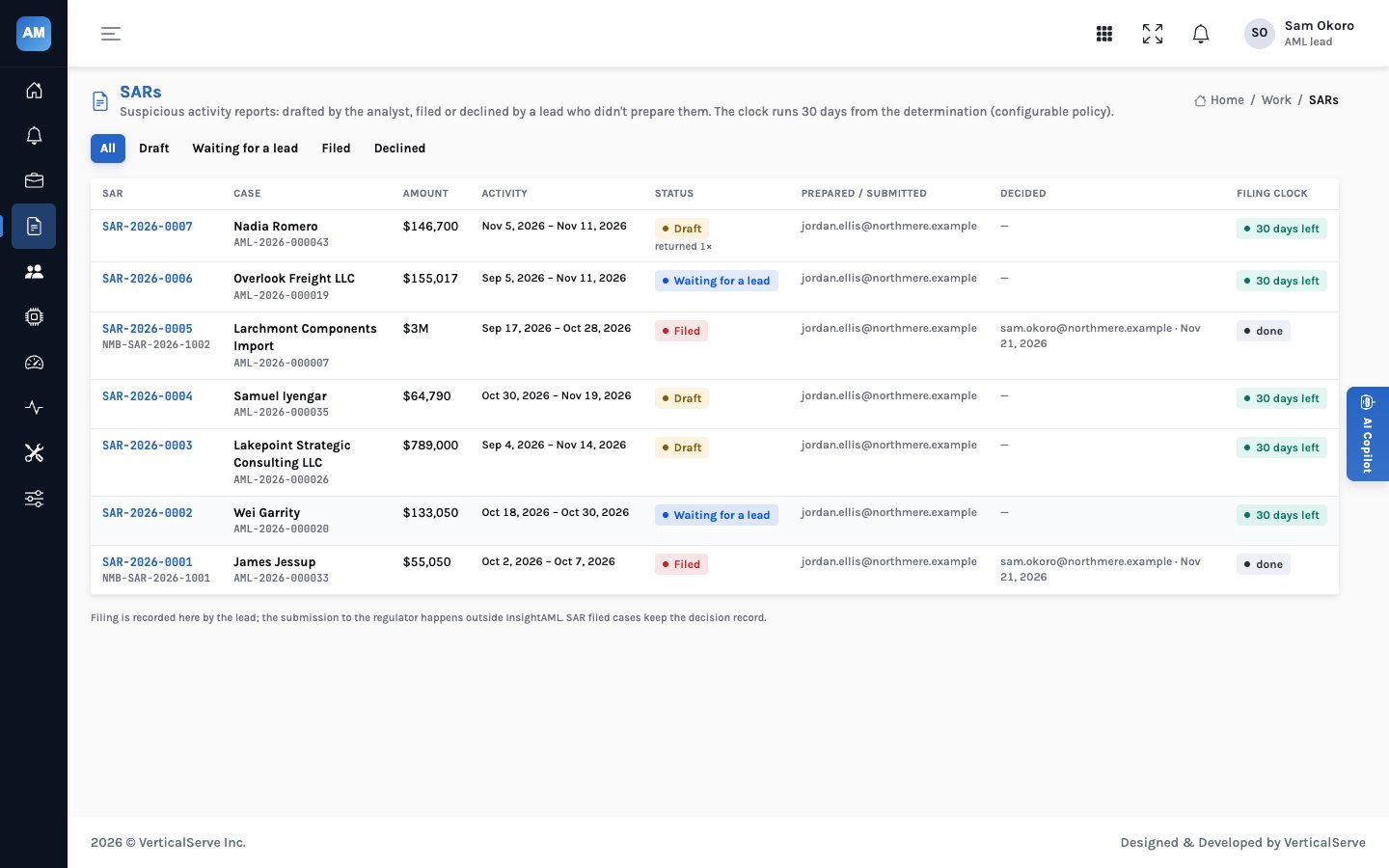
| Filing | The clock, the filing controls, the lead’s queue | Filing, returning or declining, by a lead who didn’t prepare it |
The model
Fill the left column from your own data for a recent quarter. Then run a pilot and fill it again for the same population. The difference is your case.
| Variable | Where to get it | Before | During the pilot |
|---|---|---|---|
| A: alerts raised a month | Monitoring system | ||
| C: cases opened a month (alerts grouped by customer) | Case management | ||
| tclose: investigator hours per case closed | Time study or case timestamps | ||
| tsar: investigator hours per case escalated, through submission | Time study or case timestamps | ||
| tlead: lead hours per SAR reviewed | Time study | ||
| s: share of cases escalated | Case outcomes | ||
| r: SARs returned by the lead or QA, per SAR | QA log | ||
| L: filings past the deadline your policy sets | Filing log | ||
| B: backlog: cases open past your internal target | Case management | ||
| trework: investigator hours to rework a returned SAR | Time study or QA log | ||
| w, wlead: loaded cost of an investigator hour and a lead hour | Finance |
# investigator cost a month
cost = w × C × ( (1 − s) × tclose + s × (tsar + r × trework) )  +  wlead × C × s × tlead

# the pilot's effect: the same formula with the pilot's measured values
change = costbefore − costpilot       # and, separately: ΔL, ΔB, Δr
Keep late filings (L), backlog (B) and returns (r) as their own lines. They are risk, not just cost.
Two kinds of result, kept apart: hours, and the risk lines.
Don’t count what you won’t change
If your policy is that every case is read by a person, and it should be, the saving is in the minutes before the reading and in rework, not in the reading. Model hours, not heads, unless you have decided where freed hours go: backlog, deeper reviews, or tuning.
Costs that aren’t hours
Some of the value is avoided events, and they belong in the case as counts, not as guesses at fines:
| Event | Why it matters | What InsightAML adds |
|---|---|---|
| A late filing | In the US a bank generally has 30 calendar days from initial detection of facts that may be a basis for a SAR (31 CFR 1020.320); other regimes set their own expectations. | A filing clock from the determination (30 days by default, AML_FILING_DAYS; configurable policy), due-soon and overdue states, a filing control that warns past the deadline |
| A thin or wrong narrative | Returned by QA or the lead; weak in an exam lookback | Six parts from the facts; every figure checked against the data; conclusory words flagged |
| An unexplainable closure | “Why did we close this?” asked a year later | Reason code, note, and every disposition control’s outcome on the decision record |
| A risky closure by one person | Watchlist links, prohibited jurisdictions, prior SARs, high value | Illustrative controls refer those closures to a lead |
| Tipping off | A customer question that mentions a review or a report | A message to a customer that would tip them off can’t be sent |
What it costs to run
InsightAML is a Python API, a React app and PostgreSQL, run in your own cloud account against read-only copies of your systems. The costs to put in the case are infrastructure, the integration work to feed it customers, accounts, transactions, counterparties and your lists, the effort to set your own rule parameters and controls, model validation, and (optionally) a language model. The agents and the monitoring engine work with the model switched off; every figure is computed by code, and the model, when on, explains and drafts over numbered facts.
How to present it
Baseline
- Measure A, C, s, the three t’s, r, L and B for one quarter
- Agree what counts as “late” and “returned”
- Pick one alert population for the pilot
Same population, measured
- Run InsightAML beside the current process on read-only data
- Time the same steps
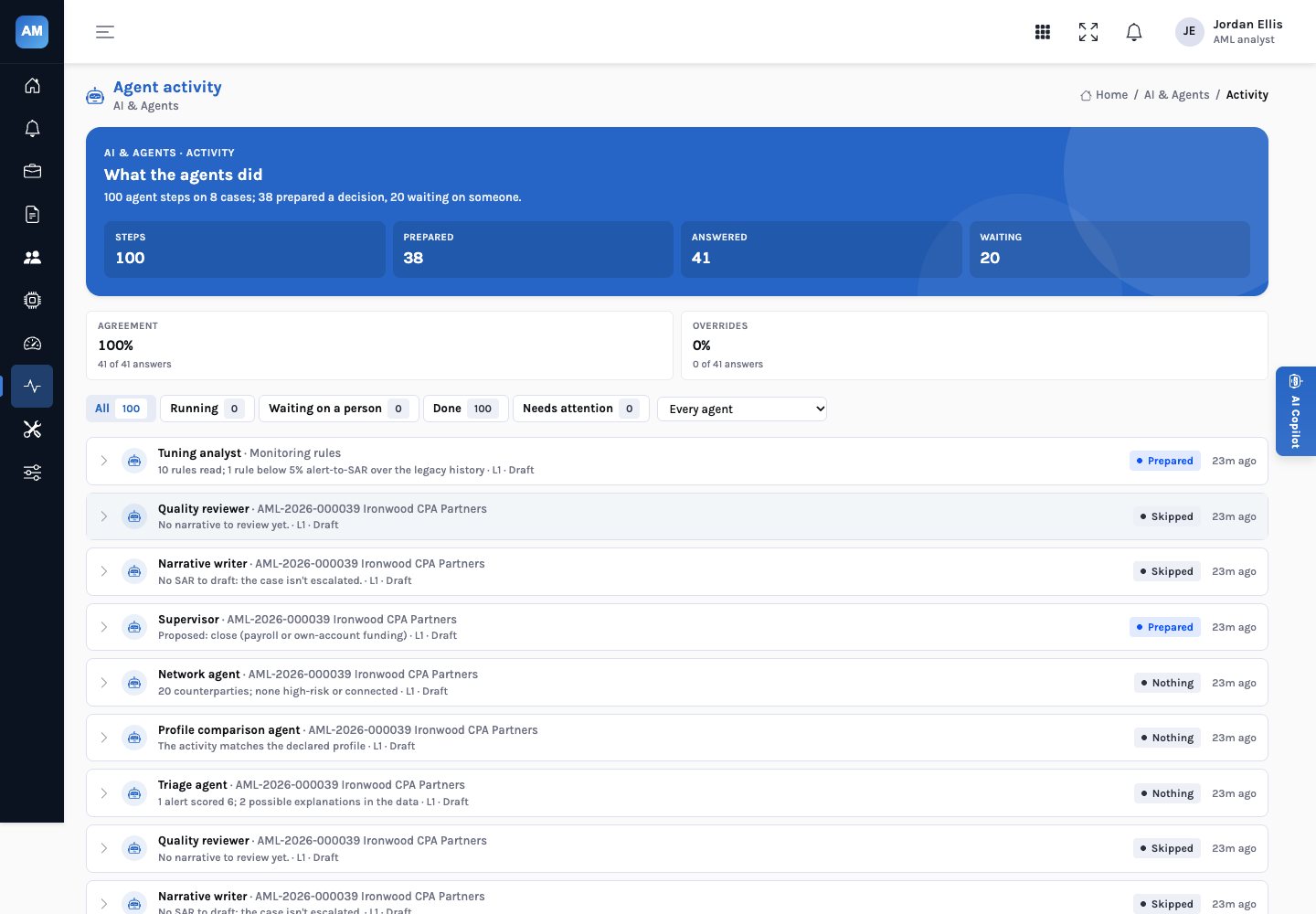
- Count agreement with what the agents prepared
Your numbers, your call
- Cost before and during, line by line
- ΔL, ΔB and Δr as separate risk lines
- Where freed hours go
For the BSA officer & MLRO
The case that survives scrutiny is the one built on your own baseline. Late filings and returned narratives are the lines your regulator cares about; show them separately.
For the investigations lead
Time the gathering, not just the deciding. That is where the measurable change is, and it is the part your team will feel first.
For the board
Ask for the before-and-after on the bank’s own cases, and for the agreement rate with what the agents prepared. Discount any number that isn’t one of those.
The only percentage worth putting in front of a CFO is one you measured.
Bring a quarter of your own alerts. The model above, filled in twice, is the business case.