Putting AML investigations on a new platform is not a switch-over. It is a period in which two systems raise alerts on the same customers, investigators learn to read prepared cases instead of building them, and the BSA officer has to be able to say, at any point, which system’s decision counts. This is a plan for the first ninety days. It promises no results; it says what to connect, what to measure and what to report.
In short
- Start read-only, beside the current process. InsightAML reads copies of the bank’s customers, accounts, transactions and counterparties. Nothing it does changes them, and the current process stays the system of record until you decide otherwise.
- Set your own policy before the first run. Every rule parameter, triage weight, control threshold and the filing clock ships as an illustrative default. Replace them from your risk assessment, with reasons, before an alert counts.
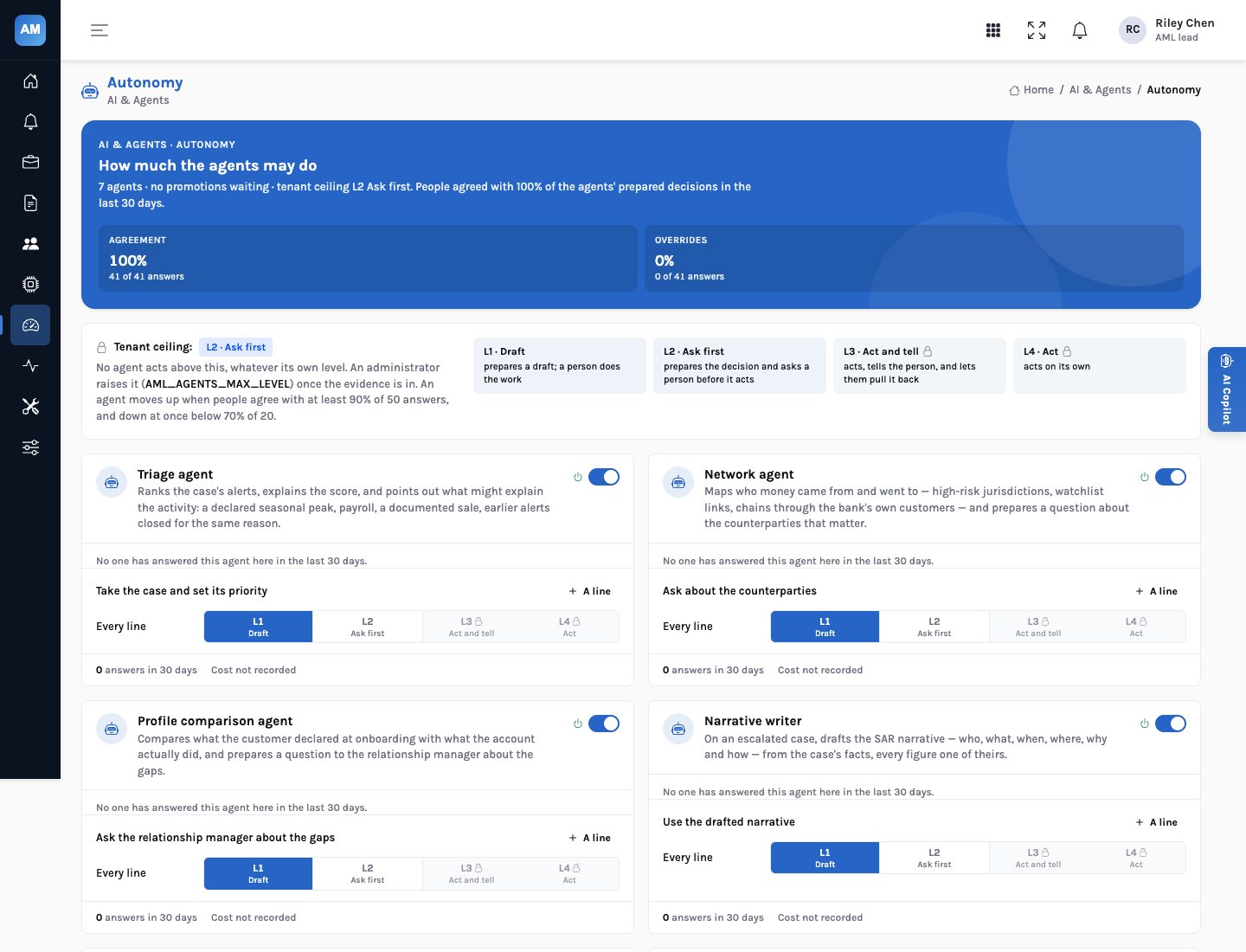
- Keep the agents at L1 to start. Every agent action is capped at L2 in the product. Begin at L1 (draft) and let the agreement rate say whether to move.
- Measure against the legacy system. Alerts by rule, alert-to-SAR rates, close reasons, time per case, late filings and returned SARs, before and during.
- Report at day 30, 60 and 90 on what was connected, what was measured and what was decided, not on promised savings.
The plan at a glance
Dates are arbitrary; the axis counts days from the start.
Days 1–30: connect, and set your own policy
InsightAML reads the bank’s systems from a source schema (AML_SOURCE_SCHEMA) and keeps
its own work in its own (INSIGHT_DATABASE_SCHEMA). The demo’s source is a fictional bank;
yours is a read-only copy of customers with their declared profiles, accounts, transactions,
counterparties, trade invoices if you finance trade, your high-risk and prohibited jurisdiction list, your
watchlists and registry links, prior SARs and the legacy system’s alert history.
| Default in the product | Where it lives | What to do in month one |
|---|---|---|
| Ten rule parameters (e.g. structuring band $8,000–$10,000, 3 deposits in 14 days) | Rule tuning, versioned | Set from your risk assessment; record why in each version’s note |
| Review window of 90 days | AML_REVIEW_DAYS | Match your monitoring policy |
| Triage weights (high 30, medium 15, low 6, prior SAR 15, KYC high 10, prohibited 25) | Code; ordering only | Agree they order the queue and decide nothing |
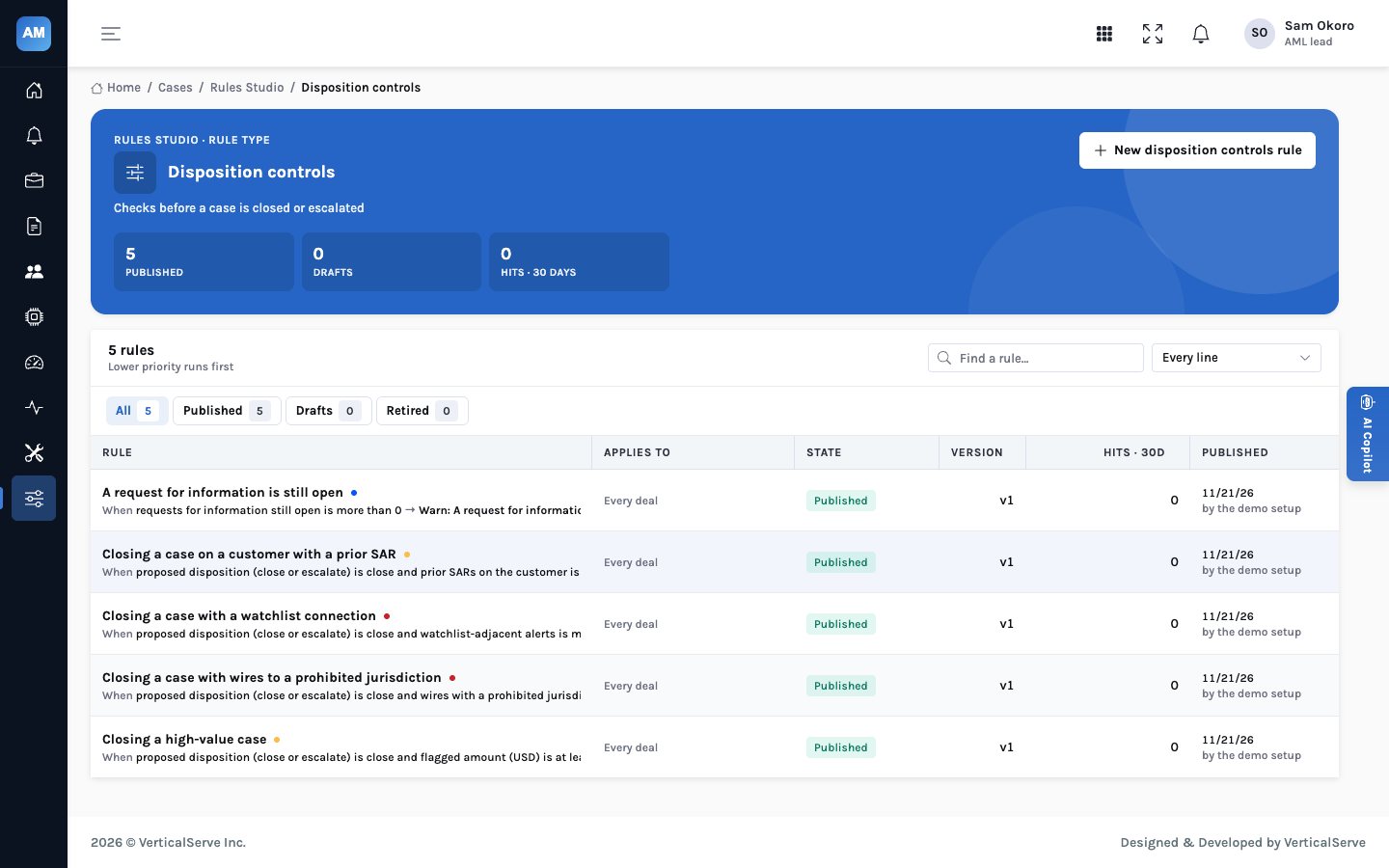
| Disposition controls: refer closures with a watchlist link, a prohibited jurisdiction, a prior SAR or a flagged amount of 250,000 or more | Rules Studio | Set the thresholds and who they refer to |
| Filing controls: block on a missing element or an unsupported figure; warn on wording, an open request, a passed deadline | Rules Studio | Review with the BSA officer or MLRO |
| Filing clock of 30 days from the determination | AML_FILING_DAYS | Set from the filing rule that applies to you |
| Agent ceiling | AML_AGENTS_MAX_LEVEL; hard cap L2 | Start at L1 |
Validate before you rely
Transaction monitoring that meets the definition of a model is expected to be validated and governed like one. Plan the validation work (conceptual soundness of each rule, data feeds, outcome analysis) into these ninety days, rather than after go-live. See the 2021 interagency statement on model risk management for BSA/AML systems and SR 11-7.
Days 31–60: run beside the current process
Pick one alert population, for example one product line or one region, and let both systems see it. Investigators work the cases in InsightAML; the decision of record follows the bank’s existing procedure until the day-90 decision says otherwise. Every case keeps its decision record either way.
Two systems on one population, compared on outcomes.
Which customers each system raised, and why they differ.
On the autonomy page: how often people accepted what each agent prepared, and where they overrode.
What the lead sent back, and whether the facts or the draft were missing.
Proposals from the tuning analyst show what a change drops; a lead applies or rejects.
No escalated case near the deadline without a plan.
Days 61–90: measure, and decide
Connected
- Feeds live and reconciled to source counts
- Your parameters, controls and clock, each with a recorded reason
- Baseline from the legacy system: alerts, outcomes, time per case
Running beside
- One population worked in InsightAML
- Agreement with prepared decisions, by agent
- First tuning proposals reviewed by a lead
Decided
- Before-and-after on your own measures
- Late filings and returned SARs, both systems
- Decision: widen, adjust or stop; and whether any agent moves to L2
| Measure | Source |
|---|---|
| Alerts raised, by rule, both systems | Alerts page; legacy history |
| Alert-to-SAR rate and close reasons, by rule | Rule tuning |
| Investigator time per closed and per escalated case | Case timestamps and audit trail |
| Returned SARs and why | SAR list; audit trail |
| Filings near or past the clock | SAR list; filing clock |
| Agreement and overrides per agent | Autonomy and agent activity |
For the BSA officer & MLRO
At day 90 you should be able to show an examiner every threshold you set and why, every control and its version, and the parallel-run comparison. That is the evidence; the platform is just where it lives.
For the investigations lead
The team’s shift is from building cases to reading them. Watch the agreement rate and the overrides: they tell you where the preparation helps and where it doesn’t.
For the board
The day-90 decision is a choice the bank makes on its own measures. Ask for those, not for projected savings.
Ninety days to replace defaults with your policy, and claims with measures.
Connect read-only. Set your own thresholds with reasons. Run beside the current process. Decide on what you measured.