Every monitoring rule is a trade. Lower a threshold and the queue grows; raise it and something real may slip under it. Most banks make that trade on instinct and on the volume of the queue. The better input is outcome: of the alerts a rule raised, how many became suspicious activity reports, and why were the rest closed? And before a change goes live, which alerts that people escalated would it have dropped?
In short
- Yield per rule, from the outcomes. InsightAML counts, for each rule, the alerts it raised and what became of them, this period and over the legacy system’s two years, and the alert-to-SAR rate of each.
- Close reasons say where the noise comes from. On the demo bank’s legacy history, round-amount alerts became SARs 3.1% of the time (16 of 520); 453 were closed, most as own-account transfers, payroll or rent.
- The proposal shows its cost. The tuning analyst proposes raising Round amounts
min_countfrom 5 to 7, and says it would drop all 10 of this period’s round-amount alerts, including one that was escalated. - Only a lead tunes. A change needs a reason, becomes a new version of the rule, and keeps its history. No agent can apply it.
- Every parameter is illustrative. The defaults are starting points: set them from your own risk assessment and tune them on your own outcomes.
Why tuning on volume goes wrong
A rule that raises too many alerts gets its threshold nudged until the queue is manageable. Nobody checks what the nudge removed, because the removed alerts are never raised and so never seen. The opposite failure is just as common: a rule nobody dares touch because no one can say what changing it would cost.
data
US banking agencies expect the models and systems that support BSA/AML compliance, including transaction monitoring, to be managed with sound model risk practices where they meet the definition of a model, scaled to the bank’s risk. In practice examiners ask how thresholds were set, when they were last reviewed, what the review looked at, and who approved the change.
Sources: Interagency Statement on Model Risk Management for Bank Systems Supporting Bank Secrecy Act/Anti-Money Laundering Compliance (April 2021); Supervisory Guidance on Model Risk Management, SR 11-7 / OCC Bulletin 2011-12; FFIEC BSA/AML Examination Manual. Check the guidance that applies in your jurisdiction.
The demo bank’s numbers
Northmere Bank is fictional; its transactions are generated and its legacy alert history (two years of a fictional previous monitoring system) is too. The figures below are what InsightAML’s tuning page counts from that data as of 20 November 2026. They describe the demo, not any real bank or benchmark.
| Rule | Legacy alerts | Legacy SARs | Alert-to-SAR | Most common close reason (legacy) |
|---|---|---|---|---|
| Structuring | 160 | 34 | 21.2% | Single deposit explained by a documented vehicle sale (64) |
| Rapid movement / pass-through | 210 | 18 | 8.6% | Documented property or vehicle purchase (93) |
| High-risk geography | 140 | 29 | 20.7% | Family support consistent with the declared profile (55) |
| Round amounts | 520 | 16 | 3.1% | Transfers between own accounts (173) |
| Velocity against profile | 613 | 37 | 6.0% | Annual bonus or one-off documented payment (193) |
| Funnel account | 60 | 18 | 30.0% | Tenant rent collection (20) |
| Dormant reactivation | 90 | 12 | 13.3% | Customer returned from abroad; explained to the RM (41) |
| Cash-intensive pattern | 230 | 21 | 9.1% | Seasonal takings (70) |
| Trade pricing anomaly | 45 | 11 | 24.4% | Price includes freight and duty (17) |
| Watchlist-adjacent counterparty | 25 | 6 | 24.0% | Link not confirmed: different entity on review (10) |
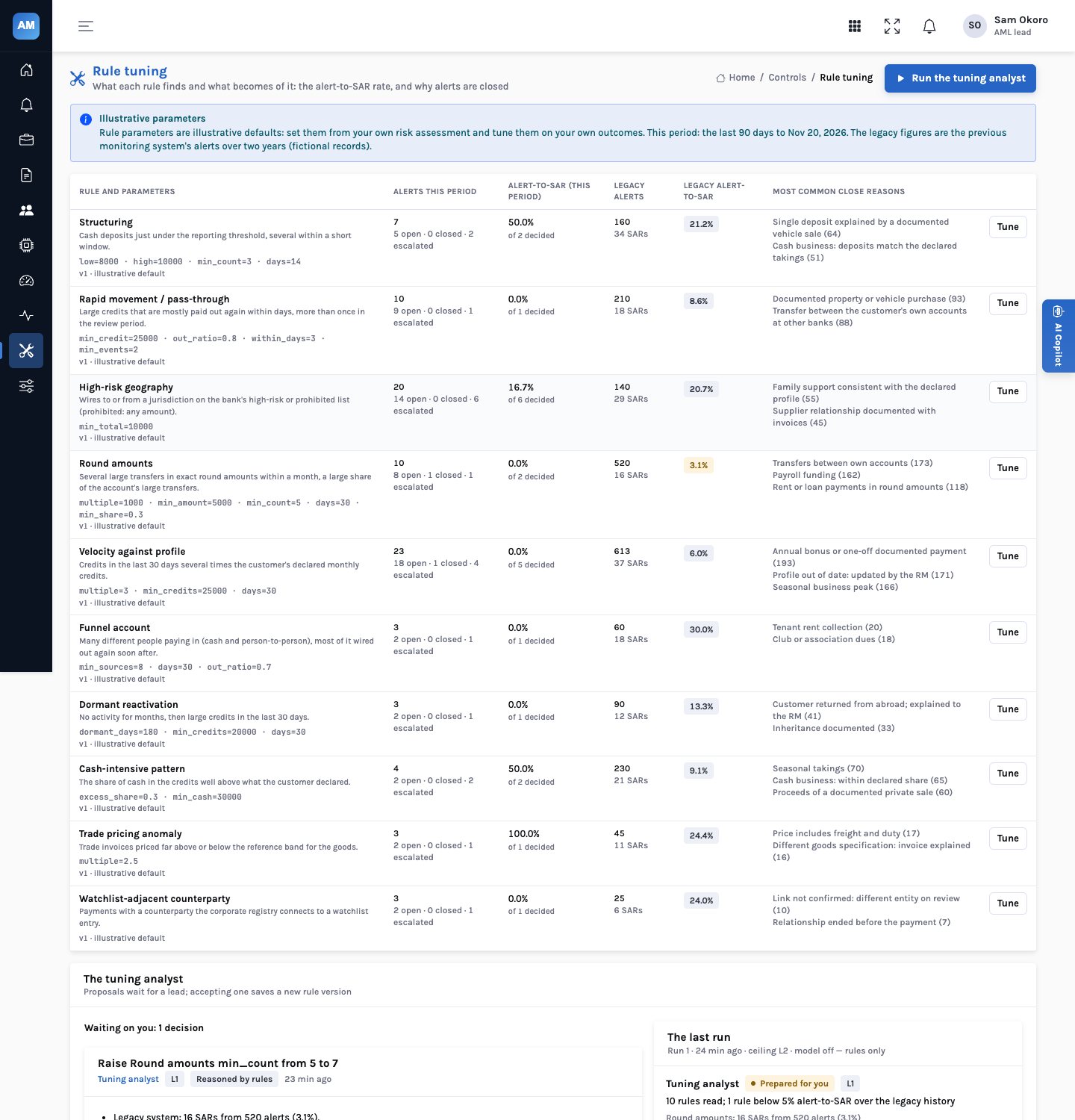
This period’s column is small on purpose: in the demo, 86 alerts were raised on the first run, and only a handful of cases have been decided. A rate of 50% from two decided alerts is not a yield; the page shows the count of decided alerts beside every rate so nobody mistakes one for the other.
Round amounts: where 453 closures came from
Outcomes of the fictional legacy system’s round-amount alerts over two years.
The pattern is familiar: businesses move round sums between their own accounts and fund payroll in round transfers, and people pay rent and loans in round amounts. In this period, one of the ten round-amount cases, Ironwood CPA Partners, was closed for exactly that reason: six transfers totalling $232,000.00, all between its own accounts or to its payroll processor.
The proposal, and what it would cost
The tuning analyst read all ten rules (“10 rules read; 1 rule below 5% alert-to-SAR over the legacy history”) and prepared one proposal for a lead. It reruns the rule over this period’s data with the change, so the effect is counted, not estimated:
Raise Round amounts min_count from 5 to 7
Legacy system: 16 SARs from 520 alerts (3.1%). Most common close reason: Transfers between own accounts (173). Most common close reason: Payroll funding (162). This period: 10 alerts now; 0 with the change (10 fewer). It would drop 1 alert that was escalated: ALR-2026-000047 (Lakepoint Strategic Consulting LLC).
That last line is the one that matters. Lakepoint Strategic Consulting LLC is a layering case: four large credits paid out again within three days, wires with a high-risk jurisdiction, credits 15.2 times the declared monthly figure, and six round transfers totalling $566,000.00. It was escalated and its SAR is in draft. The round-amount alert was one of four on the case, so raising the count to 7 would not have hidden the case. It would have removed one of the facts the narrative cites. A lead can weigh that; a lead who never sees it can’t.
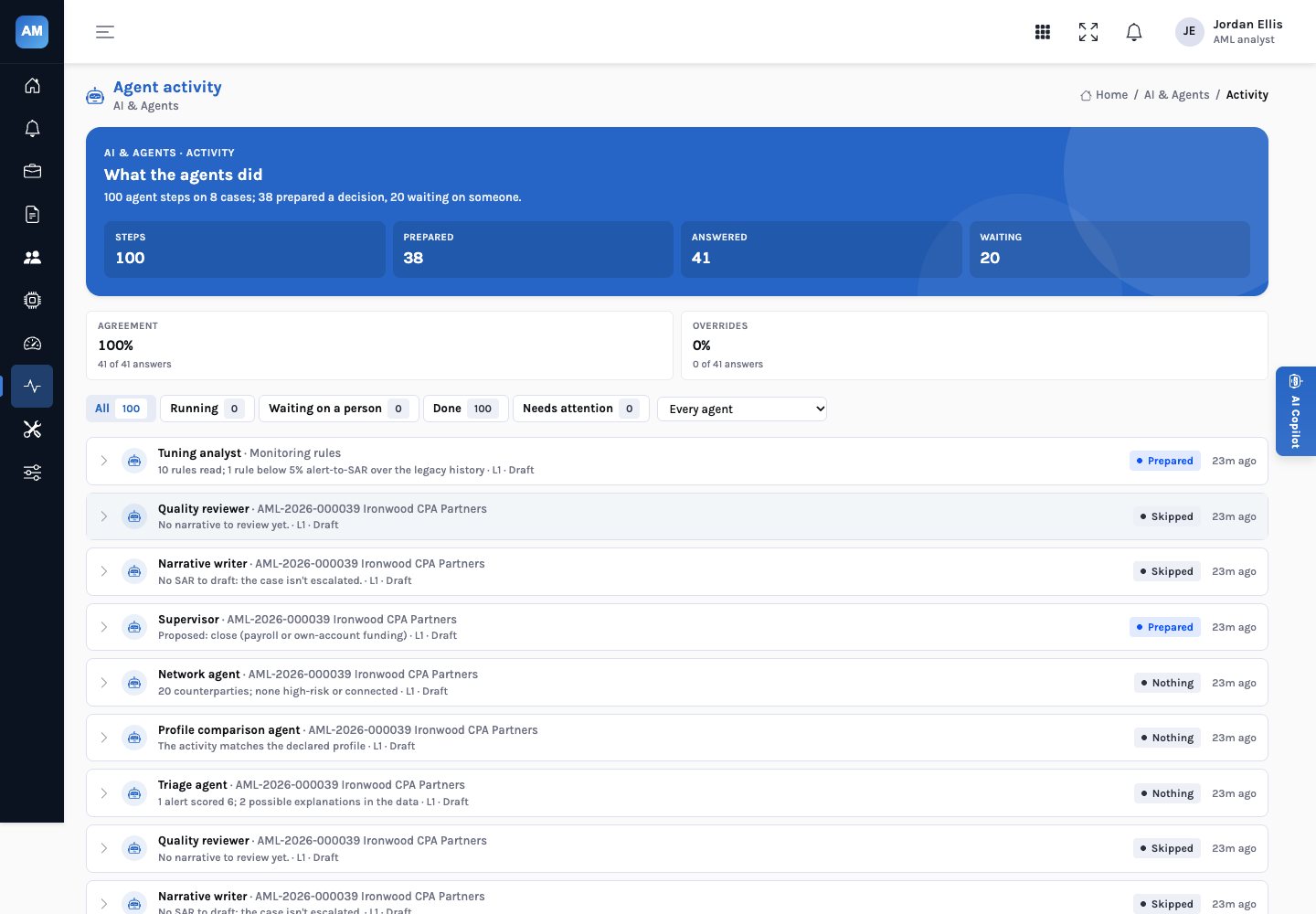
The agent prepares the evidence. The lead applies or rejects it.
Who may change a rule
Tuning is a lead’s call. InsightAML refuses a change from an agent, refuses a change without a reason (“Say why the rule is tuned; the reason stays with its version”), refuses unknown or non-positive parameters, and saves every change as a new version with who, when, the parameters and the note. Every alert records the rule version that raised it, so a later reader can tell which threshold produced which alert.
A rate from two decisions is an anecdote; the legacy history gives the larger sample.
Are the closures one explainable population (payroll, own accounts) or many?
The proposal counts this period’s alerts with and without the change, and names any escalated alert it would drop.
Apply as a new version, or reject. The reason is part of the version.
Compare the new version’s alerts and outcomes with the old one’s.
Nobody recorded which alerts the change removed, or who agreed to it. The next examiner asks how the threshold was set.
The proposal says what it drops, including the escalated alert. A lead applied or rejected it with a reason, and the version history keeps both.
Tune on what alerts became, and look at what a change would have missed.
The demo’s defaults are illustrative. The method is the point: outcomes in, a counted trade-off out, a lead’s reason on the version.