A quality check can tell you a narrative has all six parts, that every figure in it is in the data and that it avoids conclusions. It can’t tell you whether it answers the question a reader will ask next. That is the lead’s job, and it is why four eyes on a SAR is more than a signature. This case passed every automated check and came back anyway.
In short
- The activity. Nadia Romero, a pharmacist whose account had been quiet for at least 180 days, received four credits totalling $79,800.00 between 5 and 11 November 2026, two of them from the Kesh Islands, a high-risk jurisdiction in the demo.
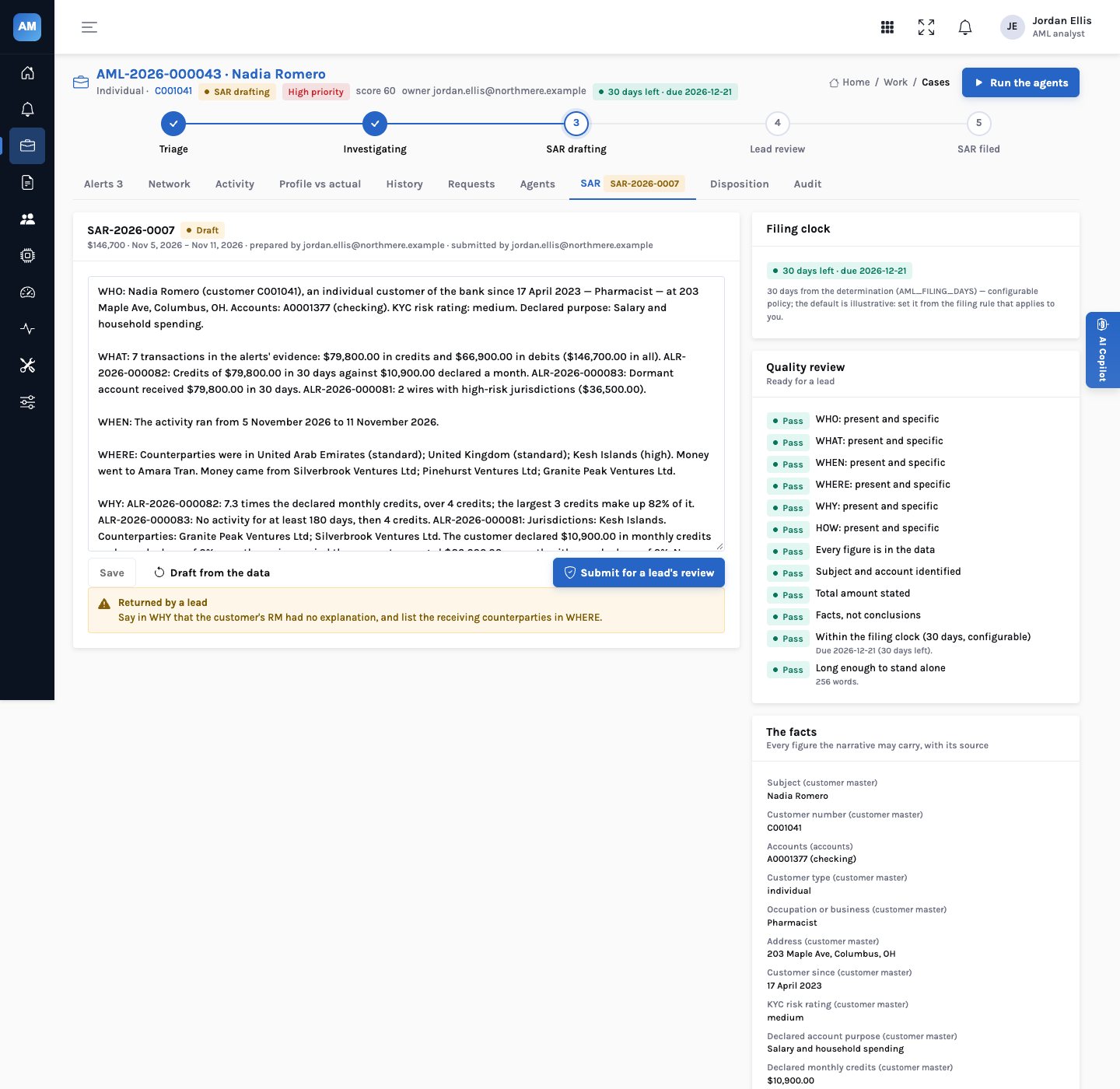
- The draft passed. SAR-2026-0007, 256 words, passed all twelve quality checks and was submitted.
- The lead returned it. “Say in WHY that the customer’s RM had no explanation, and list the receiving counterparties in WHERE.”
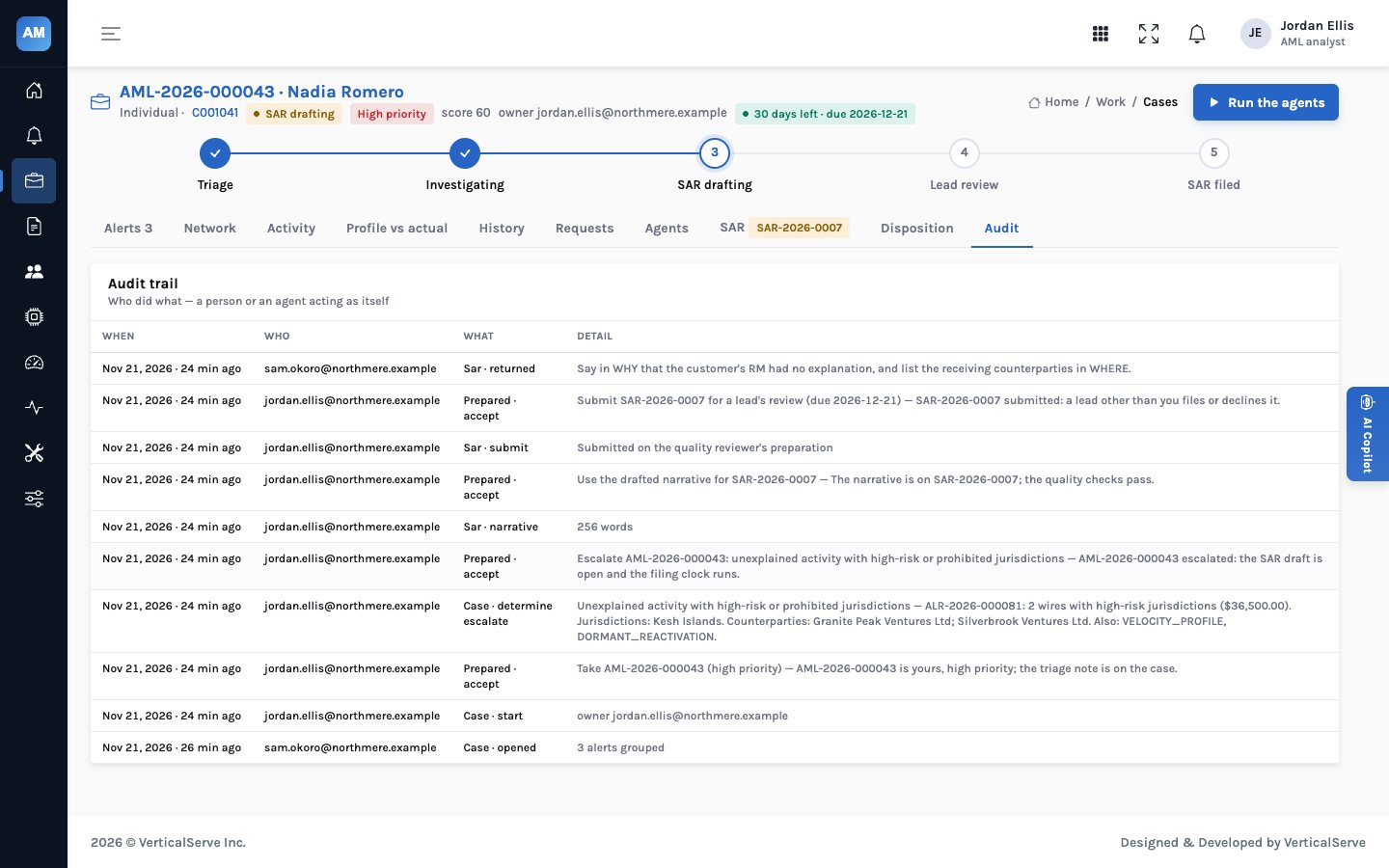
- A return is not a decline. The SAR goes back to draft, the case back to SAR drafting, the count of returns goes up, and the filing clock keeps running.
- The fix needs facts, not words. The narrative can only state what the case knows. To say the RM had no explanation, someone has to ask the RM.
The case
The demo bank, Northmere, is fictional and its transactions are generated. The Kesh Islands is an invented jurisdiction on a user-assigned code (XC). Nadia Romero (customer C001041) has banked there since 17 April 2023, with one checking account, a medium KYC rating and the purpose “Salary and household spending”. She declared $10,900.00 a month in credits and no cash.
| Alert | Rule | What it found |
|---|---|---|
| ALR-2026-000082 | Velocity against profile (high) | Credits of $79,800.00 in 30 days against $10,900.00 declared a month: 7.3 times, over 4 credits |
| ALR-2026-000083 | Dormant reactivation (medium) | No activity for at least 180 days, then 4 credits |
| ALR-2026-000081 | High-risk geography (medium) | 2 wires with high-risk jurisdictions ($36,500.00): Granite Peak Ventures Ltd; Silverbrook Ventures Ltd |
The evidence is short. In: $22,300.00 from Pinehurst Ventures Ltd (GB) on 5 November, $22,500.00 from Silverbrook Ventures Ltd (XC) on 7 November, $21,000.00 from Silverbrook Ventures Ltd on 9 November and $14,000.00 from Granite Peak Ventures Ltd (XC) on 11 November. Out, $22,300.00 at a time: a cash withdrawal on 6 November, a wire to Amara Tran on 8 November, and a wire on 10 November. Money arrived and left within days, in matching amounts.
Four credits in, three debits out, between 5 and 11 November 2026.
From escalation to submission
The triage agent scored the case 60 (30 for the high alert, 15 for each medium) and found nothing in the data that explains it. The profile agent found three differences: credits of $26,600.00 a month over the last 90 days against $10,900.00 declared, debits of $22,300.00 against $10,400.00, and three countries she never declared (United Arab Emirates and United Kingdom, both standard, and Kesh Islands, high). The network agent found seven counterparties and flagged the two in the Kesh Islands.
The analyst escalated with the reason “Unexplained activity with high-risk or prohibited jurisdictions”, which opened SAR-2026-0007 and started the filing clock (30 days by default from the determination, a configurable policy; due 21 December 2026). The narrative writer drafted it from the facts, the quality reviewer passed all twelve checks, and the analyst submitted it.
What the lead saw
Two sentences in the draft carry the weight the lead was looking at:
WHERE: Counterparties were in United Arab Emirates (standard); United Kingdom (standard); Kesh Islands (high).
Money went to Amara Tran. Money came from Silverbrook Ventures Ltd; Pinehurst Ventures Ltd; Granite Peak Ventures Ltd.

WHY: ... No documented explanation for the activity was found in the customer's records.
From the draft of SAR-2026-0007.
Both are true and both are thin. “Money went to Amara Tran” names one of three debits; the other two were a cash withdrawal and a wire whose counterparty isn’t named in the data. “No documented explanation was found in the customer’s records” says what the bank’s files lack, not whether anyone asked. Sam Okoro, the AML lead, returned it:
The lead’s note, as recorded
“Say in WHY that the customer’s RM had no explanation, and list the receiving counterparties in WHERE.”
Why the analyst can’t just type it in
The narrative is checked against the case’s facts. Every figure in it must appear in them, and the
filing control SAR_FIGURES blocks filing when one doesn’t. The WHY section writes an
answer from a request for information when there is one (“Answer from the relationship manager:
…”) and otherwise says no documented explanation was found. So the honest way to meet the
lead’s note is to put the fact on the case: send the relationship manager a question, record the
answer, and redraft. The open request will itself raise a warning on the filing controls until it is
answered, which is the point.
The return loop. The filing clock does not stop for it.
What a return records
| Return | Decline | File | |
|---|---|---|---|
| Who | A lead who neither prepared nor submitted the SAR | Same | Same |
| Note | Required: it goes back to the analyst | Required: it goes on the decision record | Optional |
| SAR status | Draft again; the return count goes up | Declined | Filed, with a filing reference |
| Case | Back to SAR drafting | Closed (SAR declined) | SAR filed |
| Decision record | Audit entry with the note | A filing decision with every filing control | A filing decision with every filing control |
For the BSA officer & MLRO
A return is evidence that review is real. An examiner reading a file where the lead sent the narrative back, and the second version says what the RM knew, sees a control that works.
For the investigations lead
The return costs days on a 30-day clock. The quickest fix is to ask the RM early, before the first submission, whenever the WHY would otherwise say “no explanation found”.
For the board
Quality checks are necessary and not sufficient. The second pair of eyes is where judgement about a report’s usefulness lives.
The checks make a narrative correct. The lead makes it useful.
Everything in SAR-2026-0007 was true and traced to the data. The lead asked for two more facts, and the only way to add a fact is to go and get it.