Every major anti-money-laundering regime puts the same duty on a bank: when it suspects, it must tell the authorities, and it must not tell the customer. The details differ: what triggers the duty, how fast the report must go, who sends it, and what happens to the transaction meanwhile. This post sets out what the US, UK and EU rules ask, what a good report contains, and where InsightAML fits. It is a summary for orientation, not legal advice; your counsel and your own procedures decide how the rules apply to you.
In short
- US banks have 30 calendar days from initial detection of facts that may be a basis for filing, extendable by up to 30 more if no suspect is identified, never beyond 60 (31 CFR 1020.320).
- In the UK the report goes to the NCA “as soon as is practicable” through the nominated officer, and a defence against money laundering request has its own notice and moratorium periods (POCA 2002).
- In the EU the report goes to the FIU promptly; the new AML Regulation, (EU) 2024/1624, applies from 10 July 2027.
- The narrative carries the report. FinCEN’s own guidance asks it to answer who, what, when, where, why and how. InsightAML drafts it in exactly those six parts, from the case’s facts.
The common standard: FATF Recommendation 20
The Financial Action Task Force sets the international standard. Recommendation 20 says that if a financial institution suspects, or has reasonable grounds to suspect, that funds are the proceeds of a criminal activity or related to terrorist financing, it should be required by law to report its suspicions promptly to the financial intelligence unit. Recommendation 21 adds the other half: the institution and its staff are protected when they report in good faith, and are prohibited from disclosing that a report is being or has been filed. National rules implement both, in their own words.
United States: the Bank Secrecy Act
data
A bank must file a suspicious activity report for a transaction conducted by, at or through it that involves or aggregates at least $5,000 in funds or other assets where it knows, suspects or has reason to suspect the transaction involves funds from illegal activity, is designed to evade Bank Secrecy Act requirements, has no business or apparent lawful purpose, or involves the use of the bank to facilitate criminal activity. The report is due no later than 30 calendar days after the date of initial detection of facts that may constitute a basis for filing; if no suspect is identified, filing may be delayed an additional 30 days to identify one, but in no case beyond 60 days after initial detection. The bank keeps a copy and the supporting documentation for five years.
Source: 31 CFR 1020.320 (reports by banks of suspicious transactions), including paragraphs (a)(2), (b)(3) and (d). The same section sets other thresholds for insider abuse and for cases where no suspect can be identified.
Three related rules matter to an investigator. Cash transactions over $10,000 in a business day need a currency transaction report (31 CFR 1010.311). Breaking cash up to avoid that report, structuring, is itself prohibited (31 U.S.C. 5324). And a SAR, and any information that would reveal one, is confidential: a bank may not notify any person involved in the transaction that it has been reported (31 U.S.C. 5318(g)(2); 31 CFR 1020.320(e)).
On the narrative, FinCEN’s guidance on preparing a complete and sufficient SAR narrative asks the filer to answer who is conducting the activity, what instruments or mechanisms are involved, when it occurred, where it took place, why the filer thinks it is suspicious, and how it was carried out. Those six questions are the structure InsightAML uses.
United Kingdom: the Proceeds of Crime Act
In the regulated sector, a person who knows or suspects, or has reasonable grounds for knowing or suspecting, that someone is engaged in money laundering, on information that came to them in the course of business, commits an offence if they do not disclose it to the firm’s nominated officer or to the National Crime Agency as soon as is practicable (POCA 2002, section 330). The nominated officer who receives that disclosure must in turn pass it to the NCA (section 331). The UK Financial Intelligence Unit within the NCA receives these suspicious activity reports.
The UK adds a feature the US does not have. If the firm needs to do something with the property that would otherwise be a money-laundering offence, such as paying away the funds, it can ask the NCA for a defence against money laundering (a “DAML”). The NCA has seven working days to refuse; if it refuses, a 31-day moratorium follows, which a court can extend. The Money Laundering, Terrorist Financing and Transfer of Funds Regulations 2017 set the wider requirements for policies, controls and the nominated officer.
European Union: from the directives to the AML Regulation
Under the current EU directive, obliged entities report suspicions promptly to the national financial intelligence unit. The 2024 package replaces most of that with directly applicable rules: Regulation (EU) 2024/1624, the AML Regulation, applies from 10 July 2027, and Regulation (EU) 2024/1620 created the Anti-Money Laundering Authority, AMLA, to supervise and coordinate. The duty to report suspicions promptly to the FIU, and the prohibition on disclosing a report, carry over.
| United States | United Kingdom | European Union | |
|---|---|---|---|
| Report goes to | FinCEN, as a SAR | The NCA (UK FIU), via the nominated officer | The national FIU |
| Trigger | Know, suspect or have reason to suspect, at or above the thresholds | Know or suspect, or reasonable grounds to, in the regulated sector | Know, suspect or have reasonable grounds to suspect |
| Timing | 30 calendar days from initial detection; up to 60 if no suspect identified | As soon as is practicable | Promptly |
| Holding the transaction | No consent regime | DAML: 7 working day notice period, then a 31 day moratorium if refused | The FIU can suspend or withhold consent |
| Telling the customer | Prohibited: 31 U.S.C. 5318(g)(2) | Tipping off offence: POCA s.333A | Prohibited |
Read the primary sources
This table compresses statutes and regulations into a line each. The exact thresholds, exceptions and timings, and how your supervisor reads them, are in the rules themselves and your counsel’s advice. Use this to orient, not to set policy.
What a good report contains
Whatever the regime, the people who read a report are not the people who investigated it. A narrative that says “unusual activity, see attached” is useless to them. One that names the subject and accounts, states the amounts and dates, says where the money went and why the bank finds it unusual, and describes the mechanism, can be acted on.
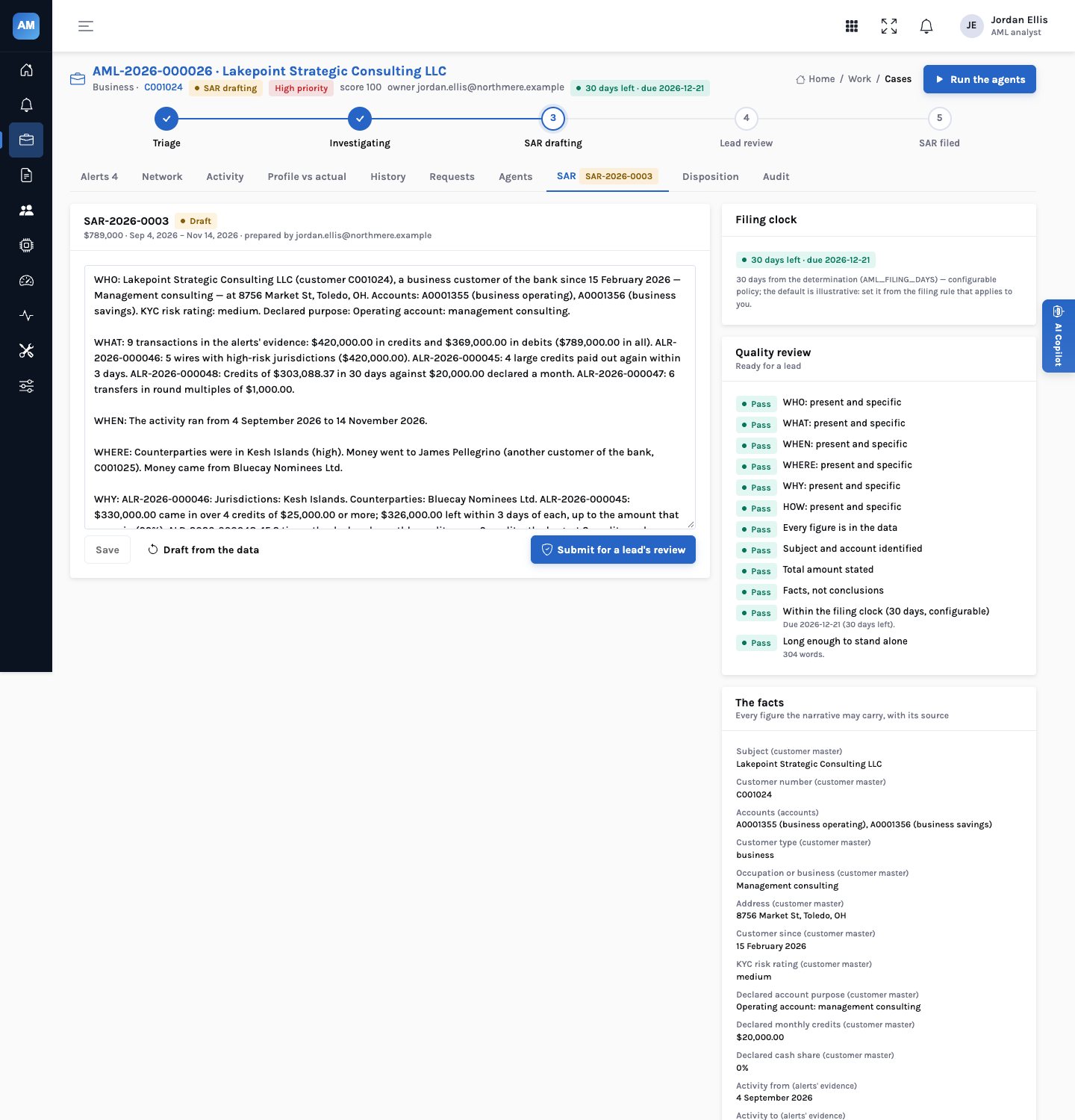
InsightAML writes the narrative in FinCEN’s six parts, only from the case’s facts, then checks it.
InsightAML’s draft is built from a list of facts, each with its source: the customer master, the accounts, the alerts’ evidence, the transactions, any answer to a request for information. The quality review then checks that each of the six parts is present and specific, that every figure in the text is one of the facts, that the customer number and an account are named, that the total is stated, that the wording describes rather than concludes, that the filing clock has not run out, and that the narrative is long enough to stand alone.
The clock, and when it starts
InsightAML starts a filing clock when an investigator escalates a case: by default 30 days from the
determination, set by AML_FILING_DAYS. That default is illustrative policy, and it is
worth being precise about the difference from the US rule. The regulation counts from initial
detection of facts that may be a basis for filing, which can be earlier than the moment the
investigator formally escalates. Banks set their own internal deadlines with that gap in mind; the
clock should be set from your procedure, not taken as the legal deadline.
The clock runs from the determination; on the case it shows days left and turns to due soon, then overdue.
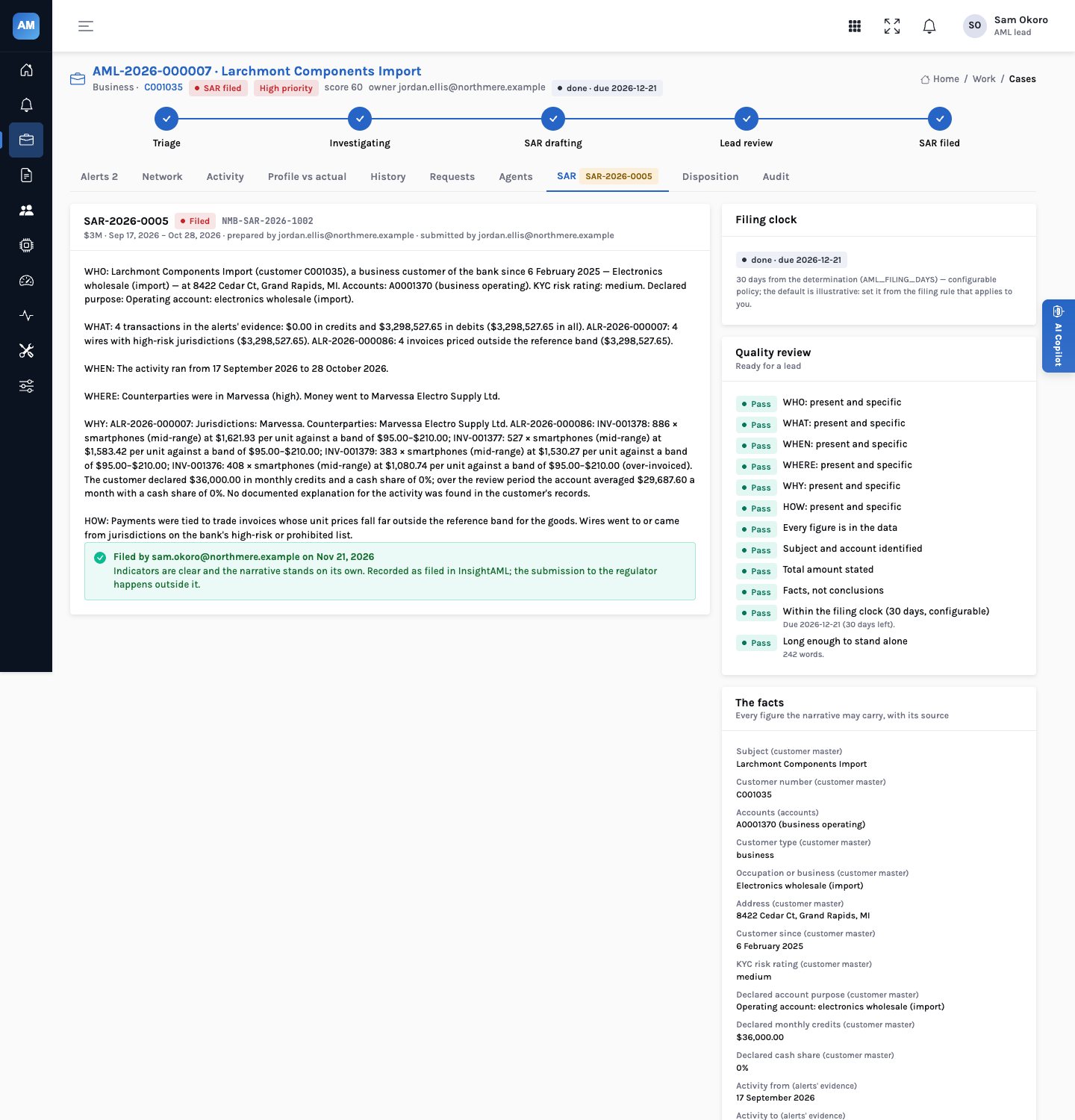
The filing controls in Rules Studio then apply. As shipped, they block filing if the narrative misses one of the six parts or carries a figure that isn’t in the facts, and warn on conclusory wording, a passed deadline or a request for information still open. A lead who neither prepared nor submitted the SAR files, returns or declines it, and the decision record keeps each control’s outcome.
What InsightAML does not do
It does not submit to FinCEN’s BSA E-Filing System, the NCA’s portal or any FIU. It prepares, checks and records. The submission, and the judgement that a report is required, stay with the people your procedure designates.
For the BSA officer & MLRO
Your exposure is a late or thin report, and a record that can’t show why a case was closed. The decision record shows who determined each case, on what reason, and which controls applied at the time.
Set the filing clock and the controls from your own procedure; the shipped values are illustrative.
For the investigations lead
The six-part structure and the facts list remove most of the rewriting. The quality review catches the figure that was mistyped and the missing WHERE before a lead does.
Requests for information that are still open show as a warning before filing.
For the board
The question for the board is whether reports go out on time and stand on their own. Both are visible: days left on every escalated case, and a quality review on every narrative.
The rules differ on timing and routing. They agree on what a report is for.
A suspicious activity report is information for someone who wasn’t in the room: who, what, when, where, why and how, with figures that hold up. Build the narrative from facts with sources and check it before a lead sees it, and the regime-specific parts, the clock and the routing, become configuration.