The person who reads a suspicious activity report at a financial intelligence unit or a law enforcement agency never sees the case file. They see the narrative. If it misstates an amount, leaves out where the money went, or concludes instead of describing, the work behind it is lost. InsightAML drafts the narrative in six parts from a list of facts, each with its source, and then checks that every figure in the text can be found in those facts.
In short
- Six parts, always. Who, what, when, where, why and how, each under its own heading, each long enough to say something specific.
- Facts first, prose second. The case’s facts (customer master, accounts, the alerts’ evidence, answers to requests, prior SARs) are listed with their sources before a word is written.
- Every figure traced. The quality review finds each number in the narrative and looks for it in the facts. A figure that isn’t there blocks filing.
- Describe, don’t conclude. Words like “laundered”, “criminal” or “definitely” are flagged. The narrative says what happened and why it is unusual.
What a narrative is for
data
FinCEN’s guidance on SAR narratives asks filers to describe the suspicious activity completely and concisely, organised around who is conducting it, what instruments or mechanisms were used, when and where it took place, why the filer thinks it is suspicious, and how it was carried out. FATF Recommendation 20 requires a report to the financial intelligence unit when an institution suspects, or has reasonable grounds to suspect, that funds are the proceeds of crime or related to terrorist financing.
Sources: FinCEN, Guidance on Preparing a Complete & Sufficient Suspicious Activity Report Narrative (November 2003); 31 CFR 1020.320 (reports by banks); FATF Recommendations, Recommendation 20.
The six questions are not a template for its own sake. Each one is something the reader will otherwise have to ask the bank later, if they ask at all.
Facts before prose
When a case is escalated, InsightAML opens the SAR draft and collects its facts. Each fact has a label, a value written the way the narrative will write it, and a source:
| Fact | Source |
|---|---|
| Subject, customer number, accounts, customer type, occupation or business, address, customer since, KYC rating, declared purpose | customer master and accounts |
| Declared monthly credits and declared cash share | customer master |
| Activity from and to, transactions in the evidence, credits, debits and total | the alerts’ evidence |
| Branches, who paid in, who was paid, counterparty jurisdictions with their risk level | transactions |
| Each alert’s title and detail | monitoring alert |
| Actual credits a month and actual cash share over the last 90 days | transactions |
| Answers from the relationship manager or the customer | request for information |
| Prior SARs, and the escalation with who determined it and when | prior SARs, the case |
Money is counted once: a transaction that appears in two alerts’ evidence is one transaction in the totals. A counterparty that is another of the bank’s customers is named with its customer number, so the chain is in the text.
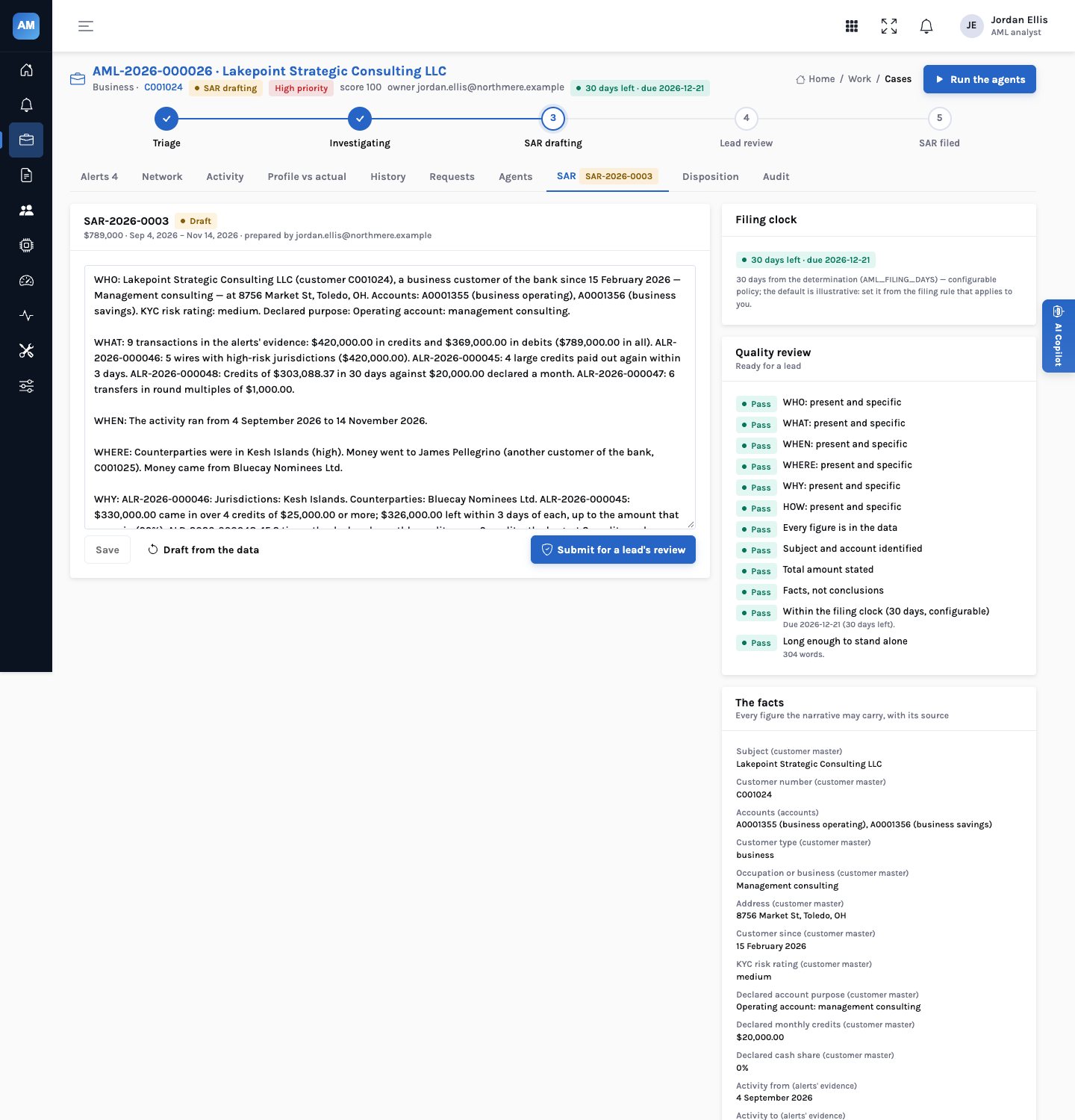
A real draft, from the demo
Lakepoint Strategic Consulting LLC (AML-2026-000026) at Northmere Bank (fictional) was escalated for layering. Its draft, SAR-2026-0003, ran to 304 words. Three of its six parts:
WHAT: 9 transactions in the alerts' evidence: $420,000.00 in credits and
$369,000.00 in debits ($789,000.00 in all). ...

WHERE: Counterparties were in Kesh Islands (high). Money went to James
Pellegrino (another customer of the bank, C001025). Money came from
Bluecay Nominees Ltd.

HOW: Funds passed through the account quickly: large credits were paid
out again within days, in round amounts, consistent with layering. ...
From SAR-2026-0003 as drafted in the demo. Every figure is one of the case’s facts.
The WHY part sets the declared profile against the actual: “The customer declared $20,000.00 in monthly credits and a cash share of 0%; over the review period the account averaged $159,485.91 a month”. Where nothing in the records explains the activity, the draft says so in those words. Where a relationship manager or the customer answered a request, the answer is quoted.
The quality review
The review runs every time the narrative is saved, and again when it is submitted and filed.
| Check | Outcome when it isn’t met |
|---|---|
| WHO, WHAT, WHEN, WHERE, WHY, HOW: each present and specific (six checks) | fail |
| Every figure is in the data | fail |
| Subject and account identified: the customer number and at least one account | fail |
| Total amount stated | warning |
| Facts, not conclusions | warning |
| Within the filing clock (30 days by default, configurable) | warning |
| Long enough to stand alone: 120 words or more | warning |
The checks are deterministic code, not a model’s opinion. The filing controls in Rules Studio then act on them: a missing element or an unsupported figure blocks filing; conclusory wording, an open request for information or a passed deadline is a warning the lead sees. The controls are illustrative and a bank can change them.
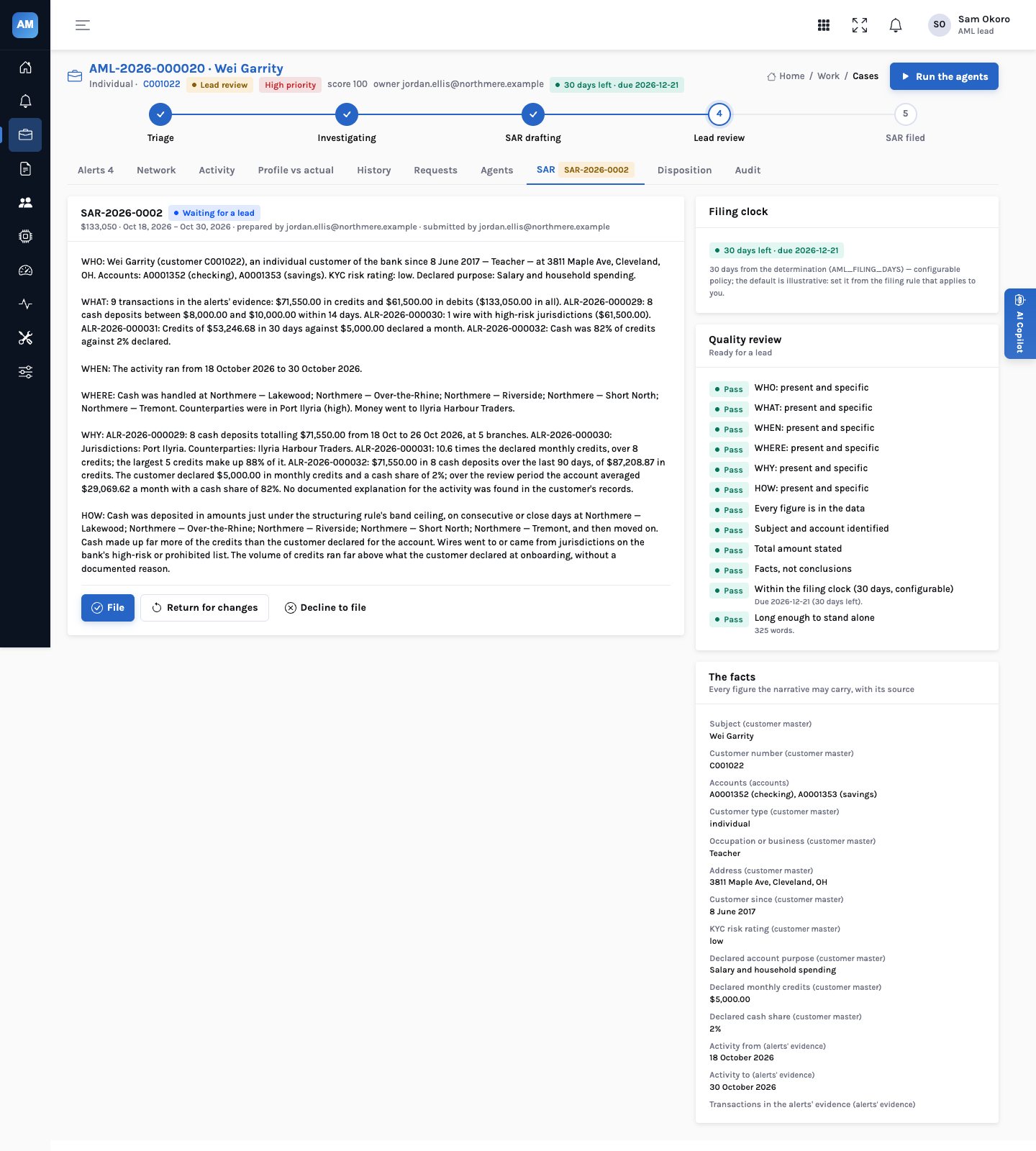
Where the agents fit
The narrative writer agent drafts the six parts on an escalated case. Its draft is a prepared decision: the investigator uses it, edits it or writes their own. With a language model switched on, the agents work over numbered facts and must cite them; an answer that carries a name or number not in the facts is thrown away. In the demo the model is switched off, so the draft is assembled by rules from the facts, and the screens say so. Either way, the quality reviewer agent runs the checks and prepares the submission. Submitting, and filing, stay with people.
The agents prepare the draft and the review. A person submits; a different person files.
The narrative is typed from notes after the investigation. Figures are copied by hand; a reviewer checks them by reopening the case.
The facts are listed with their sources first. The draft uses them, and the review proves every figure is one of them before a lead can file.
Two things InsightAML doesn’t do
It doesn’t decide that activity is suspicious, and it doesn’t submit anything to a regulator. A lead records the filing in InsightAML; the submission to FinCEN, the NCA or another FIU happens through the bank’s own channel.
A narrative is only as good as the figures in it.
List the facts with their sources, write the six parts from them, and check every number before anyone files. That is what InsightAML does on every escalated case.