Two moments in an AML case carry most of the risk. The first is closing a case that shouldn’t have been closed. The second is filing late, or filing a narrative that doesn’t stand up. Both are governed by the same three ideas: some decisions need a second, more senior person; the person who prepares a report shouldn’t be the one who files it; and the deadline starts on a known date and is visible to everyone. This post shows how InsightAML puts those three ideas on one decision record.
In short
- Some closures go to a lead. Disposition controls refer a closure to a lead when the case has a watchlist connection, wires with a prohibited jurisdiction, a customer with a prior SAR, or a flagged amount of $250,000 or more (illustrative).
- The filing clock starts at the determination. Escalating a case opens the SAR and sets a due date 30 days later by default (
AML_FILING_DAYS, a configurable policy). - Four eyes on every SAR. The investigator submits; a lead who neither prepared nor submitted it files, returns or declines. The system refuses anything else.
- The record keeps what was checked. Every control that fired and every one that didn’t, the note, and who signed, at the moment of each decision.
What the rules say about timing
data
In the US, a bank must file a SAR no later than 30 calendar days after the date of initial detection of facts that may constitute a basis for filing. If no suspect is identified on that date, filing may be delayed an additional 30 days to identify one, but no more than 60 days after initial detection. The SAR and its supporting documentation must be kept for five years. In the UK, a person in the regulated sector who knows or suspects money laundering must disclose it to the nominated officer, or the NCA, as soon as is practicable.
Sources: 31 CFR 1020.320(b)(3) and (d) (banks); Proceeds of Crime Act 2002, sections 330 and 331 (UK). EU institutions report to their national FIU under the EU anti-money-laundering rules, which require reports to be made promptly.
“Initial detection” is a bank’s interpretation to make and to document; it is not simply the day an alert was raised. InsightAML doesn’t pretend to make it for you. Its clock starts when a person determines to escalate, runs for a number of days you configure, and the screen says it is a configurable policy whose default is illustrative.
Closing: when a second person decides
An investigator closes a case with one of eight reasons (consistent with the declared profile, legitimate business documented, a declared seasonal pattern, payroll or own-account funding, a documented one-off transaction, explained by a request for information, insufficient indicators, or a duplicate) and a sentence that says why. Before the closure takes effect, the disposition controls in Rules Studio run on the case’s facts:
| Control (illustrative) | When it fires | Effect |
|---|---|---|
| Closing a case with a watchlist connection | proposed close and a watchlist-adjacent alert | refer to a lead |
| Closing a case with wires to a prohibited jurisdiction | proposed close and a prohibited-jurisdiction wire | refer to a lead |
| Closing a case on a customer with a prior SAR | proposed close and a prior SAR | refer to a lead |
| Closing a high-value case | proposed close and $250,000 or more flagged | refer to a lead |
| A request for information is still open | any open request | warning |
When a control refers it, the investigator’s closure waits on the case with its reason. A lead agrees and closes, or doesn’t agree and says why. At Northmere Bank (fictional), Malik Greaves (AML-2026-000032) is waiting on exactly that. The velocity alert was explained: the largest credit, $561,014.00, came from Keystone Title & Escrow, and the account purpose recorded at onboarding says the customer was selling the family home in 2026. The closure is probably right. It still goes to a lead, because the flagged amount is above the illustrative $250,000 threshold.
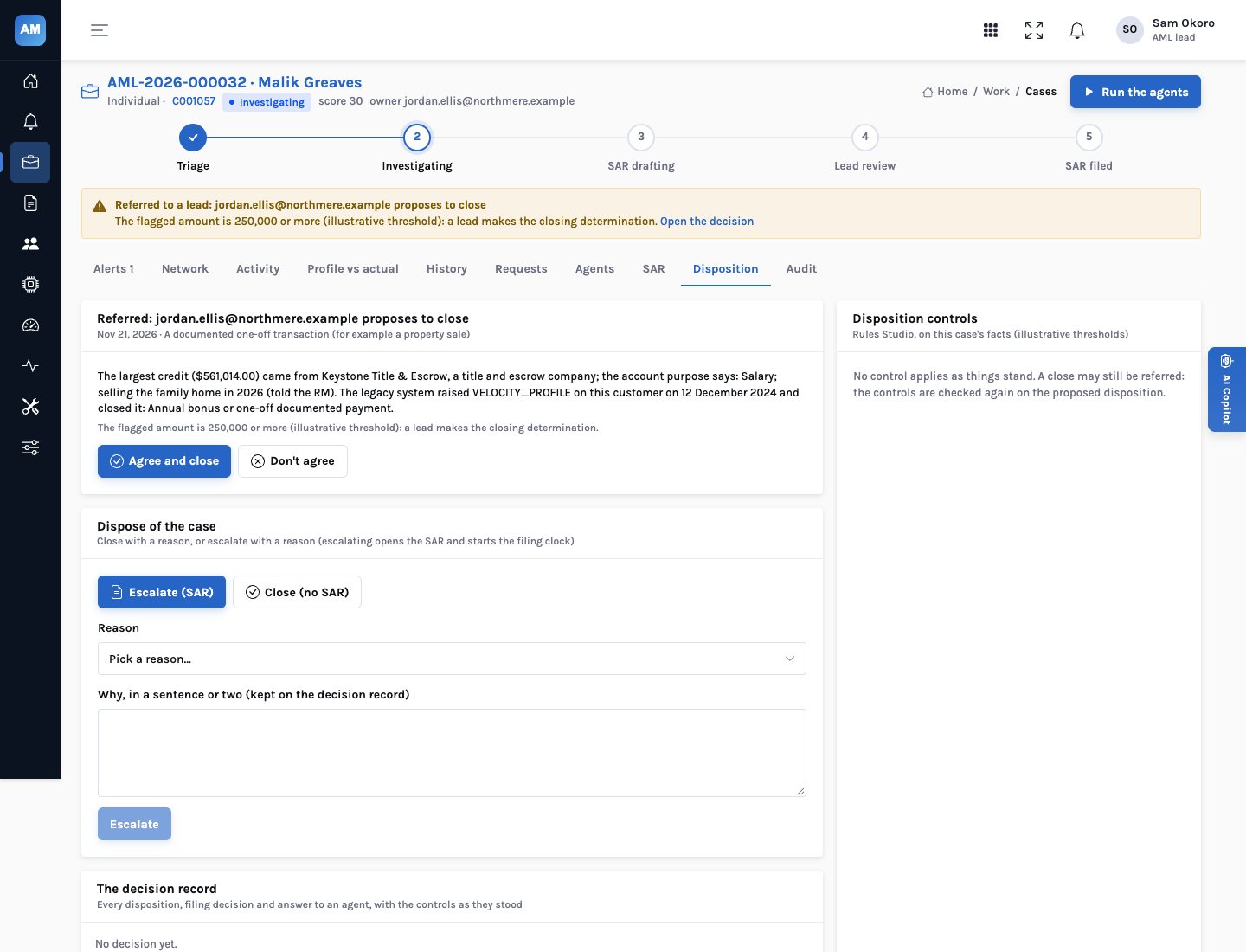
A refer control doesn’t stop a closure; it changes who makes it.
Escalating: the clock starts
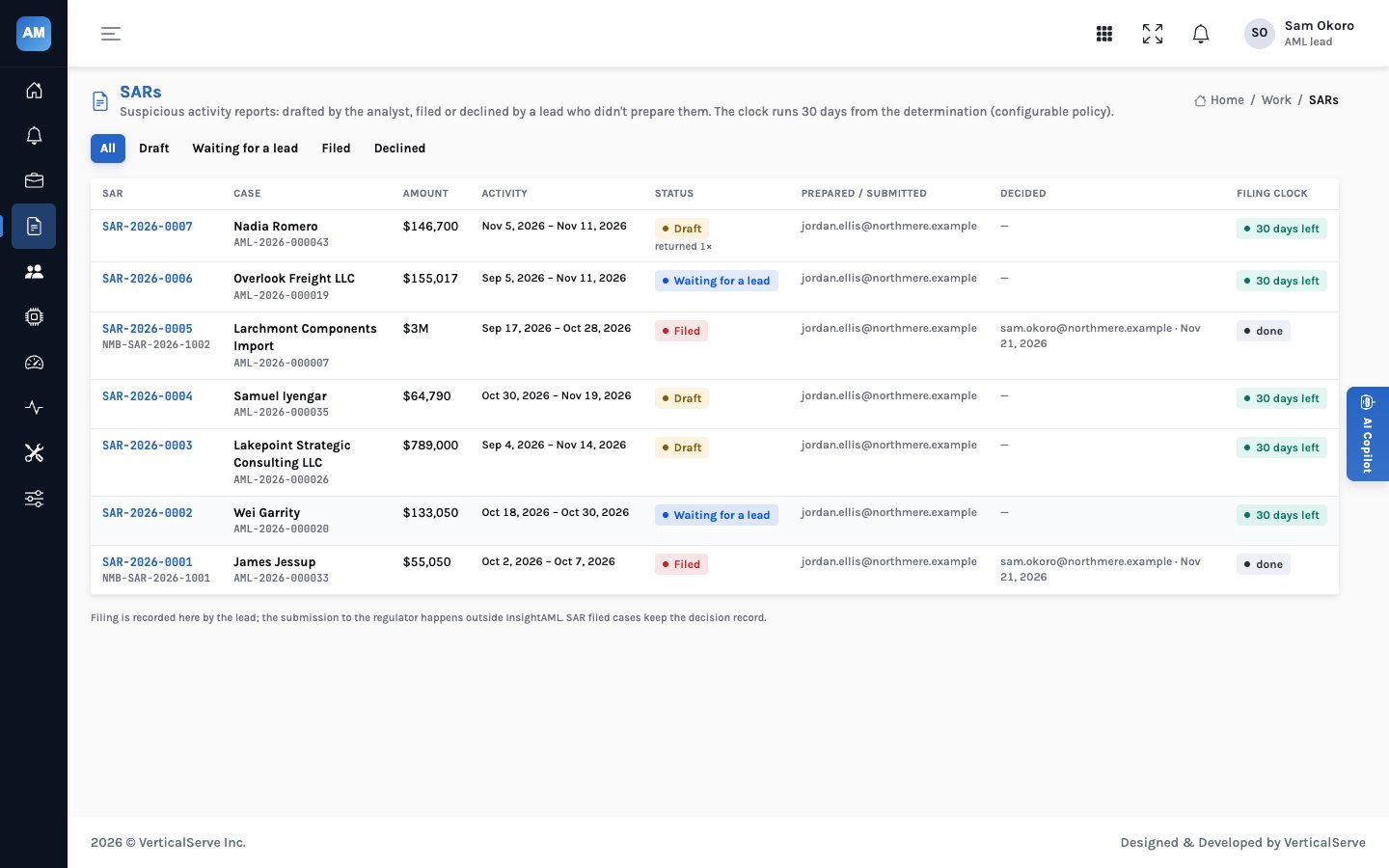
Escalating also needs a reason (structuring, layering, funnel or mule activity, trade-based indicators, a watchlist connection, unexplained high-risk geography, activity inconsistent with the profile, or cash inconsistent with the business) and a note. It moves the case to SAR drafting, opens the SAR with its facts, and sets the due date. The case header and the SAR list show the days left; at seven days or fewer the clock reads “due soon”, and after the due date “overdue”.
Filing: four eyes, enforced
Return and decline need a note; it goes back to the investigator and onto the record.
A lead is anyone with the identity role curator, or an administrator. When a lead files,
InsightAML checks three things: the SAR has been submitted, the lead is neither the person who
prepared it nor the person who submitted it, and no filing control blocks it (a missing narrative
element, or a figure not found in the facts). Agents are refused outright. Filing gives the SAR a
filing reference and records it as filed; the submission to the regulator happens outside InsightAML.
In the demo, Larchmont Components Import (AML-2026-000007) was escalated and submitted by jordan.ellis@northmere.example and filed by sam.okoro@northmere.example as NMB-SAR-2026-1002, with the note “Indicators are clear and the narrative stands on its own.” Nadia Romero’s SAR (AML-2026-000043) went the other way: the lead returned it with “Say in WHY that the customer’s RM had no explanation, and list the receiving counterparties in WHERE.” It is a draft again, the return is counted, and the clock keeps running.
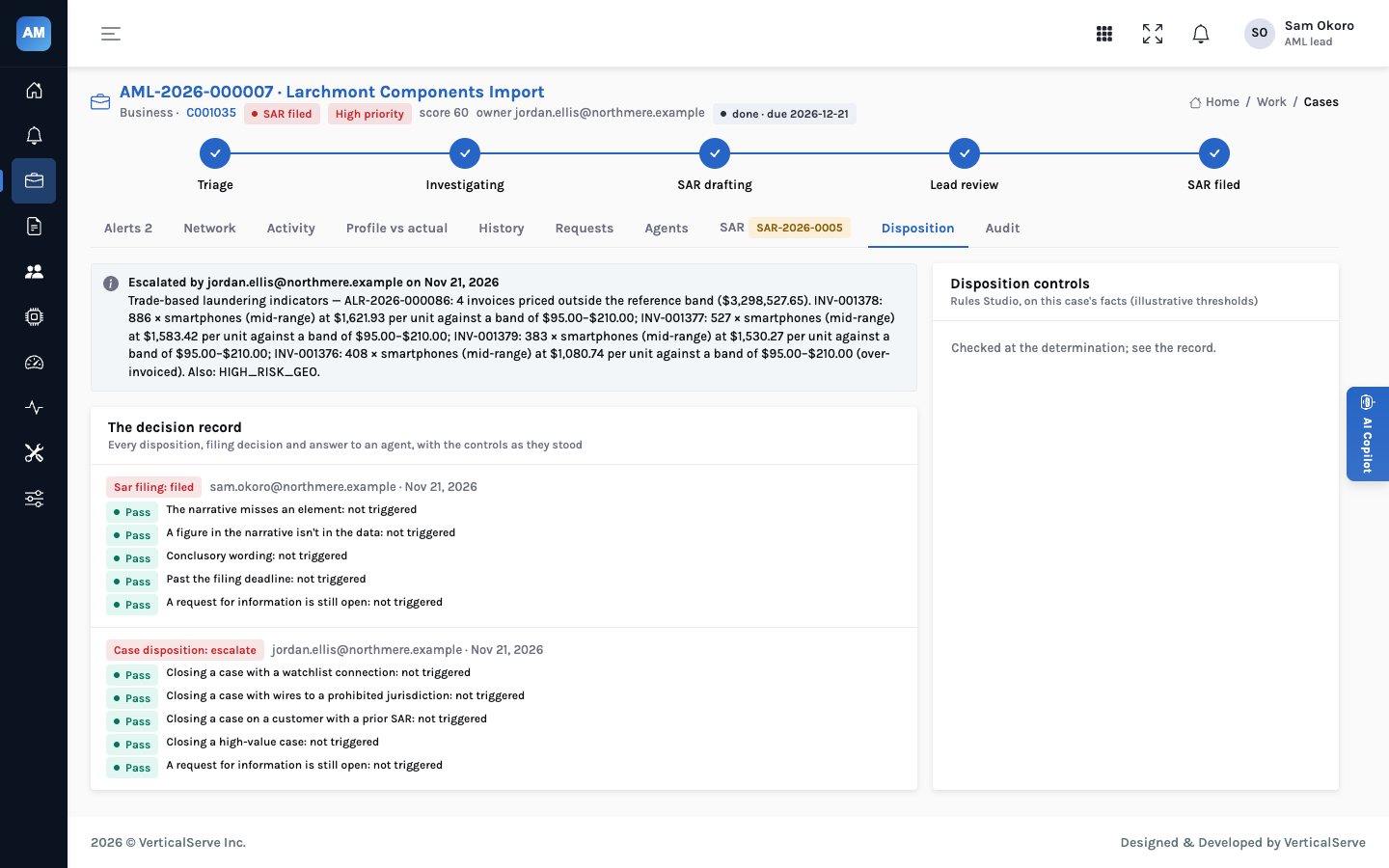
Disposition controls run; a refer control sends a closure to a lead.
Agree and close, or don’t agree with a reason for the investigator.
Six parts; the quality review runs on every save.
Days left on the case and the SAR list; due soon at seven days.
Filing controls checked; the SAR waits for a lead.
Four eyes enforced; the record keeps the controls, the note and the clock.
For the BSA officer & MLRO
Segregation of duties isn’t a procedure document; the system refuses a lead filing their own SAR.
The filing clock is your policy, visible on every case, and a late filing carries its reason on the record.
For the investigations lead
Leads see referrals and SARs waiting for them on their home page, with days left.
The referral rules are published in Rules Studio, so investigators can read which closures a lead will decide.
For the board
You can show who decided every closure that mattered and every filing, and that nobody approved their own work.
The second pair of eyes should be enforced, not remembered.
Referral rules for risky closures, a clock that starts at the determination, and a filing that only a different lead can make, all on one record.