Monitoring thinks in rules. Investigation thinks in customers. When four rules fire on the same account in the same quarter, a queue organised by alert hands four investigators four fragments of one story, or one investigator the same customer four times. InsightAML groups every alert into one case per customer and puts the three views an investigator always needs beside it: who the money moved with, what the account did over time, and how that compares with what the customer said at onboarding.
In short
- One open case per customer. A new alert joins the customer’s case if it is still in triage or under investigation; otherwise a new case opens.
- The network follows the money one hop further. When a counterparty is another of the bank’s own customers, their counterparties are drawn too, so a chain through the bank shows on one screen.
- Declared against actual. Credits, debits, cash share, transaction count and countries over the last 90 days, beside what the customer declared, with the gaps flagged.
- History in the same place. Prior SARs, the legacy system’s alerts and how each was closed, and earlier cases.
Why alert-by-alert work goes wrong
A customer who structures cash deposits and then wires the money to a high-risk jurisdiction trips at least two rules. Seen separately, the structuring alert looks like cash activity and the geography alert looks like one wire. Seen together, they describe placement and movement. The SAR that follows has to describe the whole pattern anyway, so splitting the work only adds the job of putting it back together.
Each alert is opened, researched and dispositioned on its own. The connection between them depends on someone noticing the same name twice.
The alerts land on the customer’s case, the triage score adds their points, and one investigator owns the customer, the evidence and the decision.
How grouping works
A case that has already been escalated or closed is not reopened by a new alert; a new case opens instead.
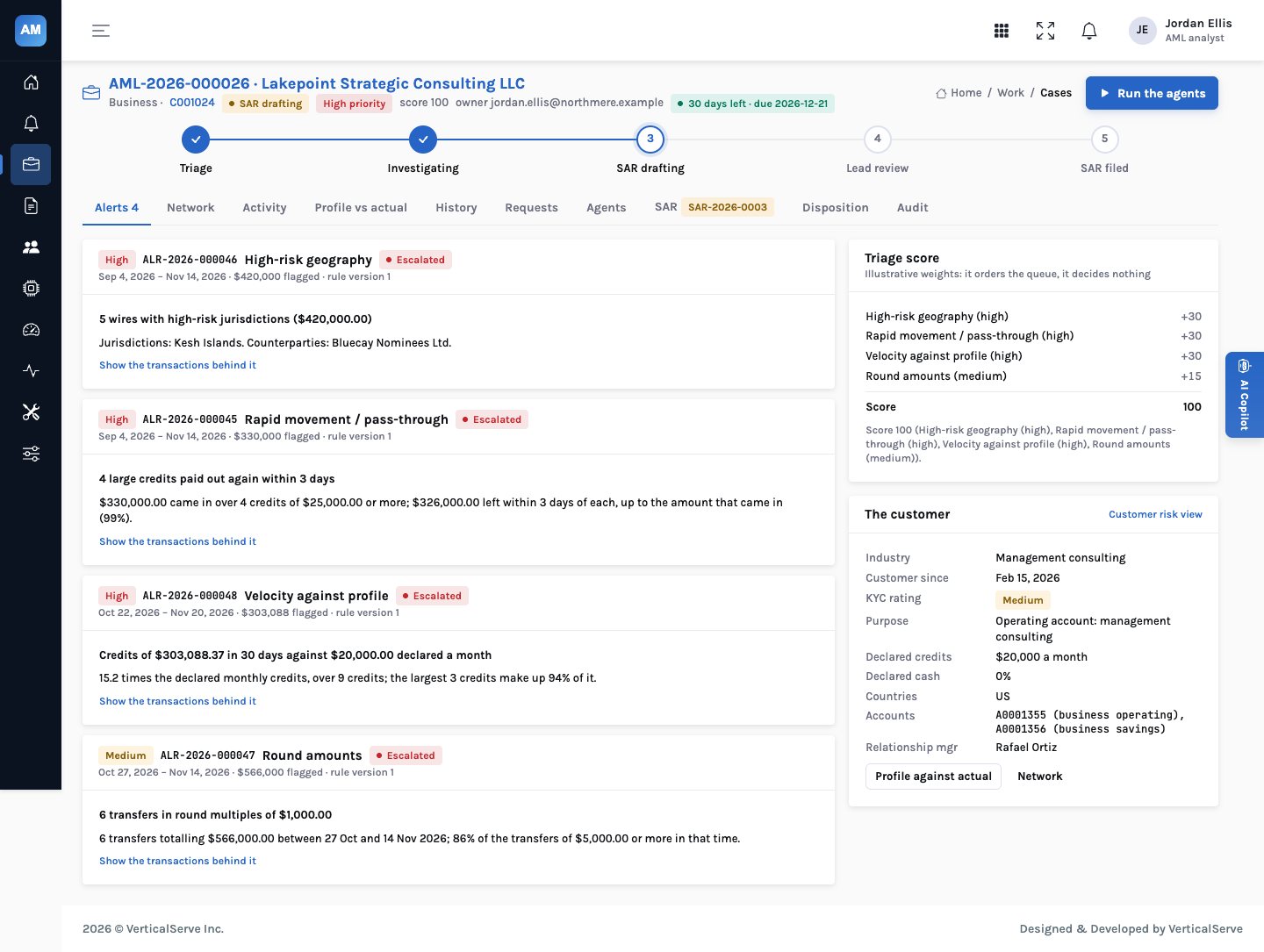
When the alert joins a case, the triage score is recalculated from all of the case’s alerts and the customer’s facts. At Northmere Bank (fictional), the first monitoring run raised 86 alerts and grouped them into 43 cases. Lakepoint Strategic Consulting LLC (AML-2026-000026) carries four of them: high-risk geography, rapid movement, velocity against profile and round amounts.
The counterparty network
The network tab draws every counterparty the customer dealt with over 180 days, sized by amount and coloured by what matters: a watchlist link or prohibited jurisdiction, a high-risk jurisdiction, another of the bank’s own customers, or neither. Counterparties that appear in the alerts’ evidence are marked.
For Lakepoint the tab reads: 21 counterparties over 180 days, $532,879.38 in and $522,176.80 out. Bluecay Nominees Ltd is flagged as a high-risk jurisdiction (Kesh Islands, a fictional jurisdiction in the demo’s data) and appears in five of the alerts’ transactions. James Pellegrino (C001025) is another customer of the bank: $413,000.00 went to him, and his own counterparties are drawn one hop further, including Westgate Meridian Trading LLC, also a customer of the bank.
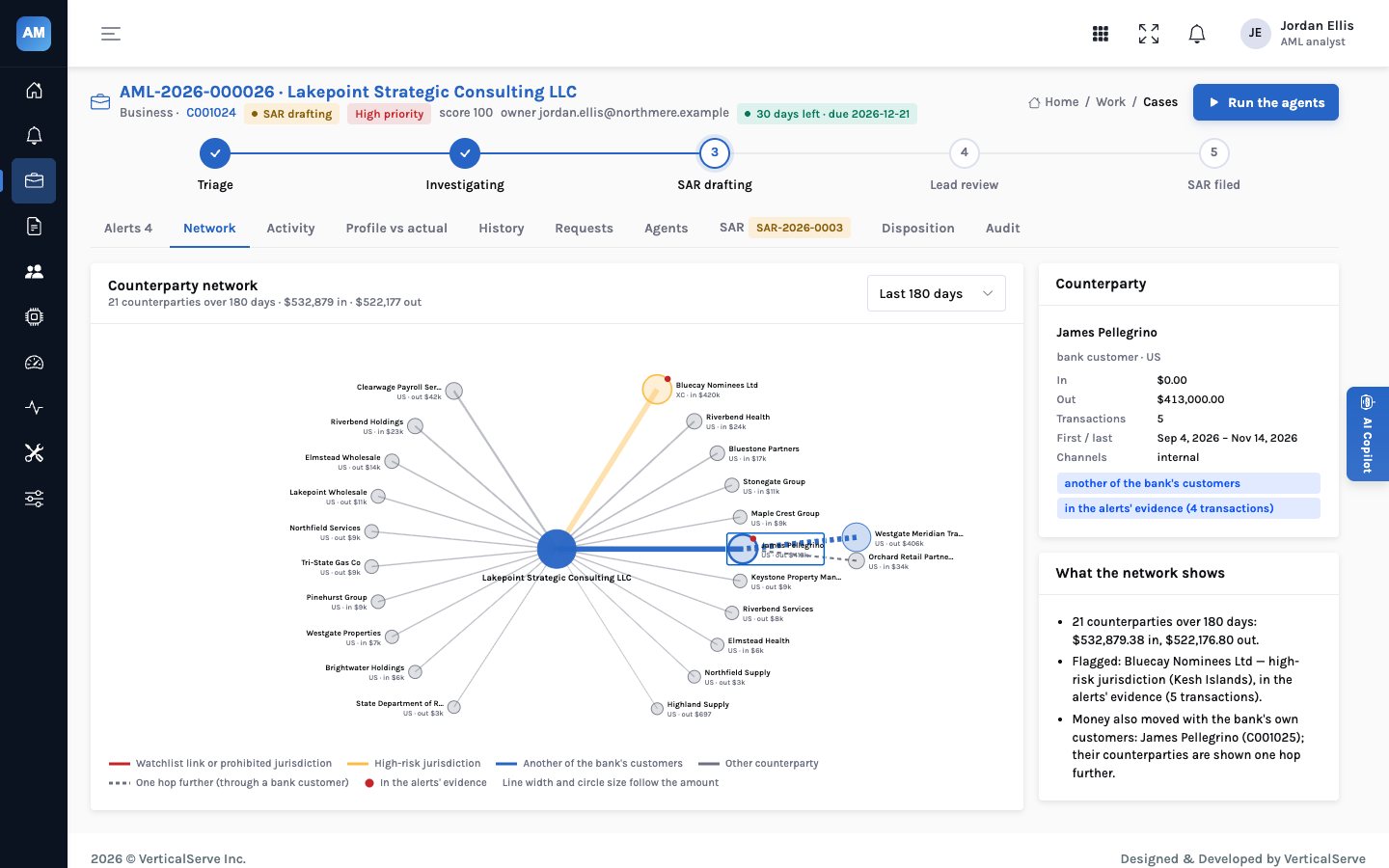
The chain the network tab shows for AML-2026-000026. Dashed lines are the second hop, through another customer.
A chain through the bank’s own customers is easy to miss when each customer is reviewed alone. It is also where layering tends to hide: money that never leaves the bank looks internal until someone draws it.
Declared profile against actual activity
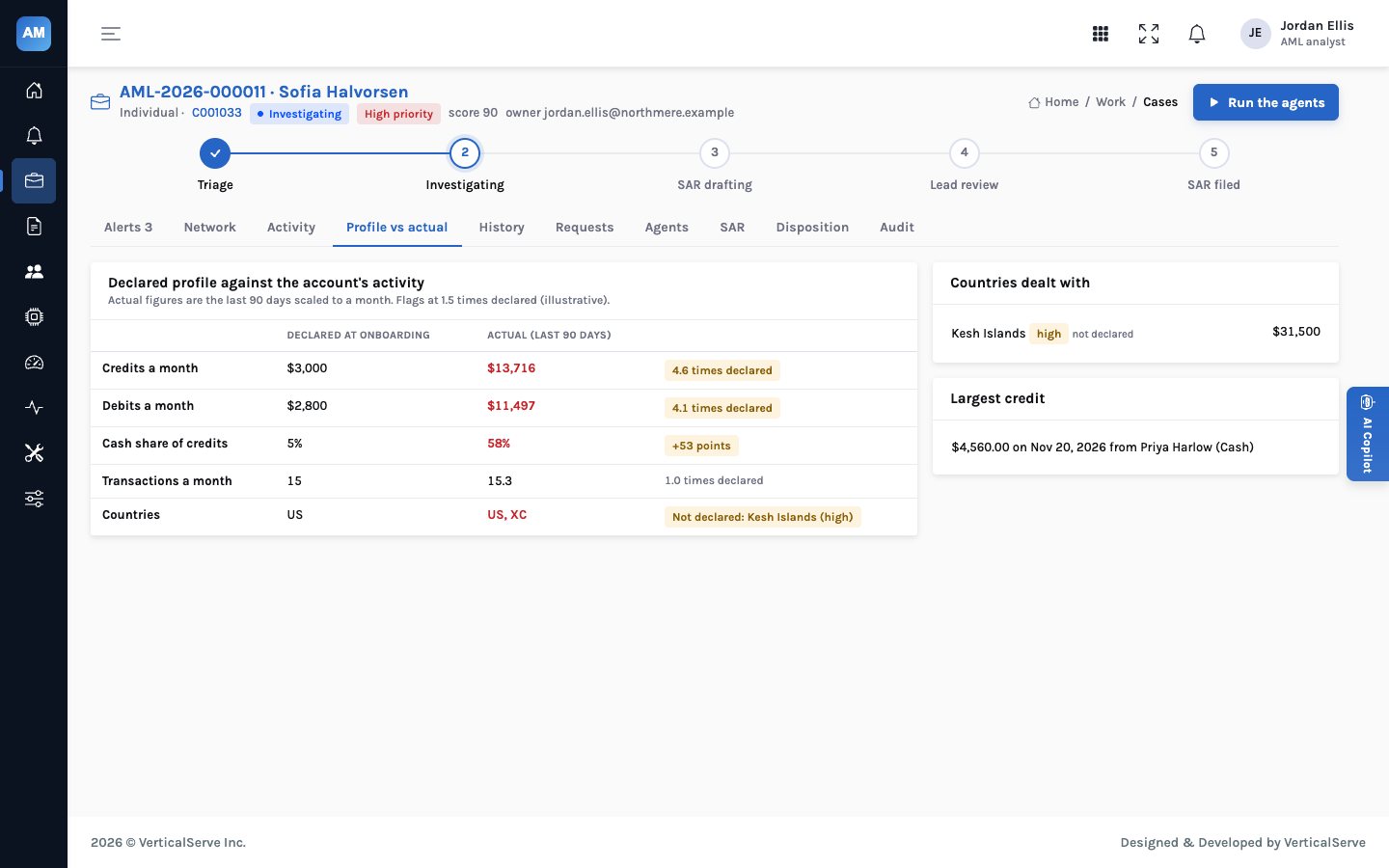
Every customer told the bank something at onboarding: what the account is for, the credits they expect each month, how much of it is cash, which countries they deal with. The profile tab sets the last 90 days against it and flags a figure above 1.5 times the declared value, or a cash share 20 points over (both illustrative). For Sofia Halvorsen (AML-2026-000011), a retail associate:
| Declared at onboarding | Actual (last 90 days, a month) | |
|---|---|---|
| Credits a month | $3,000 | $13,716 (4.6 times) |
| Debits a month | $2,800 | $11,497 (4.1 times) |
| Cash share of credits | 5% | 58% (+53 points) |
| Countries | US | US and Kesh Islands (high risk, not declared) |
The timeline and the history
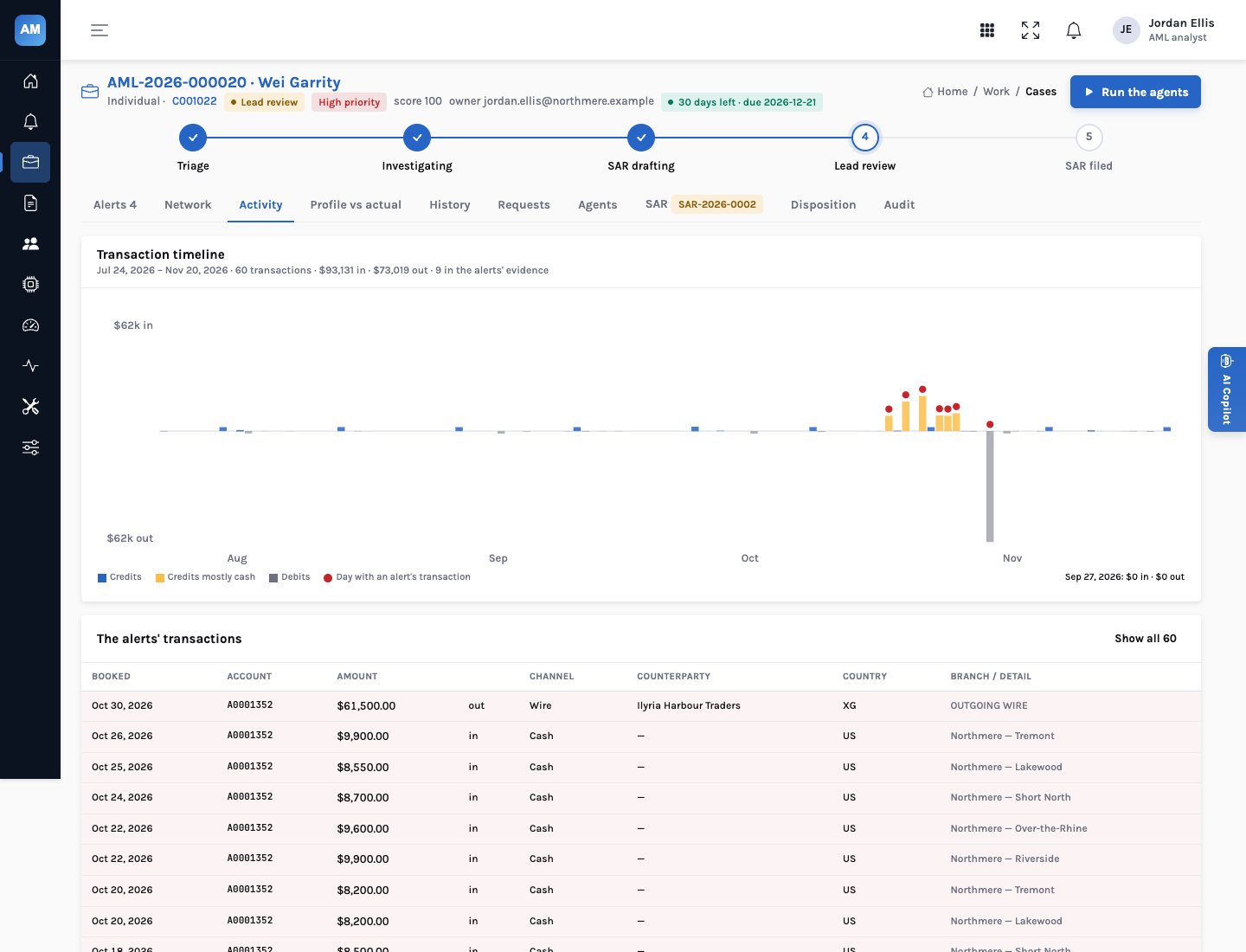
The activity tab charts daily credits and debits over 120 days with the alerts’ transactions marked, so a burst stands out against the account’s normal rhythm. The history tab lists prior SARs, the legacy system’s alerts with how each was closed, and earlier cases. For Malik Greaves (AML-2026-000032), it shows two legacy alerts, both closed without a SAR: round amounts in February 2025 (transfers between own accounts) and velocity against profile in December 2024 (an annual bonus or one-off documented payment). Context like that is what the triage agent reads when it looks for an innocent explanation.
What each rule counted, and whether the alerts describe one pattern.
Flagged counterparties, and any chain through the bank’s own customers.
Where the account departs from what the customer said, and by how much.
Prior SARs, legacy alerts and how they closed, earlier cases.
One disposition for the customer’s case, checked by the disposition controls.
The demo’s data is invented
Northmere Bank, its customers, counterparties, the Kesh Islands and every transaction are generated. The fictional jurisdictions use ISO user-assigned codes so that no real country carries a rating.
Investigate the customer, not the alert.
One case per customer, the network one hop further, the profile beside the activity and the history in the same place: the investigation starts with the whole picture instead of assembling it.