Most monitoring alerts end in a closure. That is not a failure of the rules: a rule tuned to catch will also catch the tree farm in December and the house sale. The work is in closing well, with the explanation found in the data, written down in a sentence someone else can check, and sent to a second person when the stakes say so. Here are four alerts from the demo bank that the data explains, and a fifth that looks like the same kind of closure and isn’t.
In short
- The explanation is usually already on file. A seasonal peak declared at onboarding, transfers between the customer’s own accounts, a title company paying the proceeds of a home sale the customer told the RM about.
- The triage agent looks for it first. On each of these cases it listed “possible explanations in the data”, each quoted from the profile, the transactions or the legacy alert history.
- A close needs a reason code and a sentence. Eight close reasons, from “Seasonal pattern the customer declared” to “Payroll or own-account funding”, and a note that goes on the decision record.
- Some closures aren’t the analyst’s to make. A flagged amount of $250,000 or more (an illustrative threshold) or a wire to a prohibited jurisdiction refers the closure to a lead.
The five cases
Northmere Bank is fictional and its transactions are generated; the planted scenarios include deliberate false positives (payroll, seasonal businesses, a property sale, cash businesses) so the closing side of the work can be shown honestly. The legacy alert history the triage agent quotes is fictional too.
| Case | Alert | Explanation in the data | Where it stands |
|---|---|---|---|
| AML-2026-000002 Evergreen Hollow Tree Farm | Velocity against profile: credits of $96,173.57 in 30 days against $24,000.00 declared (4.0 times) | Seasonal business; most revenue in months 11–12, declared at onboarding | Closed, no SAR: seasonal pattern |
| AML-2026-000006 Ridgeback Ski & Snowboard Rentals | Velocity against profile: $139,268.78 in 30 days against $24,000.00 (5.8 times) | Seasonal business; most revenue in months 11–3, declared at onboarding | Investigating; close proposed by the supervisor agent |
| AML-2026-000039 Ironwood CPA Partners | Round amounts: 6 transfers totalling $232,000.00 between 31 Aug and 16 Sep 2026 | 6 of the 6 round transfers are between the customer’s own accounts or to its payroll processor | Closed, no SAR: payroll or own-account funding |
| AML-2026-000032 Malik Greaves | Velocity against profile: $573,830.78 in 30 days against $9,700.00 (59.2 times) | $561,014.00 from Keystone Title & Escrow; account purpose says he is selling the family home in 2026 | Closure referred to a lead (high value) |
| AML-2026-000003 Copperline Components Import | High-risk geography: 2 wires with a prohibited jurisdiction ($25,602.35) | None found: the supervisor agent proposed escalation | Closure referred to a lead (prohibited jurisdiction) |
A seasonal peak, declared years ago
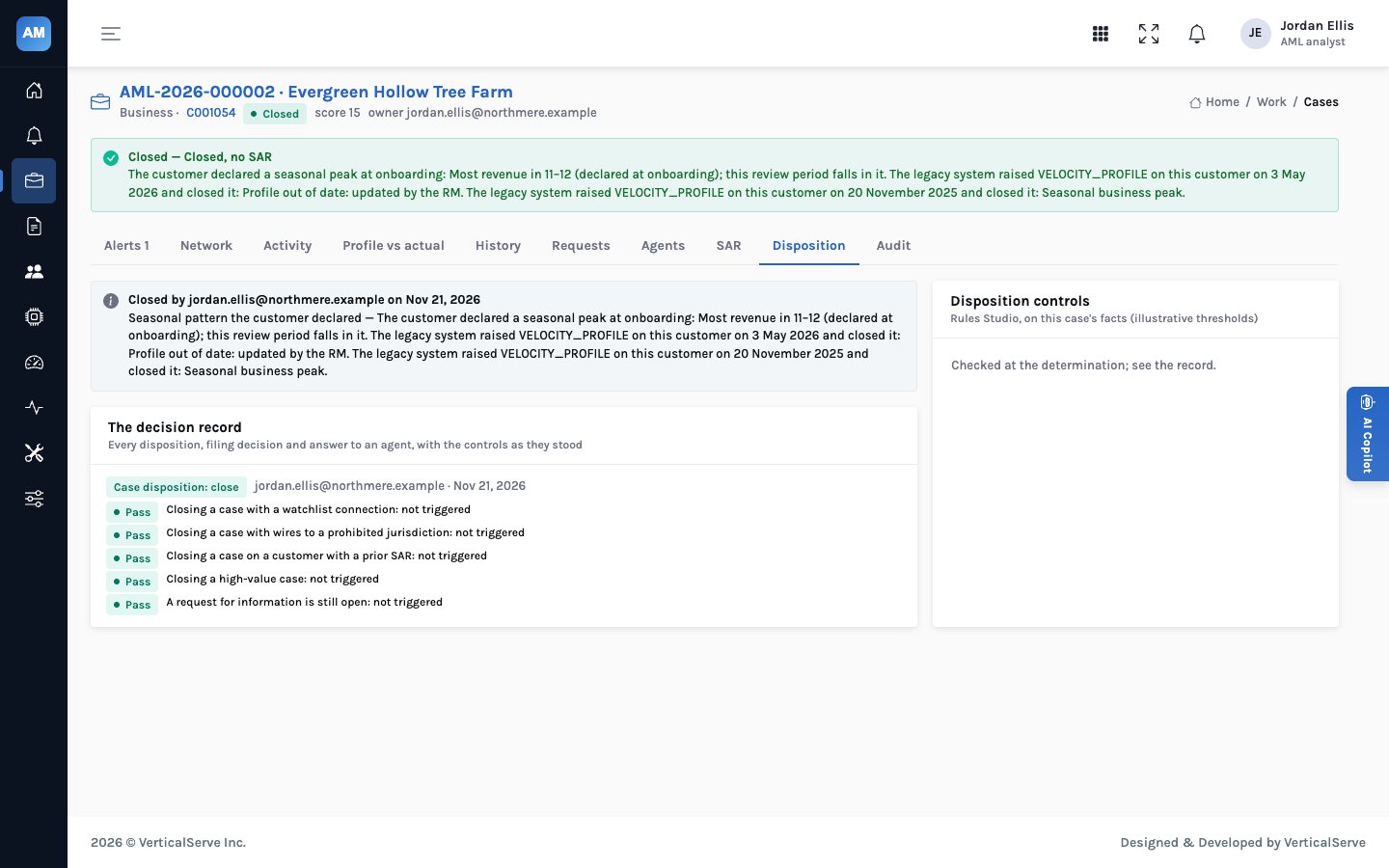
Evergreen Hollow Tree Farm has banked with Northmere since 2016. Its account purpose reads “Seasonal business: most revenue in the peak months”. In November its credits ran at four times the declared monthly figure, which is exactly what the velocity rule (an illustrative 3 times, over $25,000, in 30 days) is built to catch. The triage agent scored the case 15 (one medium alert) and listed three possible explanations: the declared peak in months 11–12, and two legacy alerts on the same rule, closed as “Profile out of date: updated by the RM” (3 May 2026) and “Seasonal business peak” (20 November 2025). The network agent found 21 counterparties and none high-risk or connected.
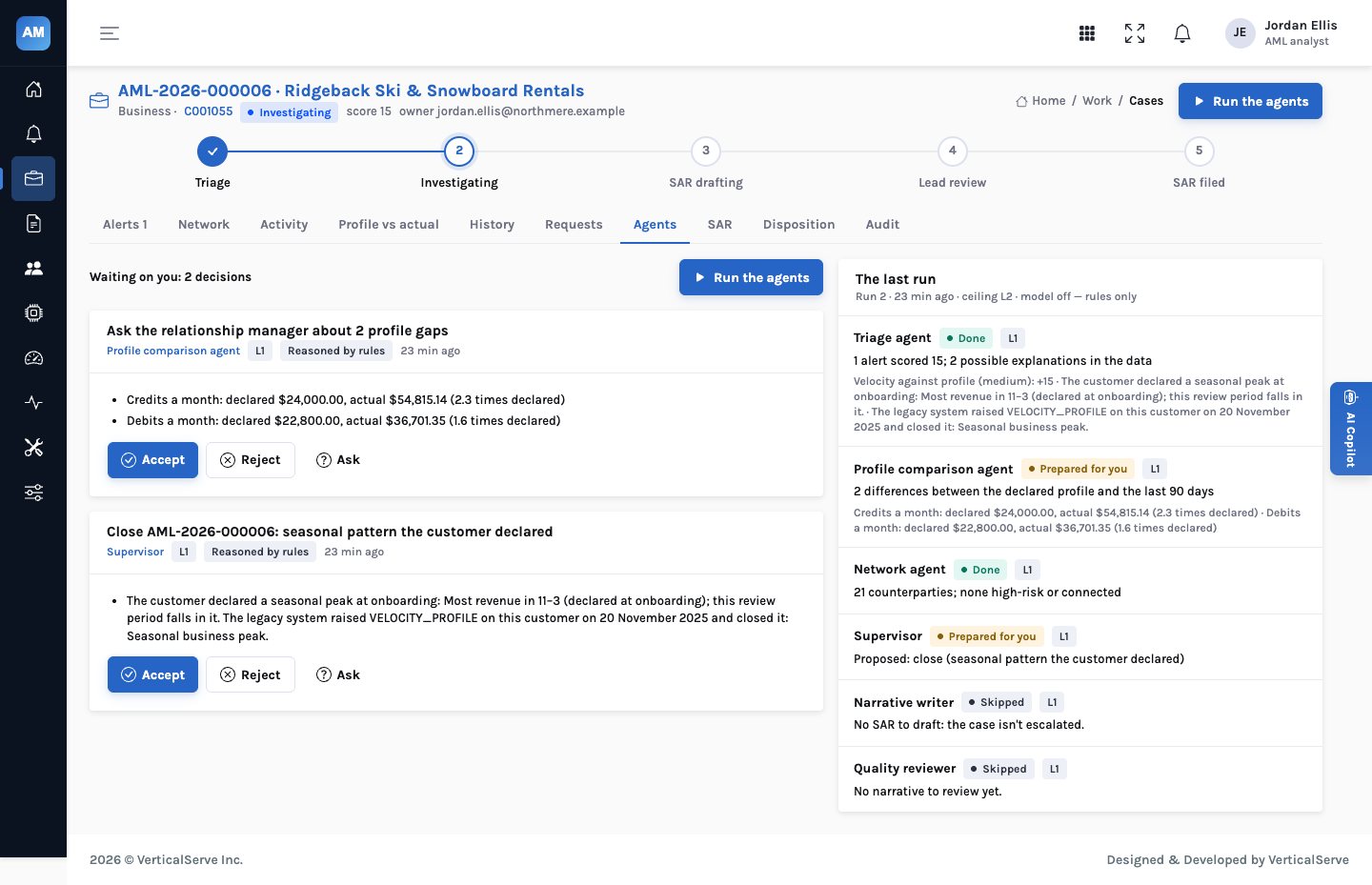
The supervisor agent proposed a close with the reason “Seasonal pattern the customer declared”. The analyst accepted it. Ridgeback Ski & Snowboard Rentals is the same picture one step earlier: a declared peak in months 11–3, a legacy alert closed as a seasonal peak, and the close proposal waiting on the analyst.
Why the agent still offers a question to the RM
Even when a seasonal peak explains the timing, the profile agent prepares a question about the size: Ridgeback’s credits ran at 2.3 times the declared monthly figure over 90 days. The analyst can close on the declared peak, or ask first. The tolerance that flags a gap (1.5 times declared) is illustrative.
Round transfers that are payroll
Ironwood CPA Partners declared that payroll is “funded by round transfers to the payroll account”. The round-amount rule (illustratively: five or more transfers of $5,000 or more in exact multiples of $1,000 within 30 days, at least 30% of the large transfers) found six. The evidence shows what they were: $40,000.00 moved between the customer’s own accounts on 31 August and 14 September, and $36,000.00 to Clearwage Payroll Services two days after each. The triage agent said so in a line, and added that the legacy system had raised the same rule on 9 September 2025 and closed it as “Payroll funding”. Score: 6. The case was closed with the reason “Payroll or own-account funding”.
The agent proposes; the controls decide who may accept the proposal.
A house sale, and why it still goes to a lead
Malik Greaves is a civil engineer whose account purpose reads: “Salary; selling the family home in 2026 (told the RM)”. In November a single credit of $561,014.00 arrived from Keystone Title & Escrow. The velocity rule saw $573,830.78 in 30 days against $9,700.00 declared a month. The triage agent found two explanations: the title company and the declared sale, and a legacy alert on the same rule from 12 December 2024, closed as “Annual bonus or one-off documented payment”. The network agent: 17 counterparties, none high-risk or connected.
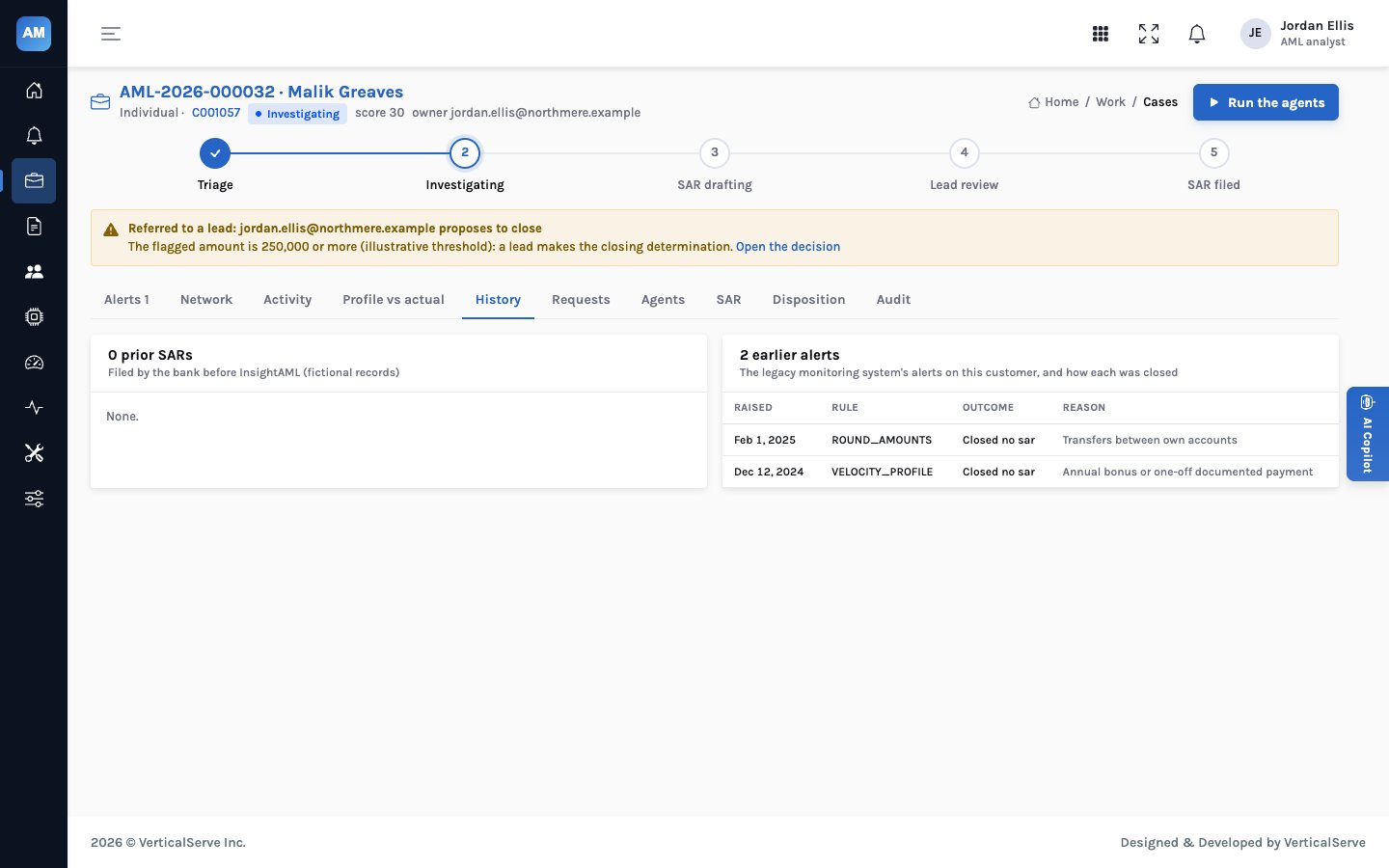
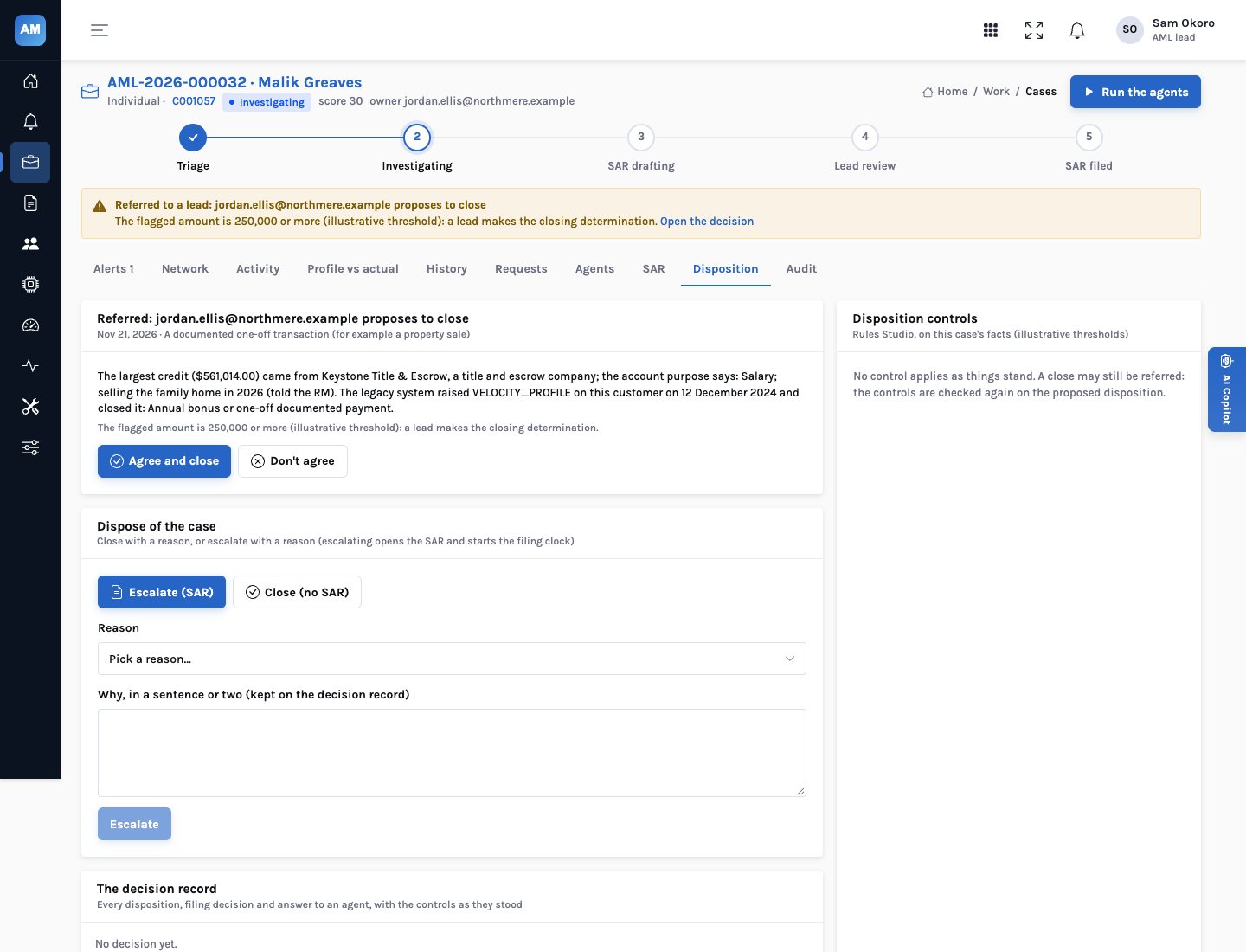
The analyst accepted the proposed close: “A documented one-off transaction (for example a property
sale)”. It did not close. The disposition control CLOSE_HIGH_VALUE refers any
closure where the flagged amount is 250,000 or more to a lead. That number is an illustrative threshold in
Rules Studio, not advice; a bank sets its own. The proposal, the analyst’s note and the reason for
the referral now sit with the lead, who can agree and close, or not agree with a note back to the
analyst. A lead can’t answer a referral they proposed themselves.
The referral path. The threshold is an illustrative Rules Studio setting.
The one that isn’t a false positive
Copperline Components Import, an electronics importer rated high risk in KYC, sent two wires to Tarkand Industrial Import Co: $9,203.37 on 13 November and $16,398.98 on 17 November 2026. Tarkand is on the bank’s fictional list as a prohibited jurisdiction. The triage score was 65: 30 for the high-severity alert, 25 for wires with a prohibited jurisdiction, 10 for the KYC rating. The triage agent found nothing that explains it, and the supervisor agent proposed escalation.
The analyst proposed a close instead, with the reason “Legitimate business activity, documented”
and the note “The customer says these are supplier payments for electronics; invoices
requested.” The control CLOSE_PROHIBITED_GEO referred it to a lead. This is what the
controls are for: not to overrule the analyst, but to make sure a closure against the agent’s
proposal, on a prohibited jurisdiction, is a second person’s decision, and that the invoices the note
mentions are seen before anyone signs.
A one-line note on the alert. The next reviewer can’t tell what was checked, and a high-value or prohibited-jurisdiction closure looks like any other.
The note quotes the declared peak or the title company. The decision record lists every control that was checked. High-value and prohibited-jurisdiction closures wait for a lead.
Each is quoted from the profile, the transactions or the legacy history. None is invented.
A declared peak explains when; the profile comparison says by how much.
The note names the fact that explains the activity.
Watchlist connection, prohibited jurisdiction, prior SAR or high value: a lead decides.
On referral, a lead other than the proposer closes or declines with a note.
Closing is half the job. Do it with the evidence, and with the right signature.
Every closure here quotes the fact that explains it. The two that touch high value or a prohibited jurisdiction wait for a lead, as the bank’s own controls say they should.