A retail associate in Cleveland declared about $3,000 a month in salary. Between 27 October and 20 November, twelve different people paid into her account, in cash at branches in three states and by person-to-person transfer. Every four days, $6,300 left by wire for a digital asset exchange in a high-risk jurisdiction. This is what a funnel account looks like in the data, and how an investigator asks the one person at the bank who knows the customer.
In short
- A funnel is many in, one out. The rule counts distinct people paying in over 30 days and how much of it was wired out soon after: 12 people, $35,700.00 in, $31,500.00 out, 88%.
- The relationship manager was asked, not the customer. The network agent prepared a question about the exchange; the analyst sent it to the RM, whose answer is now one of the case’s facts.
- The answer didn’t explain it. The RM had been told friends were paying back shared rent, thought the amounts too large, and had seen no tenancy documents.
- The same pattern, on another customer, is already escalated. Samuel Iyengar’s account sent $30,450.00 to the same exchange; his SAR draft passes its quality checks.
The situation
The case uses InsightAML’s demo data for Northmere Bank, a fictional bank; every person and transaction in it is generated. The Kesh Islands are an invented jurisdiction on the bank’s fictional high-risk list (ISO user-assigned code XC), and Crestline Digital Asset Exchange is an invented counterparty.
Sofia Halvorsen (customer C001033) opened a checking account (A0001367) and a savings account (A0001368) on 25 July 2025. She declared her occupation as retail associate, the purpose as salary and household spending, $3,000 a month in credits and a 5% cash share. Her KYC rating is medium. Three rules fired:
| Alert | Rule | What it computed |
|---|---|---|
| ALR-2026-000013 | Funnel account (high) | 12 different people paid in $35,700.00 between 27 Oct and 20 Nov 2026 (cash at branches in IN, OH, PA); $31,500.00, 88%, left by wire to Crestline Digital Asset Exchange |
| ALR-2026-000012 | Velocity against profile (high) | Credits of $38,026.84 in 30 days against $3,000.00 declared a month: 12.7 times, over 15 credits |
| ALR-2026-000011 | High-risk geography (high) | 5 wires with the Kesh Islands, $31,500.00, all to Crestline Digital Asset Exchange |
The funnel alert’s evidence lists every payment in and every wire out. The pattern out is regular: $6,300.00 on 31 October, 4 November, 8 November, 12 November and 16 November. The payments in range from $1,000.00 to $4,560.00 and come from twelve different names.
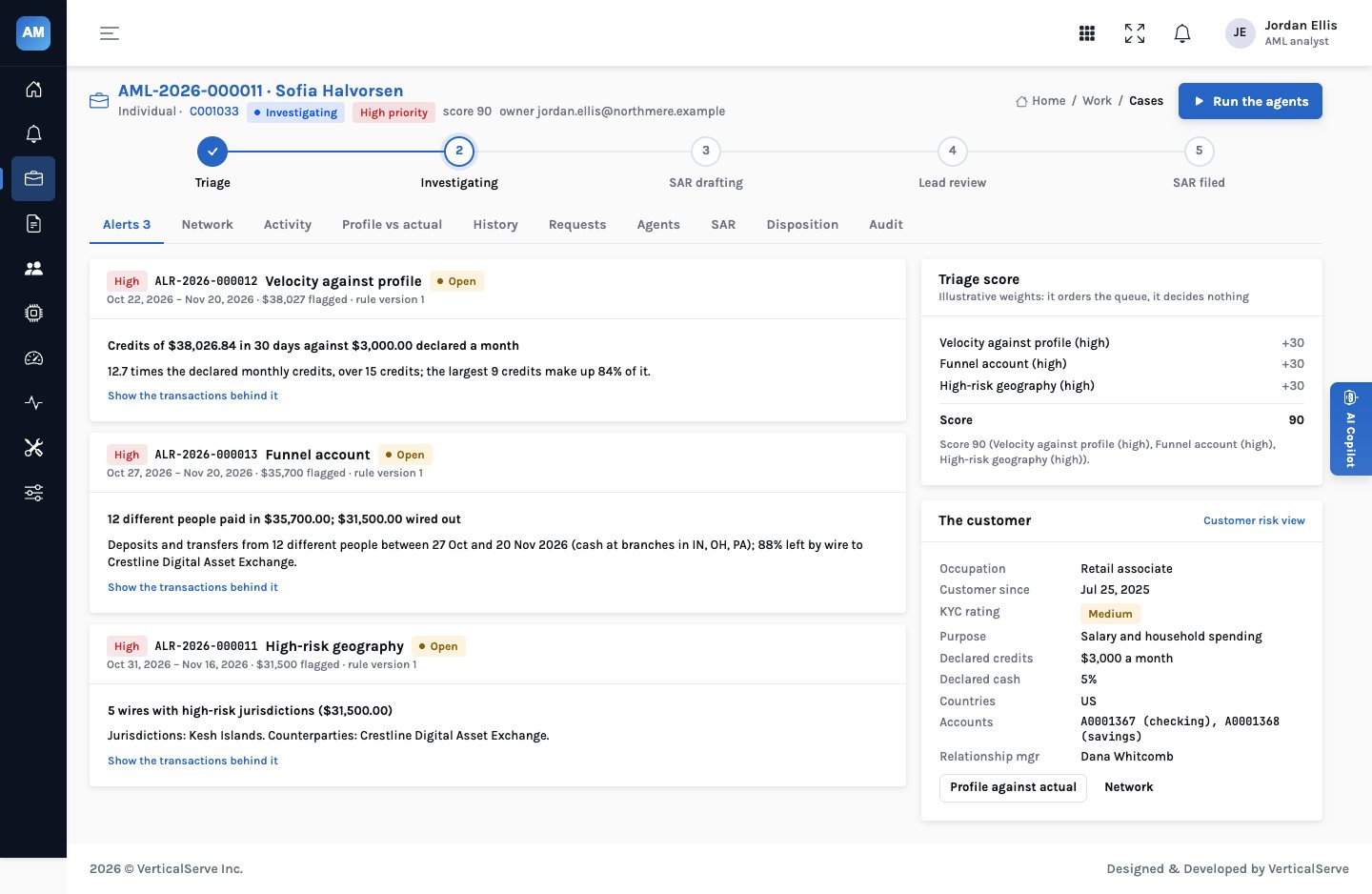
Twelve sources in, one destination out: $35,700.00 in, $31,500.00 out between 27 October and 20 November 2026.
Profile against actual
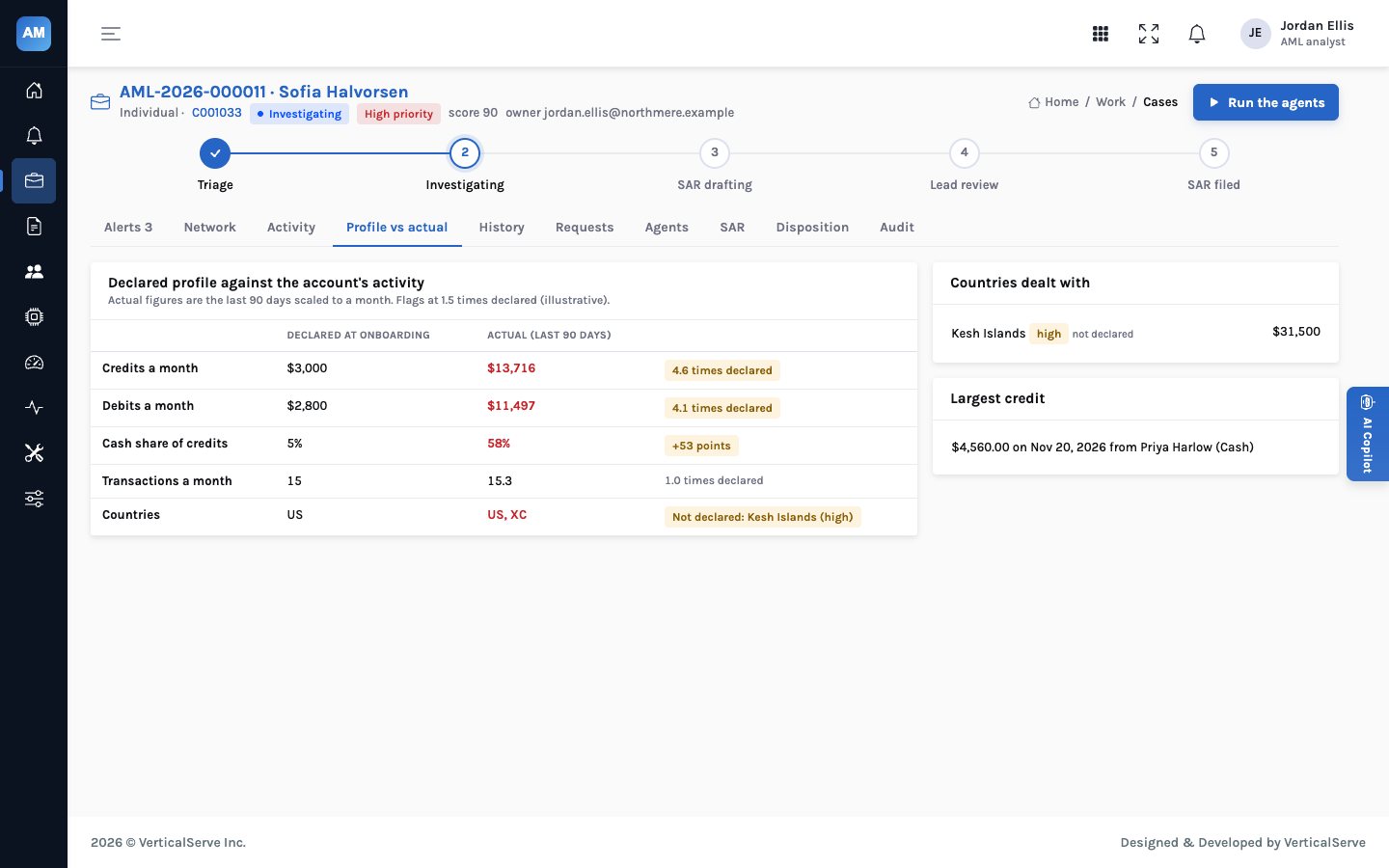
The profile tab puts the declaration beside the last 90 days, scaled to a month, and flags anything more than 1.5 times what was declared, or a cash share 20 points over it. Both tolerances are illustrative.
| Declared at onboarding | Actual, last 90 days | |
|---|---|---|
| Credits a month | $3,000 | $13,716 (4.6 times) |
| Debits a month | $2,800 | $11,497 (4.1 times) |
| Cash share of credits | 5% | 58% (+53 points) |
| Transactions a month | 15 | 15.3 |
| Countries | US | US and the Kesh Islands, not declared |
Asking the relationship manager
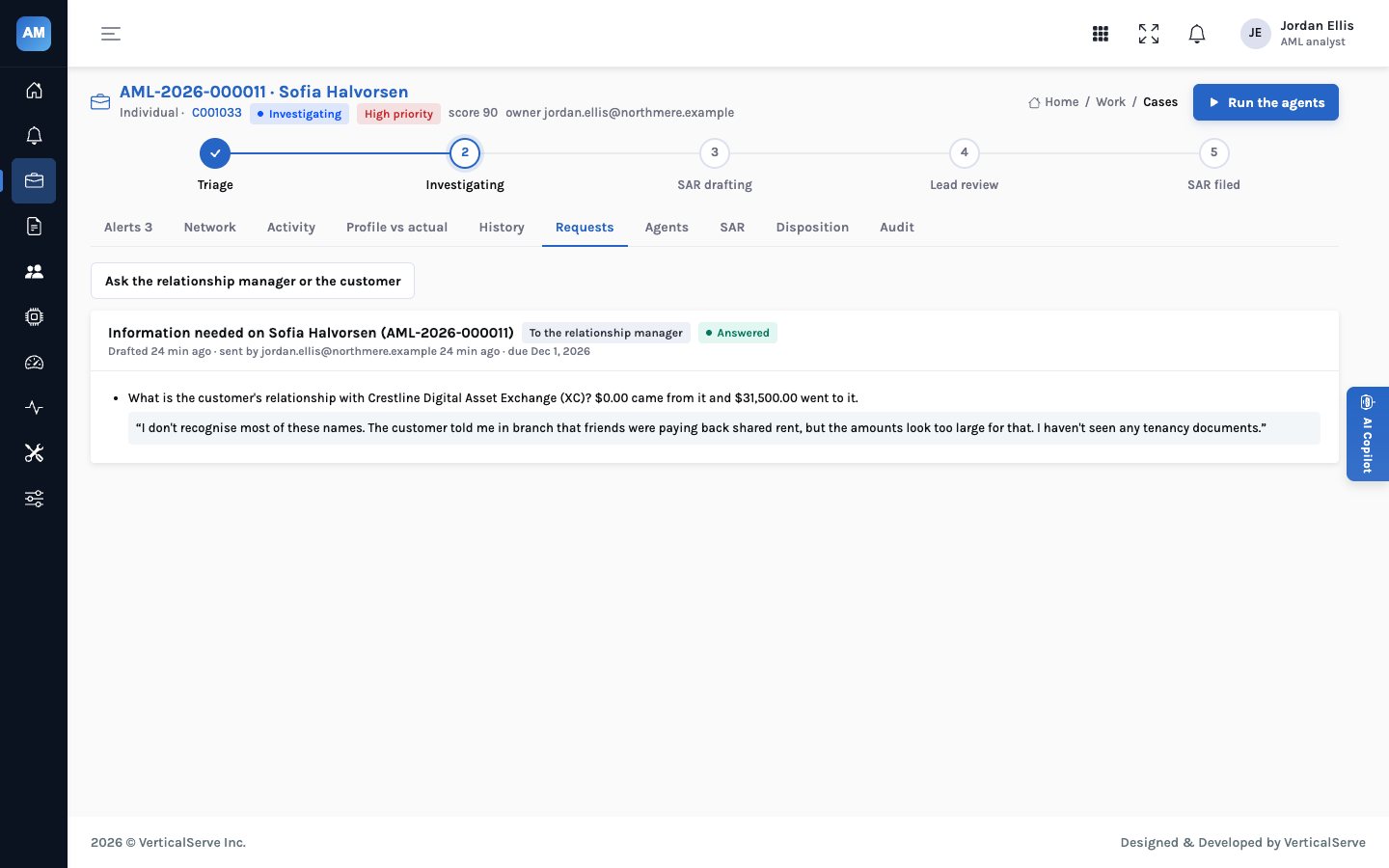
The network agent found 27 counterparties over 180 days, one needing a closer look, and prepared a request. Jordan Ellis, the analyst, accepted it; it was held on the case until he sent it to Dana Whitcomb, the relationship manager. The message InsightAML drafts for an RM ends with “Please don’t discuss this review with the customer.” The question asked:
“What is the customer’s relationship with Crestline Digital Asset Exchange (XC)? $0.00 came from it and $31,500.00 went to it.”
The RM answered through the request’s link, without signing in:
“I don’t recognise most of these names. The customer told me in branch that friends were paying back shared rent, but the amounts look too large for that. I haven’t seen any tenancy documents.”
Why the RM and not the customer
A request to a customer can be sent too, but InsightAML refuses to send one that mentions a review, suspicion, a report or money laundering, because telling the customer would be tipping off. The RM already knows the customer and can say what they were told without alerting them. In the demo, delivery is a dry run: InsightAML records the request as sent and the sender delivers the link.
Who does what
The case is still investigating: the supervisor’s escalation waits for the analyst.
Sofia Halvorsen’s case is still with the analyst. The supervisor has prepared an escalation for funnel or mule account activity, and the profile agent a second question about four profile gaps. Neither has been accepted. If the analyst escalates, the RM’s answer goes into the SAR’s WHY section as an answer from the relationship manager.
The same exchange, another customer
Samuel Iyengar (customer C001032), who declared himself a student with $1,500 a month in credits, shows the same shape. Twelve people paid in $34,340.00 between 30 October and 19 November 2026, with cash at branches in IN, MI, NY and OH, and $30,450.00, 89%, left in five wires of $6,090.00 to the same exchange. His case, AML-2026-000035, was escalated for funnel or mule account activity. SAR-2026-0004 is in draft, 306 words, passing all 12 quality checks, with the quality reviewer’s submission prepared and waiting for the analyst.
| Sofia Halvorsen | Samuel Iyengar | |
|---|---|---|
| Declared | Retail associate, $3,000 a month, 5% cash | Student, $1,500 a month, 0% cash |
| People paying in | 12 | 12 |
| In / wired out | $35,700.00 / $31,500.00 (88%) | $34,340.00 / $30,450.00 (89%) |
| Wires out | 5 × $6,300.00 | 5 × $6,090.00 |
| Stage | Investigating; RM answered | SAR drafting; submission prepared |
Both destinations are the same invented exchange. InsightAML keeps each customer in their own case; the investigator connects them by reading both, and the SAR for each states only that case’s facts.
How many distinct people, through which channels and branches, and how much left, where, how fast.
Declared occupation, credits and cash share against the last 90 days.
A held request, answered through a link. Never mention the review to the customer.
Close reasons include an RFI that explained it; escalate reasons include funnel or mule account activity.
A lead who neither prepared nor submitted the SAR files it.
The funnel rule’s parameters (eight or more sources in 30 days, 70% wired out) and the profile tolerances are illustrative defaults to be set from your own risk assessment.