An electronics importer in Grand Rapids pays its supplier abroad for mid-range smartphones. Nothing about that is unusual. What is unusual is the price: up to $1,621.93 a unit for goods whose reference band is $95 to $210, across four invoices worth $3,298,527.65 in six weeks, all paid by wire to a jurisdiction on the bank’s high-risk list. This is a trade-based money laundering case worked through to a SAR filed by a lead.
In short
- Over-invoicing moves value in the price. When an importer pays far more than the goods are worth, the difference leaves the country looking like trade. The invoice is the evidence.
- The rule reads the invoices, not just the wires. Trade pricing compares each invoice’s unit price with a reference band for the goods and flags any priced more than 2.5 times outside it (an illustrative multiple).
- All four invoices were 5 to 8 times the top of the band. $1,080.74 to $1,621.93 a unit against $95.00–$210.00.
- Filed by a different person. The analyst escalated and submitted; Sam Okoro, the AML lead, filed SAR-2026-0005, recorded as NMB-SAR-2026-1002, with every filing control passing.
Why trade pricing matters
data
FATF describes trade-based money laundering as disguising the proceeds of crime and moving value through trade transactions to legitimise their origin. Mis-invoicing the price, quantity or quality of goods is one of the techniques it names: over-invoicing an import lets the importer pay out more value than the goods are worth.
Sources: FATF, Trade Based Money Laundering (2006); FATF and Egmont Group, Trade-Based Money Laundering: Trends and Developments (December 2020). The reference band in the demo is illustrative, not a market price.
The situation
The case uses InsightAML’s demo data for Northmere Bank, a fictional bank. Every invoice and payment is generated; Marvessa is an invented jurisdiction (ISO user-assigned code XD) on the bank’s fictional high-risk list, and the commodity reference bands are illustrative.
Larchmont Components Import (customer C001035) has one business operating account (A0001370) and has banked with Northmere since 6 February 2025. It declared electronics wholesale (import), about $36,000 a month in credits, no cash, and the US and China as its countries. Its KYC rating is medium. Two rules fired on the same four payments:
| Invoice | Paid | Quantity | Unit price | Reference band | Times the top of the band | Invoice value |
|---|---|---|---|---|---|---|
| INV-001378 | 17 Sep 2026 | 886 | $1,621.93 | $95.00–$210.00 | 7.72 | $1,437,029.98 |
| INV-001377 | 2 Oct 2026 | 527 | $1,583.42 | $95.00–$210.00 | 7.54 | $834,462.34 |
| INV-001379 | 5 Oct 2026 | 383 | $1,530.27 | $95.00–$210.00 | 7.29 | $586,093.41 |
| INV-001376 | 28 Oct 2026 | 408 | $1,080.74 | $95.00–$210.00 | 5.15 | $440,941.92 |
The goods on every invoice are smartphones (mid-range). Each was paid by wire to Marvessa Electro Supply Ltd in Marvessa, so the same four payments also raised a high-risk geography alert (ALR-2026-000007, $3,298,527.65). The trade alert (ALR-2026-000086) carries each invoice beside the wire that paid it.
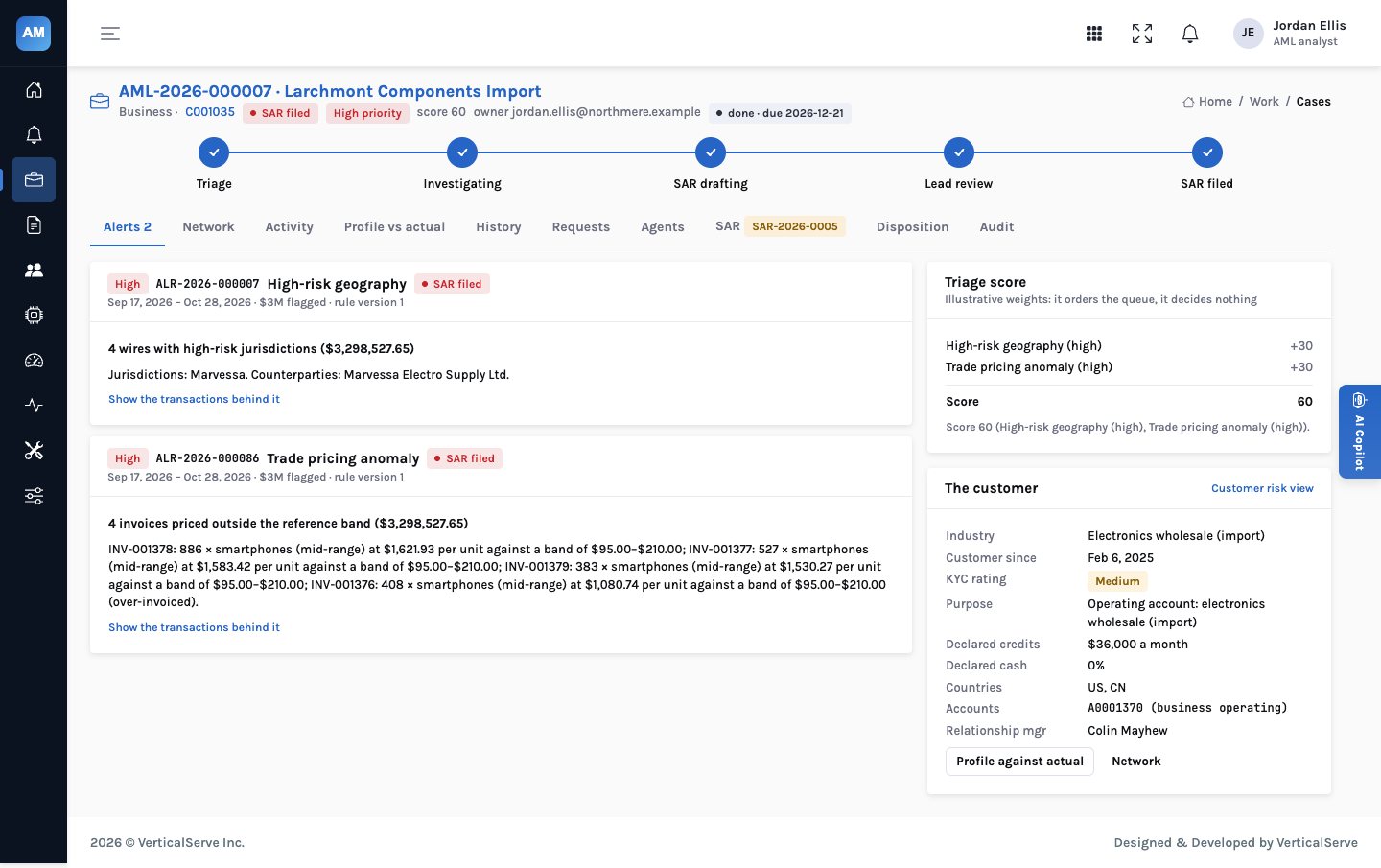
Value leaves in the price. The volume of goods is ordinary; what they were paid at is not.
Against the profile
The profile agent found two differences over the last 90 days. Debits averaged $1,176,603.71 a month against $34,200 declared, 34.4 times, and the customer dealt with a country it never declared: Marvessa. Credits, at $29,687.60 a month, were in line with the declared $36,000. In other words the business was not earning more; it was paying out far more. The network agent found 24 counterparties over 180 days, one needing a closer look: Marvessa Electro Supply Ltd. The triage agent found nothing in the data that explained the alerts.
A payments review sees four wires to a supplier, from an importer that declared foreign suppliers. Without the invoice, the price is invisible.
Each invoice’s unit price is compared with a reference band for the goods. A price several times the band is an alert with the invoice, the wire and the arithmetic on it.
Escalation, narrative and filing
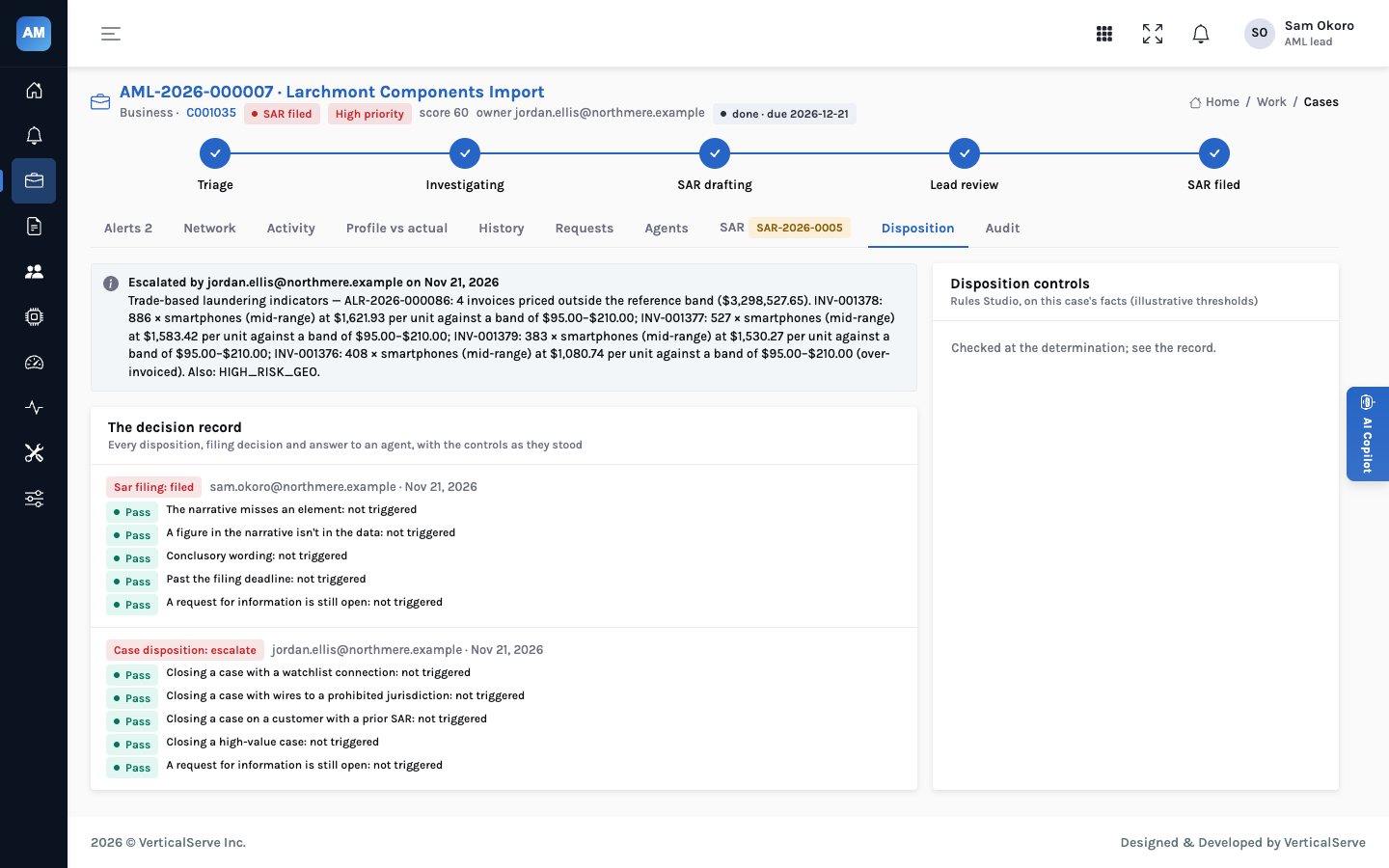
The supervisor prepared an escalation for trade-based laundering indicators. Jordan Ellis, the analyst, accepted it, which recorded the determination as his and started the filing clock: due 21 December 2026 under the demo’s illustrative 30-day policy. The narrative writer drafted the SAR from the facts. Its WHY section lists each invoice with quantity, unit price and band, and ends “(over-invoiced)”; its HOW says “Payments were tied to trade invoices whose unit prices fall far outside the reference band for the goods.” The quality review passed all 12 checks at 242 words.
The lead files. InsightAML records the filing; the submission to the regulator happens outside it.
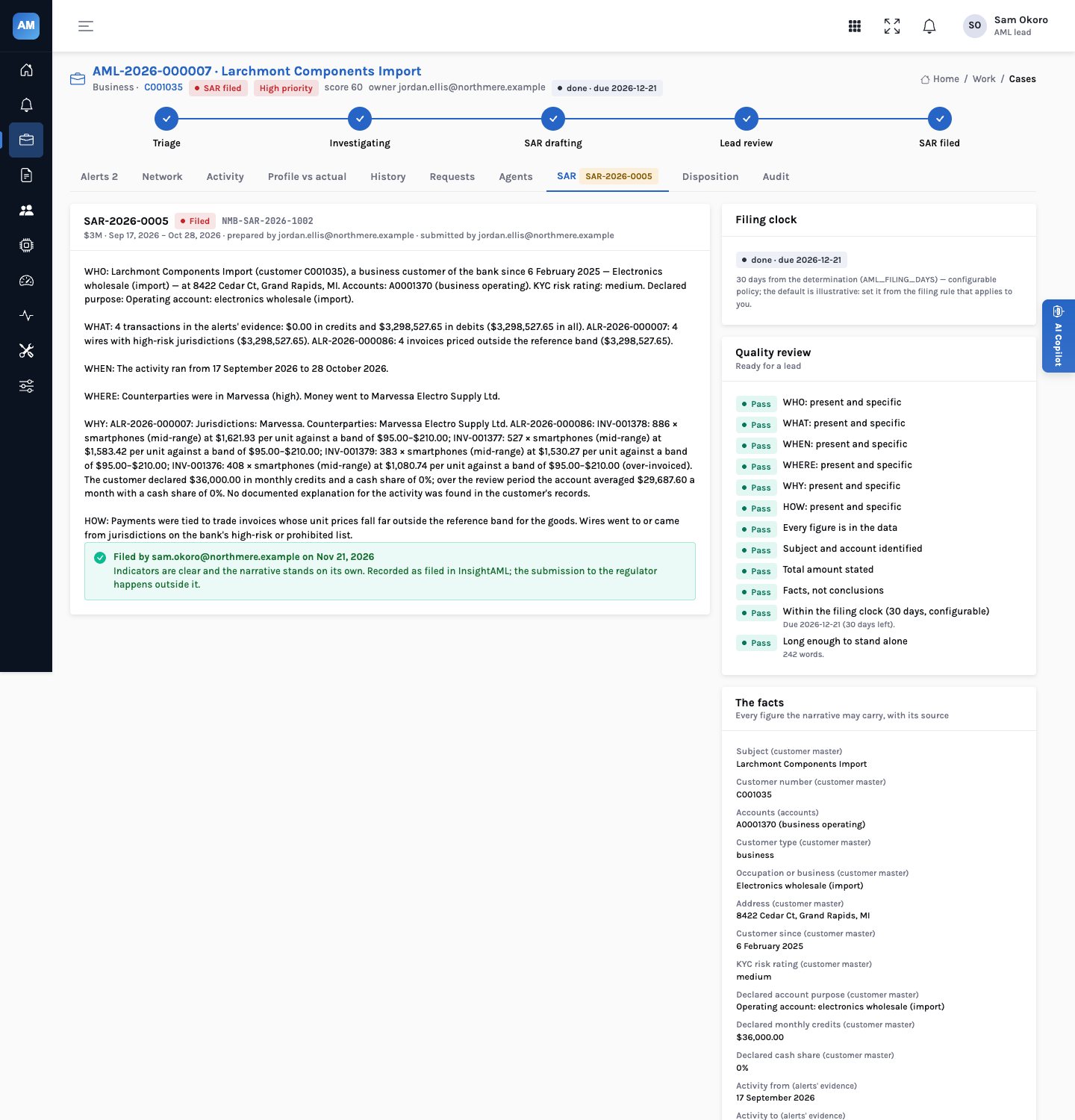
The decision record keeps both decisions on the case: the analyst’s escalation with the five disposition controls checked, and the lead’s filing with the five filing controls checked. A narrative missing one of the six elements, or carrying a figure that is not in the facts, would have blocked the filing; conclusory wording, a passed deadline or an open request for information would have warned the lead.
What the reference band can and cannot tell you
A price outside a band is a reason to ask, not a finding. Real goods vary by specification, and the demo bank’s legacy system closed trade-pricing alerts for reasons such as “Price includes freight and duty” and “Different goods specification: invoice explained”. A band you use in production needs a source you can defend, and the 2.5 multiple is a parameter a lead tunes, with a reason, from outcomes.
Who does what
Goods, quantity, unit, unit price, the band and how far outside it. Over-invoiced imports move value out.
Where the supplier is, whether the country was declared, anything on the watchlist.
Specification, freight and duty, earlier alerts closed for the same reason.
Escalated: trade-based laundering indicators.
Every invoice figure in the narrative is one of the facts.
A lead who neither prepared nor submitted it, with the filing controls checked.
For the BSA officer & MLRO
Trade cases are large: $3.3 million here. The filing note and every control are on the record for whoever reviews the decision later.
For the investigations lead
Trade pricing needs invoice data in the monitoring feed. Without it, these four wires were a high-risk geography alert and nothing more.
For the board
The reference bands are policy. Who maintains them, from what source, and how often they are reviewed is a governance question, not a technical one.