A teacher in Cleveland has banked with the same bank since 2017. She declared a salary, household spending and about $5,000 a month in credits, 2% of it cash. In nine days in October she deposited $71,550 in cash, in eight deposits at five different branches, every one between $8,000 and $10,000. Four days after the last deposit, $61,500 left by wire for a jurisdiction on the bank’s high-risk list. This is the case, from the alert to a SAR waiting for a lead.
In short
- Structuring is an offence in its own right in the US. Breaking cash into amounts that avoid the $10,000 currency transaction report is prohibited by 31 U.S.C. 5324, whatever the source of the money.
- The rule shows its evidence. Eight deposits, five branches, nine days, $71,550.00, each one listed with its date, amount and branch.
- The profile makes it a case, not a coincidence. Cash was 82% of credits against 2% declared; credits ran 10.6 times the declared month.
- Four eyes before filing. The analyst escalated and submitted SAR-2026-0002. It now waits for a lead who did not prepare it. A similar case, James Jessup’s, has already been filed.
The legal background, briefly
data
US banks file a currency transaction report for cash transactions of more than $10,000 in a business day, with multiple transactions by or for the same person aggregated. Structuring transactions to evade that report is prohibited. A bank must file a suspicious activity report for a transaction of at least $5,000 that it knows, suspects or has reason to suspect is designed to evade Bank Secrecy Act requirements.
Sources: 31 CFR 1010.311 and 1010.313 (currency transaction reports and aggregation); 31 U.S.C. 5324 (structuring); 31 CFR 1020.320 (suspicious activity reports by banks). Other countries set their own thresholds; this post uses the US rules because the demo bank is American.
The situation
The case comes from InsightAML’s demo data for Northmere Bank, a fictional bank whose every customer and transaction is generated. Port Ilyria, the destination of the wire, is an invented jurisdiction on the bank’s fictional high-risk list, with an ISO user-assigned code (XG).
Wei Garrity (customer C001022) holds a checking account (A0001352) and a savings account (A0001353). Her KYC rating is low. The structuring rule looks for at least three cash deposits between $8,000 and $10,000 within 14 days; it found eight:
| Date | Cash deposit | Branch |
|---|---|---|
| 18 October 2026 | $8,500.00 | Northmere — Short North |
| 20 October 2026 | $8,200.00 | Northmere — Lakewood |
| 20 October 2026 | $8,200.00 | Northmere — Tremont |
| 22 October 2026 | $9,900.00 | Northmere — Riverside |
| 22 October 2026 | $9,600.00 | Northmere — Over-the-Rhine |
| 24 October 2026 | $8,700.00 | Northmere — Short North |
| 25 October 2026 | $8,550.00 | Northmere — Lakewood |
| 26 October 2026 | $9,900.00 | Northmere — Tremont |
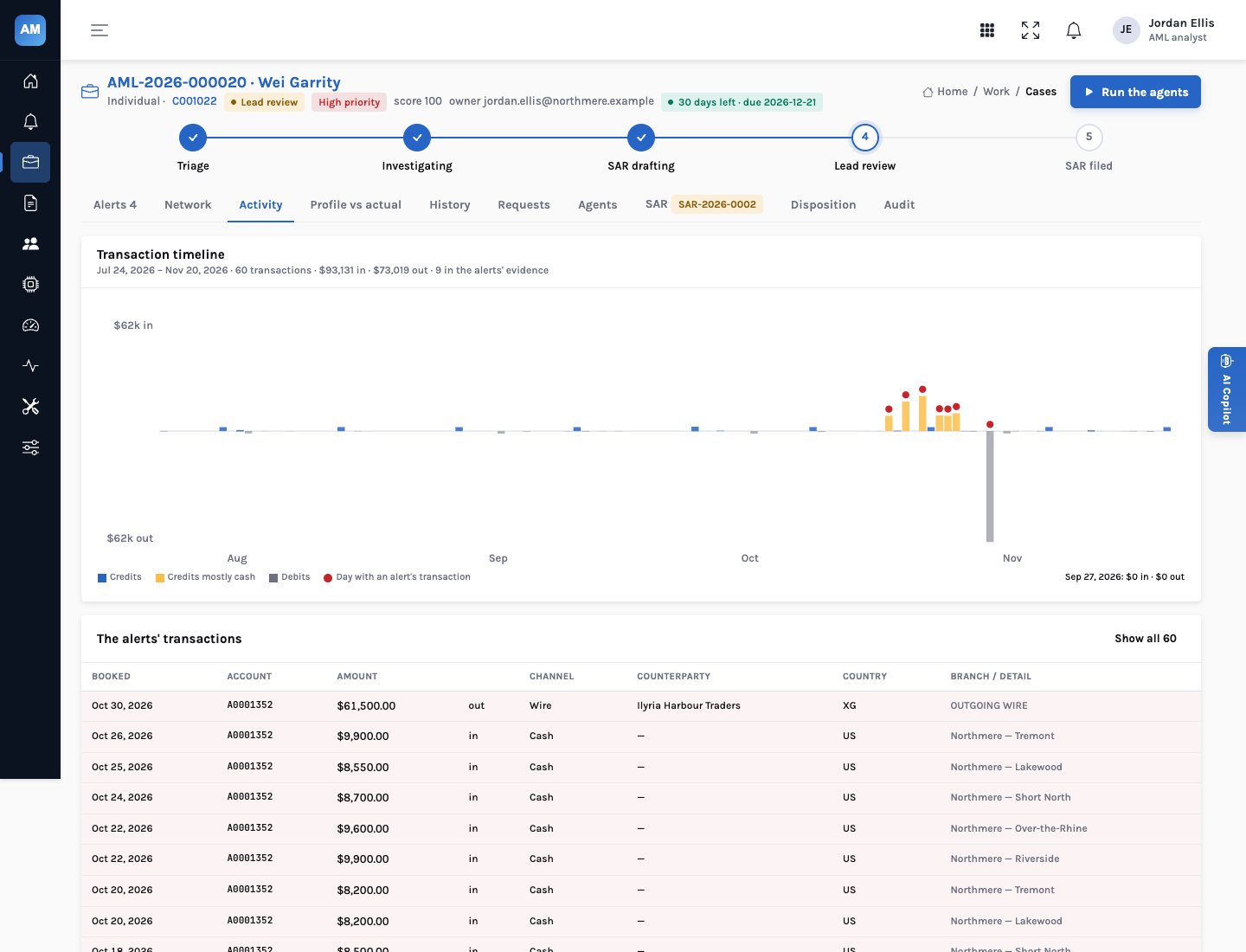
No single deposit reaches the reporting threshold. On two days, two deposits were made at two different branches the same day. Together they come to $71,550.00. On 30 October a wire of $61,500.00 went to Ilyria Harbour Traders in Port Ilyria. The same run raised four alerts on the customer:
| Alert | Rule | What it computed |
|---|---|---|
| ALR-2026-000029 | Structuring (high) | 8 cash deposits totalling $71,550.00 from 18 Oct to 26 Oct 2026, at 5 branches |
| ALR-2026-000030 | High-risk geography (high) | 1 wire with a high-risk jurisdiction ($61,500.00): Ilyria Harbour Traders, Port Ilyria |
| ALR-2026-000031 | Velocity against profile (high) | Credits of $53,246.68 in 30 days against $5,000.00 declared a month: 10.6 times |
| ALR-2026-000032 | Cash-intensive pattern (medium) | Cash was 82% of credits against 2% declared: $71,550.00 of $87,208.87 |
How the case was built
Cash in across branches, a wire out. Every alert on the customer lands in her one case.
The triage score adds the alerts’ points: three high alerts at 30 each and a medium one at 15, capped at 100. The weights are illustrative; they order the queue and decide nothing. The triage agent looked for an innocent explanation already in the data, such as a documented sale or earlier alerts closed for the same reason, and found none.
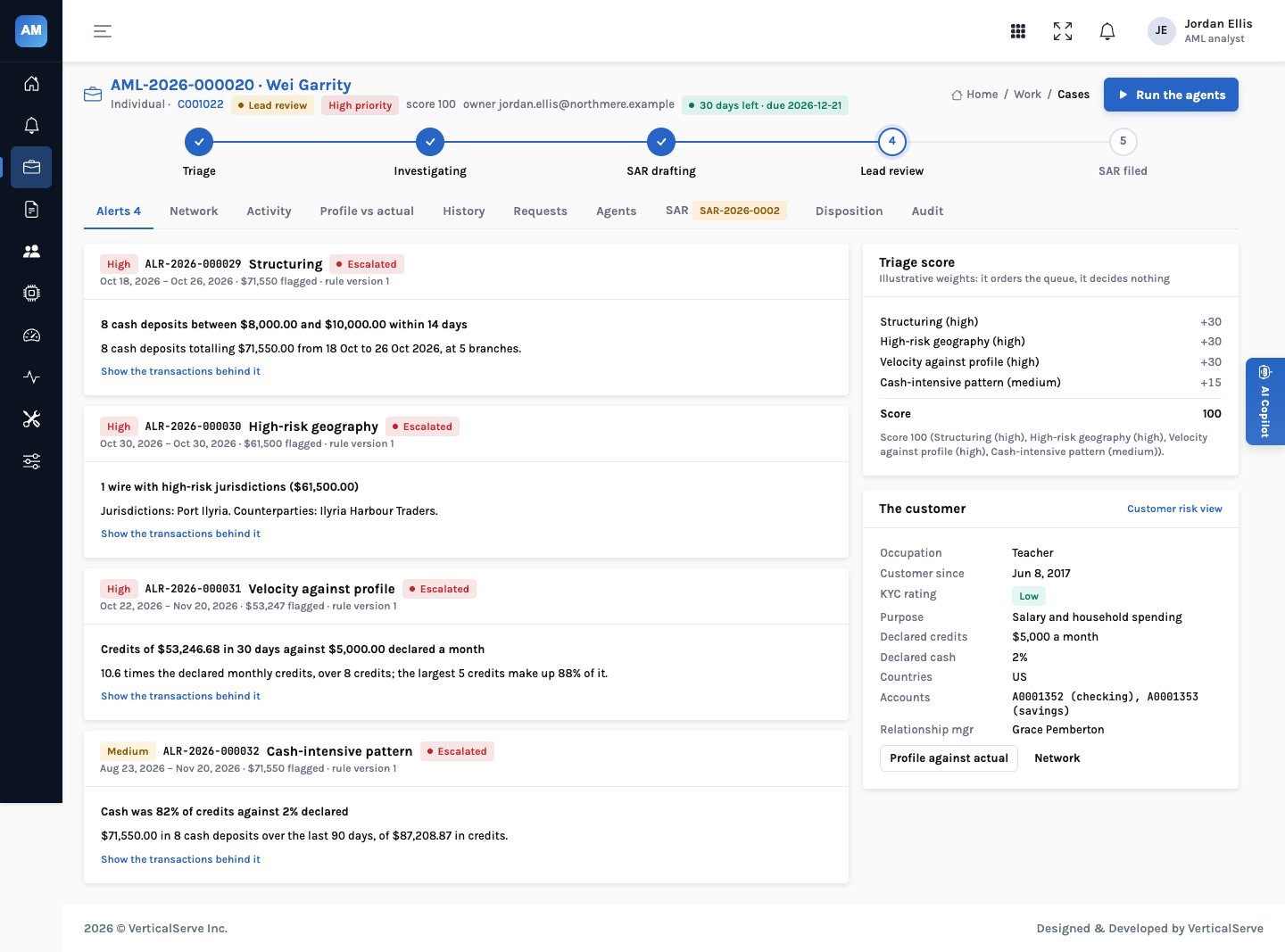
The profile agent compared the last 90 days with the declaration and found four differences: credits of $29,069.62 a month against $5,000 (5.8 times), debits of $23,176.55 against $4,800 (4.8 times), a cash share of 82% against 2%, and an undeclared country. The network agent found 16 counterparties, one needing a closer look: Ilyria Harbour Traders. The history tab shows no prior SAR on the customer.
Who did what
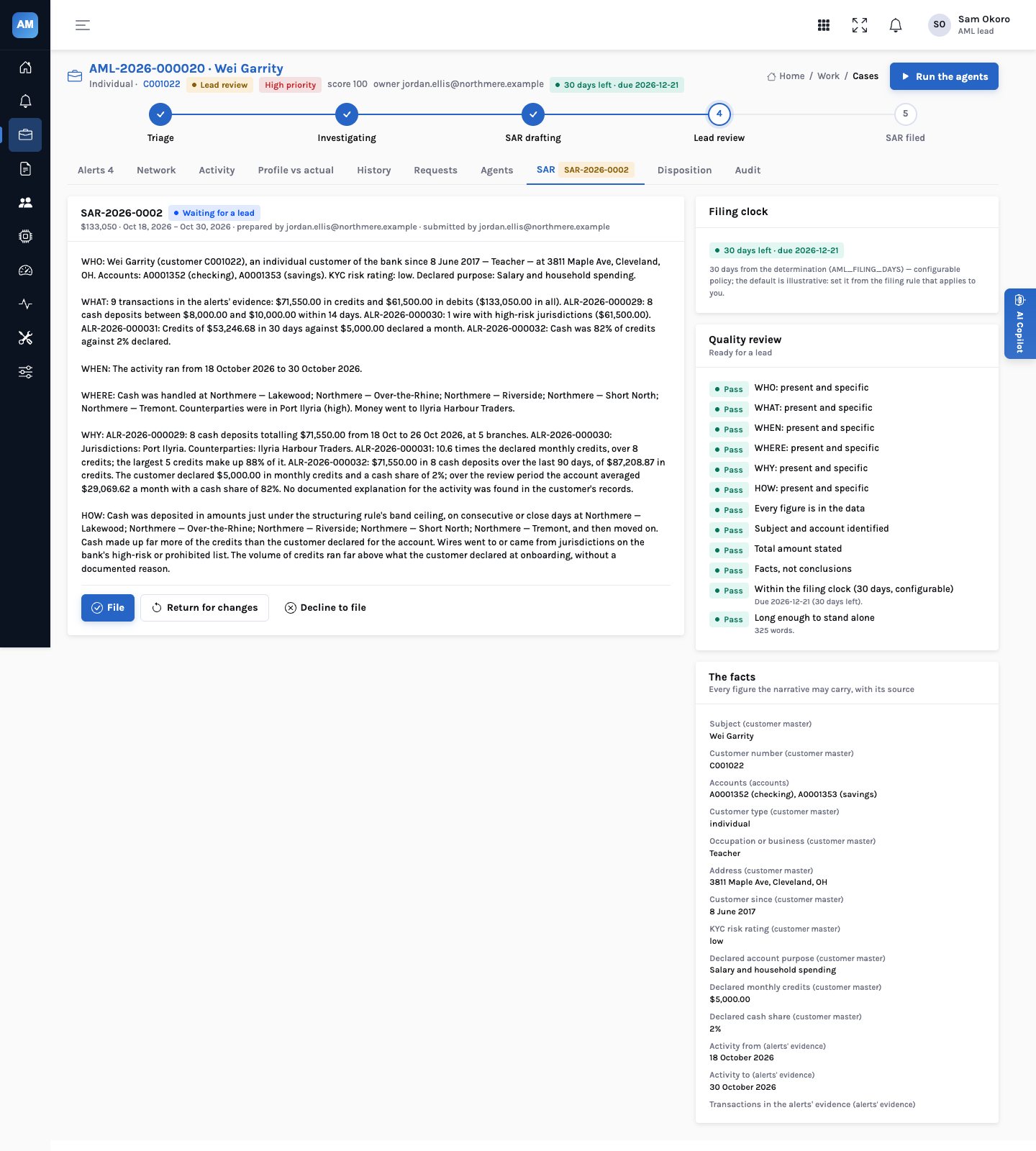
The analyst can submit; only a lead who neither prepared nor submitted the SAR can file it.
The SAR’s WHERE section lists the five branches by name and says that counterparties were in Port Ilyria (high) and that money went to Ilyria Harbour Traders. Its HOW section describes cash “deposited in amounts just under the structuring rule’s band ceiling, on consecutive or close days” at those branches. Every figure in it is one of the case’s facts.
Why the lead, and not the analyst, files
Segregation of duties: the person who prepared the SAR and the person who decides it goes out are different people, and InsightAML enforces it. If Sam Okoro had prepared or submitted SAR-2026-0002, the File button would be refused. Filing is recorded in InsightAML; the submission to FinCEN, or any other authority, happens outside it.
Two other structuring cases on the same book
The same rule fired on two other customers, with different outcomes so far:
| Case | What the rule found | What else the case shows | Where it stands |
|---|---|---|---|
| AML-2026-000033 James Jessup, truck driver | 6 cash deposits totalling $55,050.00 from 2 to 7 October 2026, at 5 branches | Cash 77% of credits against 2% declared; no high-risk counterparties | SAR-2026-0001 filed by the lead as NMB-SAR-2026-1001 |
| AML-2026-000017 Riverbend Mechanical, plumbing and HVAC contractor | 9 cash deposits totalling $81,350.00 from 21 to 30 September 2026, at 5 branches | The profile agent found the activity matches the declared profile ($232,000 a month); one prior SAR for structuring, filed in January 2026 | Investigating: the supervisor proposed escalation; the analyst hasn’t decided |
Riverbend Mechanical shows why the rule is a question and not an answer. A contractor whose declared monthly credits are $232,000 can plausibly deposit cash. What the pattern does not explain is why nine deposits all fall between $8,000 and $10,000 across five branches in ten days, and the prior SAR for structuring adds 15 points to the score and means a lead would have to agree to any closure. That determination is still open.
Amounts, dates, branches. How close to the threshold, how many, over how long, and how many branches on the same day.
Occupation or business, declared credits and cash share. A salaried customer and a cash business are different questions.
Wires out after the deposits, counterparties in high-risk jurisdictions.
A closure on a customer with a prior SAR is referred to a lead by an illustrative disposition control.
Six parts from the facts; 12 checks; the analyst submits.
A different person, before the clock runs out.
The structuring band ($8,000 to $10,000), the count and window, the triage weights and the 30-day clock are illustrative defaults. Set them from your own risk assessment and filing procedure.