A sanctions screen asks whether a party is on a list. A watchlist-adjacent alert asks something quieter: is the bank’s customer paying someone the corporate registry connects to a listed entity? The counterparty is not on the list. It shares an address with someone who is, or it is a subsidiary of someone who is. That is not a finding of wrongdoing. It is a connection an investigator has to look at, explain, or report, and it is exactly the kind of thing a busy queue skims past.
In short
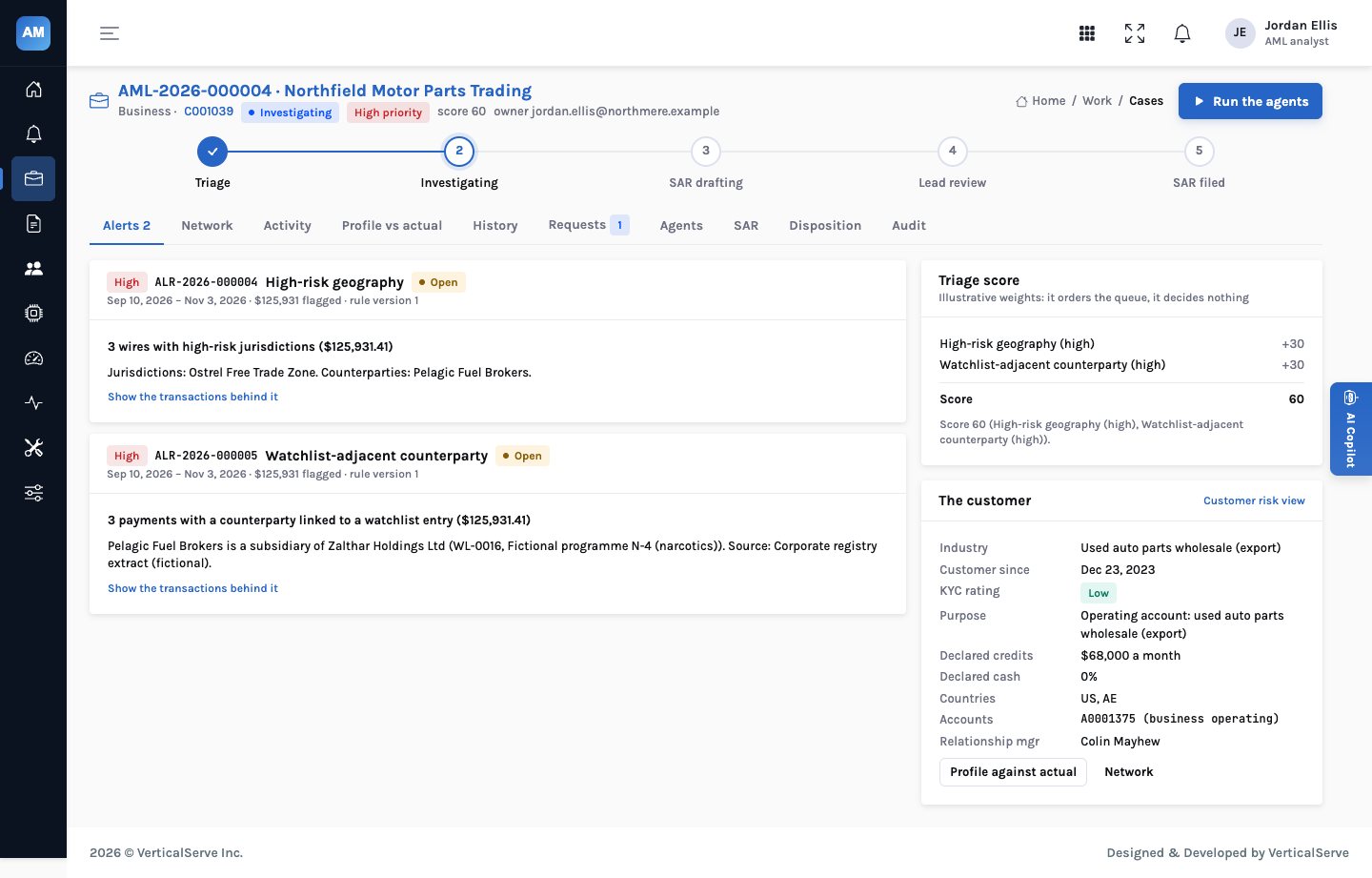
- Two real cases from the demo. Overlook Freight LLC paid $155,016.77 in three wires to a shipping agency that shares a registered address with a watchlist entry. Northfield Motor Parts Trading paid $125,931.41 in three wires to a subsidiary of another.
- The alert says what the link is and where it came from. “Shares a registered address with” and “is a subsidiary of” are different facts, and the source (a corporate registry extract) is on the alert.
- One case is at the lead. Overlook Freight’s SAR passed all twelve quality checks and waits for a lead who didn’t prepare it.
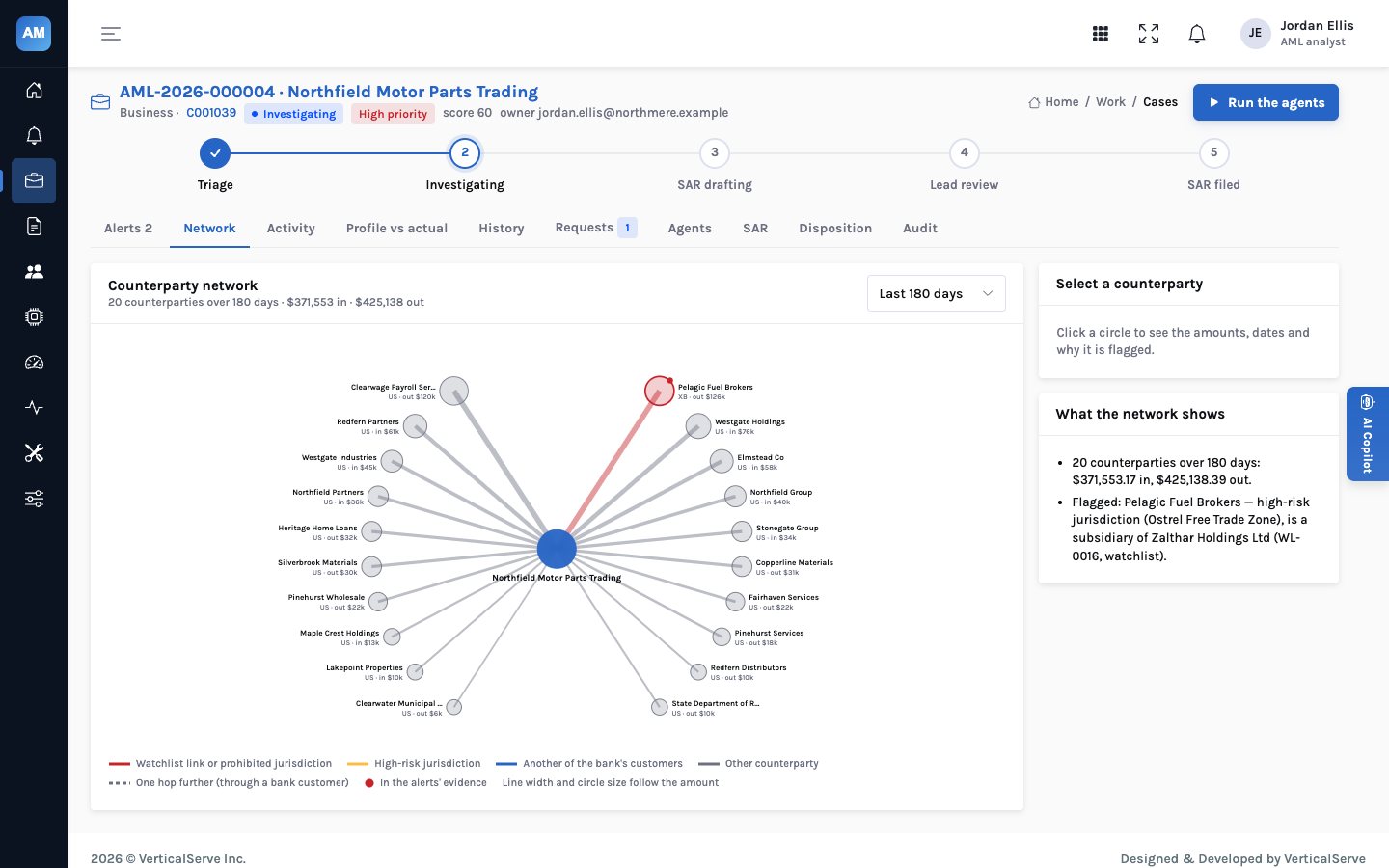
- The other is waiting on an answer. On Northfield, the analyst sent the relationship manager a question; the supervisor agent proposes escalation and warns that the open request may change it.
- Closing either would go to a lead. The illustrative disposition controls refer any closure of a case with a watchlist connection to a lead.
What “watchlist-adjacent” means here
The demo uses Northmere Bank, a fictional bank. Its transactions are generated, its watchlist is fictional,
and so are the registry links and the jurisdictions (Ostrel Free Trade Zone is invented, on a user-assigned
code, XB). The monitoring rule WATCHLIST_ADJACENT fires when a customer pays, or is paid by, a
counterparty that the corporate registry extract links to a watchlist entry. It has no parameters: any
payment with a linked counterparty in the 90-day review window raises it, at high severity.
| Overlook Freight LLC (C001038) | Northfield Motor Parts Trading (C001039) | |
|---|---|---|
| Business | General freight trucking, Lancaster, PA | Used auto parts wholesale (export), Fort Wayne, IN |
| Customer since / KYC rating | 13 June 2024 / low | 23 December 2023 / low |
| Declared countries | US | US, AE |
| Counterparty | Halvard Shipping Agency (XB) | Pelagic Fuel Brokers (XB) |
| The link | shares a registered address with Halcor Commodities AG (WL-0001) | is a subsidiary of Zalthar Holdings Ltd (WL-0016) |
| Programme | Fictional programme N-4 (narcotics) | Fictional programme N-4 (narcotics) |
| Payments | $59,286.48 (5 Sep), $53,884.81 (2 Oct), $41,845.48 (11 Nov 2026) | $44,341.65 (10 Sep), $52,198.46 (13 Sep), $29,391.30 (3 Nov 2026) |
| Total | $155,016.77 | $125,931.41 |
| Case | AML-2026-000019, SAR-2026-0006 waiting for a lead | AML-2026-000004, investigating, request to the RM sent |
Both customers have a second alert on the same three wires: HIGH_RISK_GEO, because Ostrel
Free Trade Zone is on the bank’s high-risk list. The triage score adds 30 points for each
high-severity alert, so both cases score 60 and are marked high priority. The score orders the queue; it
decides nothing.
Why the wording of the link matters
“Shares a registered address” and “is a subsidiary of” carry different weight. A shared registered address can mean a common formation agent or office building, or it can mean common control. A subsidiary relationship is ownership. An investigator who only sees “watchlist hit, high” can’t tell them apart, and a narrative that says “linked to a sanctioned entity” overstates the first and understates the second.
Adjacency is not a sanctions match, and ownership can make it one
In the US, OFAC treats an entity owned 50 percent or more, directly or indirectly and in the aggregate, by one or more blocked persons as blocked itself, whether or not it is named on a list. Where a registry shows a counterparty is a subsidiary of a listed party, the ownership percentage decides whether this is an AML question or a sanctions one, and that belongs to the bank’s sanctions team. The demo’s watchlist and programme are fictional; the rule only surfaces the connection.
Overlook Freight: from alert to a SAR at the lead
The money moves along the solid line. The dashed line is a registry fact, not a payment.
The agents ran in order. The triage agent found nothing in the data that explains the alerts. The profile agent found one difference: the customer declared US only, and the last 90 days include Ostrel Free Trade Zone. Volumes were within the declared profile: $198,279.18 a month in credits against $278,000.00 declared. The network agent read 20 counterparties over 180 days and flagged one, Halvard Shipping Agency.
The analyst escalated with the reason “Connection to a watchlist entry”. Escalating opened
SAR-2026-0006 and started the filing clock: 30 days from the determination by default
(AML_FILING_DAYS, a configurable policy; the default is illustrative), due 21 December 2026.
The narrative writer drafted the six parts from the case’s facts. The WHY section quotes the link
exactly as the alert does, source included:
WHY: ALR-2026-000027: Jurisdictions: Ostrel Free Trade Zone. Counterparties: Halvard Shipping Agency.
ALR-2026-000028: Halvard Shipping Agency shares a registered address with Halcor Commodities AG (WL-0001,
Fictional programme N-4 (narcotics)). Source: Corporate registry extract (fictional). ...
HOW: Payments went to a counterparty that a corporate registry extract connects to an entry on the watchlist.
From the draft of SAR-2026-0006, 214 words. Every figure in it is one of the case’s facts.
The quality reviewer ran its twelve checks (the six elements, every figure in the data, identifiers, total stated, facts not conclusions, the clock, length) and all passed. The analyst submitted it. It now sits on the lead’s home page.
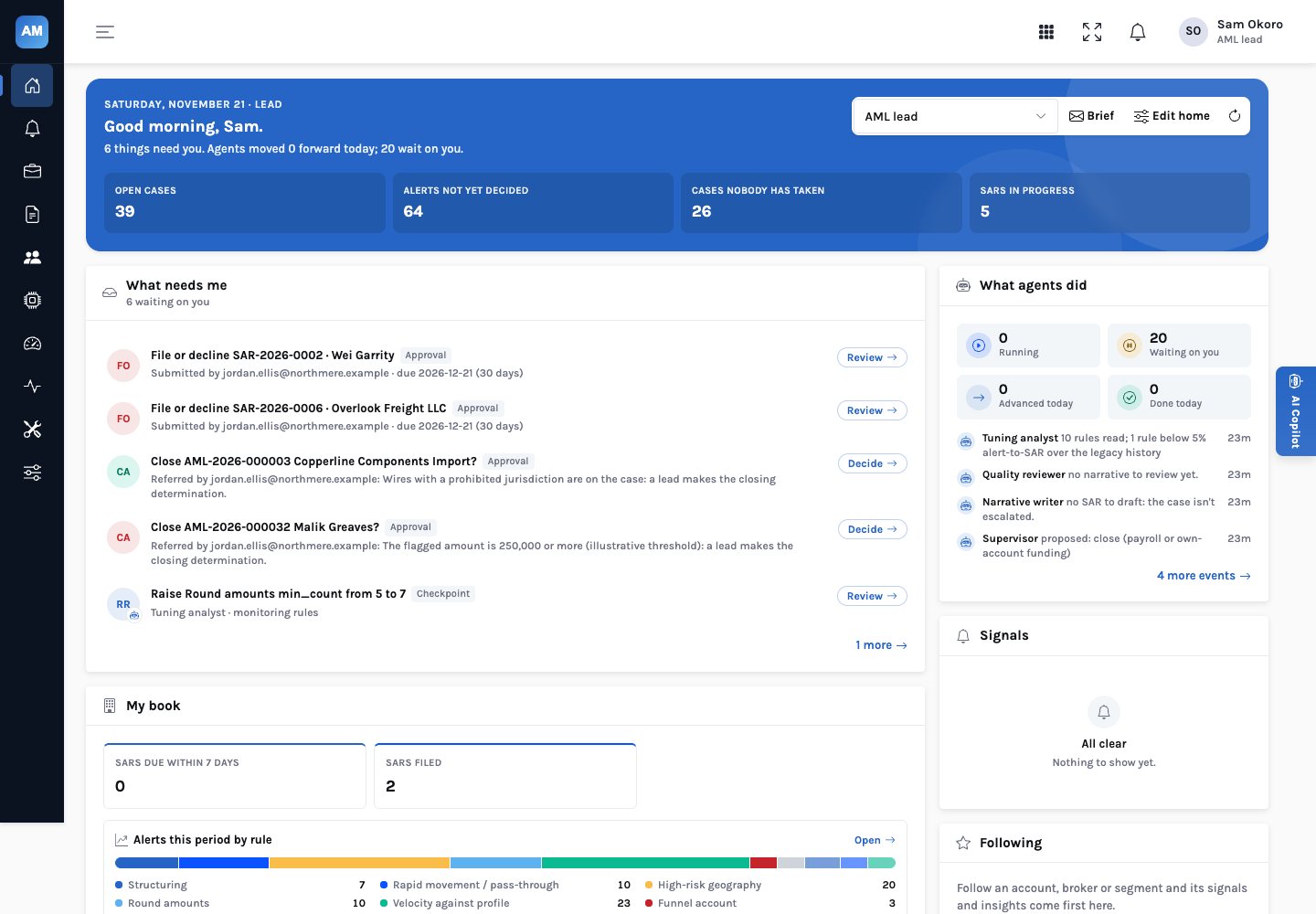
The lead who files it can’t be the person who prepared or submitted it; InsightAML refuses. The lead files, returns it with a note, or declines with a reason. Filing is recorded in InsightAML with a filing reference; the submission to the regulator happens outside it.
Northfield: a question before a determination
Northfield’s case is earlier. The network agent prepared a question for the relationship manager, and the analyst accepted it, read it, and sent it. The request is to the relationship manager, not the customer, so it can name the case; it closes with “Please don’t discuss this review with the customer.”
To: colin.mayhew@northmere.example        Due: 2026-12-01
- What is the customer's relationship with Pelagic Fuel Brokers (XB)? $0.00 came from it
  and $125,931.41 went to it.
The request as sent. In the demo, delivery is a dry run: the link is recorded and the sender sends it.
The supervisor proposes; the analyst decides; a closing determination on a watchlist connection goes to a lead.
Who does what
Which relationship (address, subsidiary, director), which entry, which programme, which registry extract.
Where the link is ownership, the percentage may make it a sanctions matter rather than an AML one.
Did the customer declare this jurisdiction or this kind of counterparty? Who else pays the same party?
A neutral question prepared by the network agent, edited and sent by a person.
A closure on a watchlist connection is referred to a lead by the illustrative control.
A lead who neither prepared nor submitted the SAR, on the decision record.
For the BSA officer & MLRO
A watchlist connection is the alert you least want closed on a one-word note. Referral to a lead on any closure, and a SAR that quotes the link exactly, are the two controls an examiner will ask about.
For the investigations lead
Both cases scored 60 and sat in the high-priority band. The analyst’s time went on the one question that matters, what the relationship is, not on assembling wires from three systems.
For the board
The bank can show, for each connection, what it knew, who decided and when. That is the answer to “did we know?”
A connection is a question, and the record should say which question.
The rule surfaces the link with its source. The investigator decides what it means. A lead signs off on anything that closes it.