Transaction monitoring was built to catch. Every new typology, every examination finding and every near miss added a rule, and every rule added alerts. The investigators who clear those alerts were added more slowly. The result, in most banks, is a queue that grows faster than it empties, and an investigator who spends the first hour of every case collecting facts that the monitoring system already had when it raised the alert.
In short
- The cost of an alert is in the reading. An alert that says only “structuring, high” sends the investigator to three other systems before any judgement starts.
- Most alerts are closed, and the reasons repeat. On the demo bank’s fictional legacy history, round-amount alerts became SARs 16 times in 520; the close reasons were own-account transfers, payroll and rent.
- Alerts belong to customers, not to rules. Four rules firing on one customer are one investigation. InsightAML groups them into one case.
- Preparation can be automated; the decision can’t. Agents gather the evidence, the network, the profile and the history. A person closes, escalates and files.
How the queue got this long
A monitoring rule is a hypothesis about what laundering looks like in a bank’s data: cash just under a reporting threshold, money that passes straight through an account, payments to a jurisdiction the bank rates high risk. Each hypothesis is reasonable on its own. The trouble is that each one also matches a great deal of ordinary life. A payroll run is a series of round transfers. A seasonal business takes most of its revenue in a few months. A family selling a house receives a six-figure credit that looks nothing like the salary on file.
Rules are rarely removed, because removing one feels like accepting a gap. Thresholds are rarely raised, for the same reason. So the alert volume ratchets upwards, and the investigations team is asked to absorb it.
The ratchet: every gap closed with a rule adds alerts, and the time to read each one shrinks.
Where an investigator’s hour goes
Ask an investigator to describe a routine alert and most of the answer is not judgement. It is retrieval. The alert names a rule and a customer. To decide anything, the investigator needs:
- the transactions behind the alert, not just a total, with counterparties, channels, branches and countries;
- what the customer declared at onboarding: occupation or business, expected monthly credits, expected cash share, the countries they said they would deal with;
- who the money came from and went to, including whether any counterparty is another customer of the bank, sits in a high-risk jurisdiction or is linked to a watchlist entry;
- the customer’s history: earlier alerts and how they were closed, and any prior suspicious activity reports;
- whether other alerts on the same customer are sitting with a colleague.
In a typical estate those live in the monitoring system, the core banking system, the KYC file and a case manager. The judgement, which is the part that needs an experienced person, gets whatever time is left after the copying.
The investigator opens the core system for transactions, the KYC file for the profile, a spreadsheet for earlier alerts, and writes “reviewed, consistent with profile”.
The transactions behind each alert, the counterparty network, the declared profile beside the actual, the history and a triage score with its points are on the case before anyone opens it.
Most alerts close, for the same few reasons
InsightAML’s demo runs on Northmere Bank, a fictional bank whose data is generated, including two years of alerts from a fictional legacy monitoring system and how each was closed. The numbers below are that invented history, shown to illustrate the shape of the problem, not a measurement of any real bank.
| Rule (illustrative defaults) | Legacy alerts | Became SARs | Most common close reasons |
|---|---|---|---|
| Round amounts | 520 | 16 (3.1%) | Transfers between own accounts (173); payroll funding (162); rent or loan payments in round amounts (118) |
| Velocity against profile | 613 | 37 (6.0%) | Annual bonus or one-off documented payment (193); profile out of date (171); seasonal business peak (166) |
| Structuring | 160 | 34 (21.2%) | Single deposit explained by a documented vehicle sale (64); cash business matching declared takings (51) |
| Funnel account | 60 | 18 (30.0%) | Tenant rent collection (20); club or association dues (18) |
Three reasons account for every alert on this rule that was closed without escalation in the demo’s invented history.
Two things follow. First, the explanation for most alerts is already somewhere in the bank’s data: a seasonal peak the customer declared, a payroll processor among the counterparties, an earlier alert closed for the same reason. Finding it is preparation, not judgement. Second, a rule’s yield, the share of its alerts that become reports, is the most useful single number for deciding where to tune. We cover that in tuning on outcomes.
Alerts belong to customers
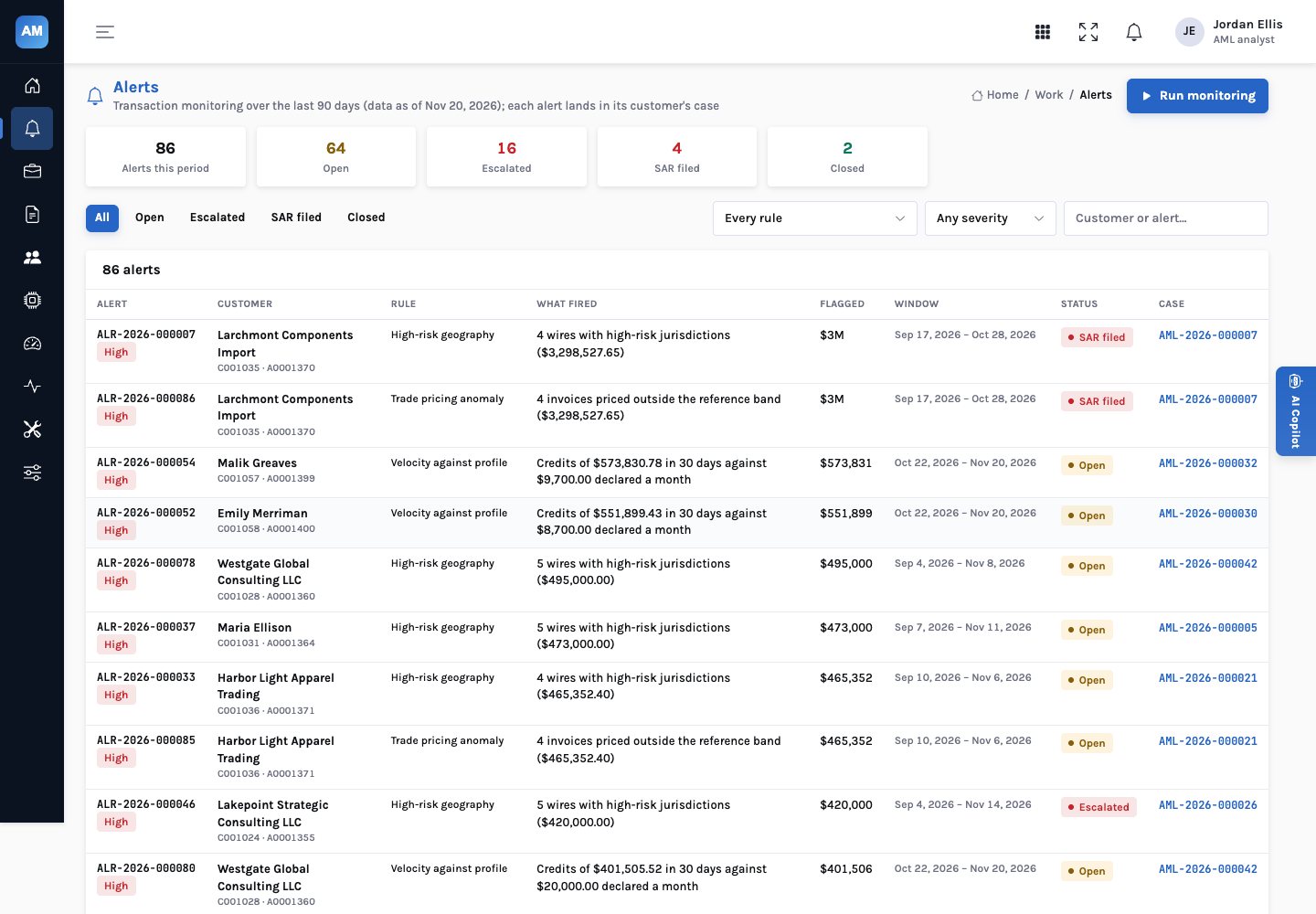
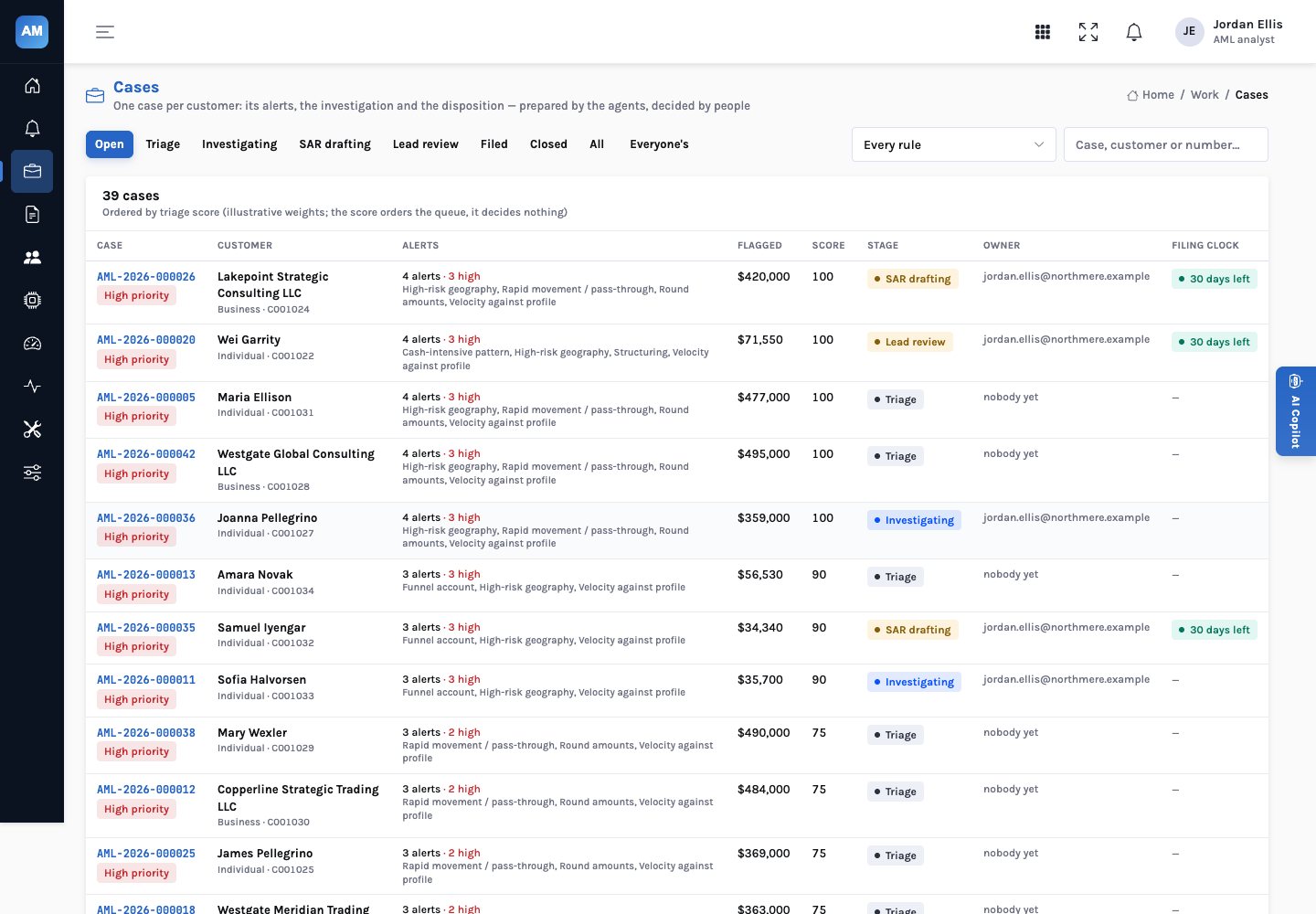
On the demo run, ten rules over 90 days of transactions raised 86 alerts, which grouped into 43 cases, one per customer. Lakepoint Strategic Consulting LLC alone carries four: high-risk geography, rapid movement, velocity against profile and round amounts. Worked as four separate alerts, that is four look-ups of the same transactions by up to four people. Worked as one case, it is one investigation with one network, one profile comparison and, if it comes to it, one narrative.
What has to change
Hiring more investigators treats the symptom. The change that matters is in how a case is prepared before a person reads it, and in keeping the decision, and the reasons for it, with that person.
Every new alert lands in its customer’s open case; a rerun doesn’t duplicate an alert it has already raised.
The score’s points are listed, and anything in the data that might explain the activity is pointed out: a declared seasonal peak, payroll, a documented sale.
Declared profile against the last 90 days; counterparties over 180 days, one hop further through the bank’s own customers.
Close with a reason or escalate with a reason, with the disposition controls that apply.
Accept, change or reject what was prepared. Some closures are referred to a lead by policy.
A six-part narrative from the facts, checked; a lead who didn’t prepare it files it.
What this does not do
It does not decide whether activity is suspicious, and it does not file anything with a regulator. Every agent action in InsightAML is capped at the level where a person must answer it. Filing is recorded in InsightAML by a lead; the submission itself happens outside it.
An alert is a question. The investigator should start with the answer’s evidence, not go looking for it.
Monitoring will always raise more alerts than there are reports to file; that is what a sensitive rule does. The fix is to make each alert cheap to read: its transactions, the customer’s declared profile, the network and the history on the case before anyone opens it.
Then the hours that matter, the judgement, the narrative and the filing decision, go to the people accountable for them.